Christmas is Not Essential: the Levers OMB has Over Agencies under Continuing Resolutions and Government Shutdowns
This is a free piece of Notes on the Crises. All pieces in this OMB series will be free. Please take out a paid subscription to support this work. Or leave a tip.
Joshua Lawrence is a research fellow at Notes on the Crises and graduate of Sarah Lawrence College. Find him on Bluesky here.
Juan Hanes is a research fellow at Notes on the Crises and a Journalism student at NYU. Find him on Bluesky here.
This is Part 4 of a 5 part series. Read Part 1, Part 2 & Part 3.
In the last installment of this series on the “seven levers” that OMB has over agencies (as first outlined by Professor Eloise Pasachoff), we discussed the two levers available during the “execution” phase of the federal budgeting process. In introducing and explaining the concept of “budget execution”, though, we made one very heroic assumption: our discussion for that piece would only focus on how OMB manages budget execution when the appropriations process flows according to plan.
This assumption is “heroic”, of course, because Congress never passes budgets on time anymore. The constant stop-gap “funding legislation” blurs the lines between budget preparation and budget execution and makes things both more dysfunctional and more complicated.
Thus, today’s piece is exploring the OMB’s influence over budget execution in the actual budgetary circumstances we’ve experienced in recent decades. When we examine this closely it becomes clear that the Office of Budget and Management’s power grows by orders of magnitude whenever the budget execution phase is complicated by crises in appropriations and other deviations from the “normal” process. In this piece we will explain what these budgetary procedures are and just how they empower the OMB.
The Execution Phase, Complicated
At this point, readers might be tired of seeing our chart depicting the budgeting process for a given fiscal year across the various different stages of the budgeting process. You might recall that we put forward the “conventional” moment of transition between “budget preparation” and “budget execution” as that point at which all appropriations bills for the next fiscal year have passed and the current fiscal year has correspondingly ended. For the federal government, this means that preparation ends on September 30th and execution begins on October 1 each year.
But if you were keeping up with the ongoing events of recent years, especially the last year, and you compared them to our chart, you might have noticed a bit of a problem. (see a snippet of the chart below, “budget preparation” has again been highlighted in yellow).
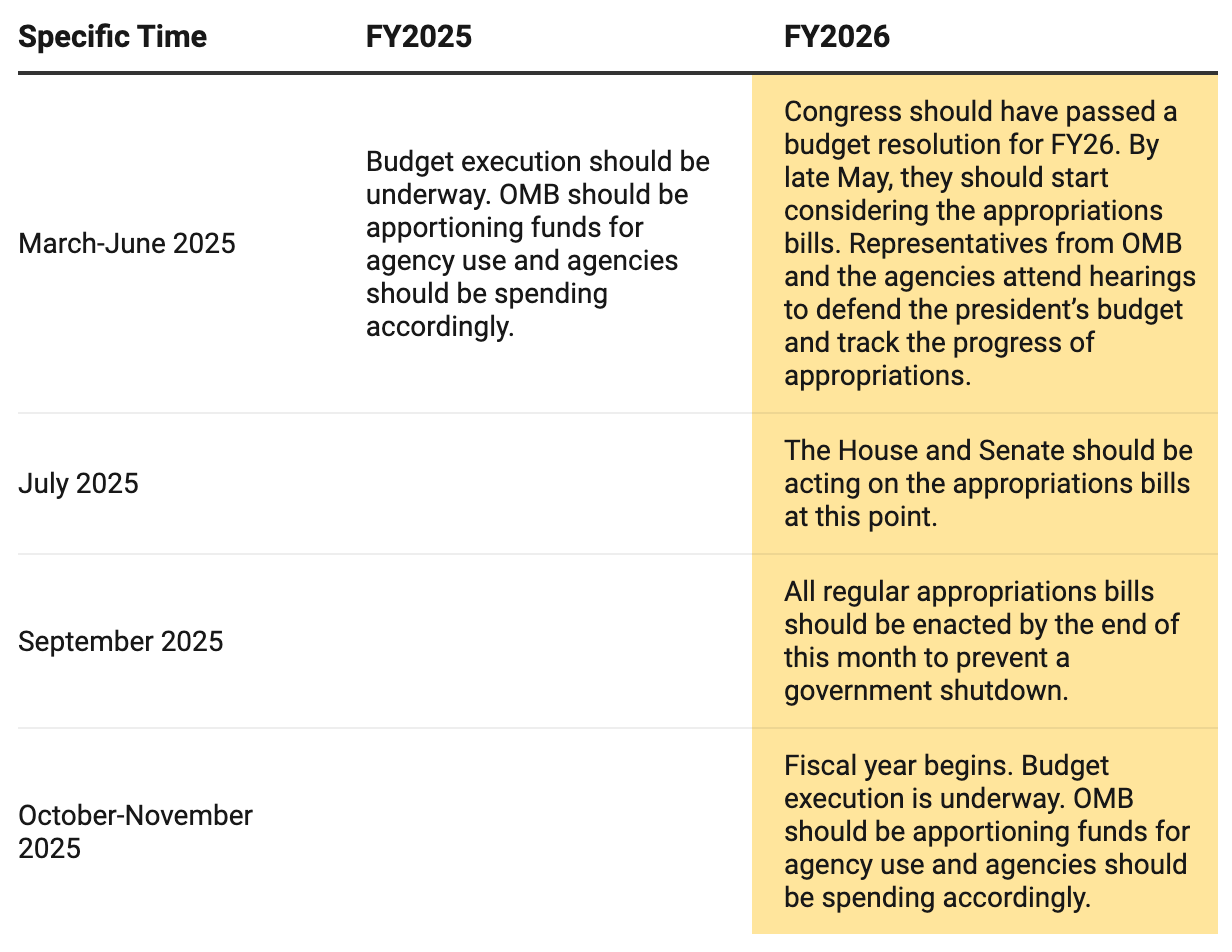
This chart is false!
For one, the funding for FY2025 itself was still an issue even as the fiscal year was nearly halfway through -- meaning that the “preparation” phase was still ongoing six months into the fiscal year. Readers might recall the time that the government nearly shut down in March of last year because the “continuing resolution" that was keeping the government funded was set to expire. In short, this event transpired because Congress had failed to pass the typical appropriations bills in the leadup to the start of FY2025. Consequently, they were forced to pass multiple short-term bills that kept the government “funded” for only a few months at a time. Those short-term “funding” bills in lieu of regular appropriations are what we refer to as “continuing resolutions”, and it was the expiration of a three-month CR that led to the appropriations crisis of March 2025.
As we will get into later, the nature and details of these funding bills not only complicate what it means for “budget preparation” to end, but they also give OMB massive opportunities to insert its interests into the execution of what little budgetary authority agencies manage to secure.
The March 2025 crisis came and went with the passage of a new Republican-backed continuing resolution, but not all appropriations crises end in such a timely manner. Instead, it has become increasingly common for all forms of appropriations legislation to stall in Congress and lead to a total “lapse in appropriations”. When this happens, agencies are left in appropriations limbo with no or minimal legal authority to obligate funds. Such budgetary lapses are what we have come to refer to as “government shutdowns”.
In events like these – either under a continuing resolution or especially amidst a shutdown – the rules for spending, and the amounts available for agencies to spend, are wildly different than when Congress manages to get a regular appropriations bill passed. And, of course, it is OMB that gets to play referee to keep agencies in check during these times. In other words, its middleman role between Congress and agencies grows even larger- and more arbitrary.
The blurring of “budget preparation” and “budget execution” is, however, not just a matter of crises. Even once an appropriation bill has been passed and the new fiscal year has started, both agencies and the White House have some legal wiggle room to change their appropriated amounts via “transfers”, “reprogrammings”, “deferrals”, or even “rescissions”. Readers should be unsurprised at this point to learn that the procedural details of these legal mechanisms grant OMB tremendous room to inject its own judgment along the way.
Exploring all of these budget complications in depth has become ever more important in recent years due to Congress’ inability to make it across the “budget preparation” finish line. But up until this point in history, we have yet to see the government go unfunded for a full fiscal year (anything is possible though!). So at some point, or perhaps at different points for different agencies, the “budget execution” phase must begin somehow. The rest of this article will explore the role OMB plays in this altered, but increasingly regular, execution process.
Budget Specification Under Pressure
The last installment of this series explained that OMB’s “specification” lever manifested in the office’s power to articulate and stipulate how and when agencies could spend their appropriated funds. This power is evident primarily through the “apportionment” process, and it is exemplified even further by the “footnotes” that OMB can attach to an apportionment. If you need a refresher, go back to that piece.
But footnotes themselves only tell half the story of OMB’s apportionment power. Yes, OMB has a lot of discretion during regular years to affect agency policy via footnotes. But the real magic happens when congress fails to pass appropriations bills on time.
Recall that a “continuing resolution” is the go-to temporary stop-gap legislation that Congress uses to keep agencies “funded” in lieu of regular appropriations. As traditionally used by Congress, a continuing resolution creates budgetary authority for the agencies that is on par with or only slightly adjusted from the levels set in the previous year’s budget. As opposed to a specific number for each appropriation, most authority is calculated via formulas that estimate how much agencies should spend given the amount they were previously appropriated and the length of the new CR. This helps to keep operations ongoing at the expense of Congress’ abilities to implement more extensive budgetary changes. As demonstrated by the March 2025 budgeting fiasco we referenced earlier, continuing resolutions tend to last less than the full fiscal year, though sometimes they go all the way to the end (or even longer).
The important detail to highlight is that continuing resolutions tend to keep agency budgets at similar levels compared to the previous year even if agencies were hoping to get more money during the budget preparation process. Often, the small increases in budgetary authority allowed by CRs are not even enough for agency spending to keep up with the year-over-year increases in the prices of the goods and services they regularly purchase. This makes budgets significantly tighter for the agencies, especially if the CR is not set to last for a full year. In turn, OMB’s power as the agency budget micro-manager becomes even more suffocating. Per a source cited in Pasachoff’s original paper, continuing resolutions give OMB the chance to "take on an aura of the trustees role in a corporate bankruptcy”.
OMB’s Circular A-11, which we discussed in part two of this series, explained the budgeting mentality under CRs best, stating that amidst a short-term CR especially, “each agency should
operate at a minimal level until after its regular fiscal year appropriations are enacted”. And of course, OMB doesn’t trust the agencies to manage their money well independently, meaning that the program examiners become deeply involved in agency operations the more extreme the appropriations crisis is.
And when the government completely shuts down, that is when OMB’s power to adjudicate funding is at its highest.
Given how commonplace they’ve become in recent years, many people might not know that government shutdowns are actually a relatively recent legal construction. It was only in 1980 when Benjamin Civiletti, President Carter’s Attorney General, authored an opinion suggesting that any government spending during a period of “lapsed appropriations” was a violation of the Antideficiency Act’s efforts to curtail agency “overspending” (for a discussion on the Antideficiency Act and OMB’s role in enforcing it, see part three of this series). The logic of Civiletti’s opinion was that the Antideficiency Act established a clear ban on agencies obligating any funds without Congressional authorization. Consequently, he determined that funds could only be spent beyond enacted legislation in order to “bring about the orderly termination of its [an agency’s] functions”. This exception was carved out under the assumption that it is impossible for an agency to completely halt operations without incurring some “minimal” amount of obligations.
A year later, though, Civiletti authored a new opinion affirming his previous decree and adding that certain parts of an agency could continue operations even amidst a shutdown if “some reasonable and articulable connection between the function to be performed and the safety of human life or the protection of property” exists. This additional carveout was borrowed from the language of the Antideficiency Act itself, which explicitly allowed for the obligation of funds in “cases of emergency” that fit the above criteria.
But of course, it’s impossible to determine which expenditures are directly connected to saving human life or protecting “property” without making a plethora of value-based judgments as to what truly matters in government functioning. In lieu of democratic decisionmaking (via Congress), OMB is empowered to make these judgements with unimpeached authority.
We can refer back to the A-11 for details on how OMB manages agencies amidst a shutdown. Per the circular, agencies are required to draft and revise “lapse plans” every few years in anticipation of any possible shutdown. These plans include not only a tally of employees that must stay on board during the shutdown but also a tally of how many employees and days will be needed to “complete shutdown activities”-- meaning activities needed to bring an orderly halt or pause to regular agency procedures -- before appropriations fully run out.
There are a handful of categories under which an employee may be kept on payroll even amidst a shutdown; such categories include those that are “financed by a resource other than annual appropriations”, those “necessary to perform activities expressly authorized by law”, those “necessary to perform activities necessarily implied by law” [emphasis added], those “necessary to the discharge of the President's constitutional duties and powers”, and those “necessary to protect life and property”.
Some of these categories, such as those involving financing outside of appropriations or those involving activities "expressly authorized by law”, are fairly straightforward and offer less (but still non-zero) room for agency or OMB discretion. The other categories, meanwhile, are profoundly open ended in specifying what types of staff might be kept on payroll. The idea that the law might “imply” that an action is necessary is particularly vague, potentially giving OMB considerable discretion to find implicit statutory support for whatever program they might want to keep running.
Ultimately, it is OMB who monitors the progression of appropriations bills in congress and works with the agencies to make these final judgements. In an article cited by Pasachoff, Clinton-era OMB director (and later vice chair of the Federal Reserve) Alice Rivlin described her experience managing the two shutdowns that the government faced during her tenure. She recalled putting John Koskinen, her at-the-time deputy director, in charge of making the final decisions. He became known as “Mr. Shutdown”, with his primary duty being simply to determine what counted as “essential” and what didn’t. Her retelling highlights the fact that the law itself does not specify what counts as essential, and consequently, the decisions in Koskinen’s hands were almost entirely “judgement call[s]”.
Perhaps the most revealing story about the power of OMB’s discretion is that of the … national Christmas tree. Yes, really. As Rivlin described, the December 1995 shutdown forced the office to weigh whether or not the maintenance of the tree was “essential”. Rivlin herself made the choice to designate it as nonessential. After the decision was made, though, many private firms called in and offered to pay for electricity and security details to keep the festivities going. As Rivlin put it, she accepted these offers “at no cost to the government”.
The former OMB head recounted the tree story as an innocent tale about keeping Christmas alive, but in it is revealed the way OMB can singlehandedly leverage a shutdown to “save money” for the government while facilitating positive PR for major corporations. To be sure, the national Christmas tree returned to its normal federal funding structure in the aftermath of the 1995-96 shutdown, but the notion that the White House can accept support from private industry amidst a failure in Congressional lawmaking raises serious questions about the power of the purse and the relationships that OMB is allowed to maintain with private actors.
The power to determine what stays funded during a shutdown was (questionably) presented as a bipartisan, technocratic concern decades ago, but more and more we are seeing the ways in which OMB can wield that power to achieve its own (and the presidency’s) policy goals. What stands out the most is not the decisions that the White House has made to prevent certain shutdown activities from being carried out, but rather what they have allowed even in lieu of appropriations.
In the leadup to the historic government shutdown last fall, the Office of Personnel Management -- the federal agency that works with OMB to determine which staff are “essential” -- released a guidance document outlining which employees would be exempted from leave as agencies faced lapses in appropriations. Among the more traditional categories of exempted employees, though, were protections for staff who were tasked with carrying out the ongoing mass firing campaign of the Trump administration.
See below the exact quote from the guidance:
OMB has determined that agencies are authorized to direct employees to perform work necessary to administer the RIF [Reduction in Force] process during the lapse in appropriations as excepted activities.
In a situation similar to but with much higher stakes than the Christmas tree story, then, we see in the Trump-era shutdown guidance a White House willing to bend the rules and use any means necessary to get around Congress' power of the purse. Unlike the explicitly pro-corporate ends of the first story, though, this example shows how OMB managed to leverage the loose language of shutdown exemptions in order to spend money beyond the authorization of Congress. And of course, all of this was somehow done in the name of “cutting costs” and improving the “efficiency” of government.
When Congress and the President find the time to collaborate, though, we have seen leaders use a slew of accounting gimmicks to ensure that presidential priorities stay funded for years to come no matter if the rest of the government shuts down. In recent appropriations cycles, we have seen this manifest most prominently in the multi-year appropriations bills for agencies like DHS, CBP, and ICE. Via these laws, the agencies are effectively insulated from the typical conflicts of the annual appropriations cycle thanks to their funding being guaranteed all the way through to the end of the decade.
Because the role of the OMB under continuing resolutions and shutdowns developed ad-hoc, there is still a lot we don’t know about how the process works. We plan on investigating this more in the future, especially since we will almost certainly face another government shutdown this year. Even when there isn’t an active crisis in appropriations, there still exists a whole world of opportunities for OMB to influence spending should the office wish to change appropriations ex post.
Transfers, Reprogramming, Deferral, and Rescission
Just because Congress has appropriated a certain amount of money for a certain activity, that doesn’t mean that the agency has to spend it as designated. Refusing to spend the money outright, though, or spending it on something other than what Congress appropriated it for, is illegal. Nevertheless, Congress has (over time) created mechanisms for reworking existing appropriations. These started as minor concessions and compromises to the president after the Impoundment Control Act of 1974. Nowadays, they’ve taken on a life of their own.
Inevitably, OMB has taken on an outsized role in these processes. As we’ll discuss below, these typically involve changes to “appropriation accounts” with the OMB. Let’s go through each of them briefly.
Transfers and reprogrammings are Congressionally authorized changes in how agencies are allowed to spend appropriated funds. A “transfer” is a movement of budgetary authority from one appropriations account to another (again, see part three of this series for an explanation of appropriations accounts), while a “reprogramming” is a movement of budgetary authority from one activity to another within the same account. Sometimes, Congress sets aside a certain amount of money for agencies to transfer or reprogram without needing to seek new statutory authorization, but more often than not, an agency must go through Congress before it can move money around.
The relationship between Congress and the administrative agencies itself is a hot topic of discussion, as Congress has increasingly battled with agencies over how much they might be allowed to reprogram before asking for approval. But well before an agency can even speak to Congress, they must, of course, go through OMB.
It is none other than the Circular A-11 that establishes that agencies must “clear” their reprogramming and transfer requests with OMB before submission to Congress. This falls in line with the broader requirements of the “confidentiality lever”, which stipulate that all agency communications with Congress are subject to OMB clearance beforehand. Pulling on our analysis of the confidentiality lever, then, we can see how OMB’s clearance requirement helps to filter out agency requests that might not be in line with presidential policy. There is no statute or rule coming from either Congress or the executive branch that requires that OMB be neutral or technocratic in its decisions to approve or disapprove agency reprogramming requests.
This means that OMB and the staff of its Resource Management Offices have the ultimate word in the event that an agency might want to implement a change. Given how intimately the program examiners work with agencies, it is theoretically possible that a push to reprogram or transfer funds could come first and foremost from OMB, compelling them to “initiate” a request OMB will eagerly forward to congress. In the event that there is any disagreement between the agency staff and OMB, the confidentiality demanded by OMB once a decision has been reached helps to ensure that the public never finds out who within the government actually wanted a transfer and why.
Sometimes, though, shifting funds from one account or activity to another isn’t enough. Sometimes OMB or the president (or maybe even the agency) simply doesn’t want to spend the money at all. In much earlier times appropriations were a ceiling- you can’t spend more than this- and congress granted major discretion to the president to not spend funds- legal impoundment if you like. Unsurprisingly, the LBJ tapes have a colorful and suggestive summary of this budgetary approach in a conversation the president had with Federal Reserve Chair William McChesney Martin Jr. on June 30th 1966:
They'll go ahead with their appropriations but they would authorize the president to withhold and to stretch out and to postpone, say not to exceed five percent. And then I would take that as a mandate you see. I could say “congress has approved this” and so then I could just impound the stuff that I could impound. If I could get even that through I would be alright, I don’t mind taking it.
The context of the phone call is that LBJ is attempting to cajole Martin not to raise interest rates by pointing to his attempt to implement budgetary austerity, including congressionally authorized impoundment.
Since the 1974 Impoundment Control Act, which was enacted in response to brazen impoundment by the Nixon administration, presidential discretion over spending appropriated funds was tightened further and “legal impoundment” went out of fashion as a congressional budget tool. Congress did create a mechanism to allow for funds to be cancelled so long as the president came to the legislature for approval. This was, and is not, the kind of discretion that LBJ and his presidential predecessors had however.
This is where the “deferral” and “rescission” processes come in. These mechanisms were created by the aforementioned ICA to give the president a little bit of breathing room should he want to impound funds legally. Of course, the ongoing Trump-led constitutional crisis has demonstrated that the actual enforcement mechanisms of ICA and the related Administrative Procedure Act are, by now, incredibly weak and that these laws do very little in the face of a lawless executive backed by the Supreme Court. Nevertheless, even when the president uses these measures, there is still a lot of room for executive power to win out.
Which brings us to “deferrals”. A “deferral” is a temporary pause on the disbursement of appropriated funds. For reference, we could say that the first Trump administration’s repeated delays in allowing for the Ukraine aid disbursement was a form of “deferral”. Crucially however, in refusing to seek Congressional approval for such actions, Trump’s deferral in this case was an “unconstitutional deferral” and not an “ICA deferral”. A “rescission”, meanwhile, is a complete removal of budgetary authority from an appropriations account. In other words, congress orders funds taken out of an agency’s bank appropriation account that it had previously filled up. Under both of these processes, the agencies must send a letter to Congress making their request and providing reasons as to why they want funds cancelled or delayed.
Notably, the Impoundment Control Act bars the executive branch from requesting deferrals or rescissions on the basis of “policy” interests. But as the rampage of DOGE demonstrated, it is very easy to mask policy goals as “cost-savings” or something else so long as the rest of the government is willing to play along with the charade. Which brings us back to the “Confidentiality Lever”. Since agencies are required to clear all rescission and deferral requests with the OMB, the insertion of presidential policy into the process is not difficult.
In a future planned article, we will explore in more depth how OMB has actually co-opted this rescission and deferral process to impound funds even without the approval of Congress. This technique is known as a “pocket rescission”, and OMB’s leadership has refused to disavow their use of it.
With this last technical point, we have finally touched on all of the nuances in the “budget execution” levers. Finally, at long last. As evidenced by the specification lever requiring two whole (long…) pieces to be fully articulated, it is perhaps the most crucial lever for understanding OMB’s actions as manifested under Russell Vought and the Trump administration. We will undoubtedly revisit basically every concept discussed in these “budget execution” pieces. If you feel a little lost, that’s okay. We’ll continually return to this topic and keep clarifying how it works.
Finally, at long last, we’re ready to finish this series with the sixth and seventh levers. See you next time.
Sign up for Notes on the Crises
Currently: Comprehensive coverage of the Trump-Musk Payments Crisis of 2025