Agency Independence in One Agency: Humphrey’s Executor is Cowering in the Basement of the Eccles Building
Today is the 6th anniversary of Bloomberg Businessweek's profile on me, which forever changed my life. Its so long ago now that many readers may not actually be familiar with it, so I'm linking to it for the first time in many years.
To those who have hung around all these years, through the highs and lows, thank you for your support. For those who have never taken out a paid subscription, there has never been a better time.
“You Can Tell the Supreme Court Does Not Want to Mess with the Fed. They’ve said it as clearly as they can”
—Former Federal Reserve Chair Jerome Powell
So, here we are. The unitary executive theory is now the official law of the land in the United States of America. Every administrative agency is now supposed to be a direct conduit for the president’s will. Any government employee should be removable by the president. Well…except for a few employees. (We’ll get back to that in a moment. )) I’ve been warning about the coming imposition of unitary executive theory since early on last year. My first coverage of the Trump administration’s attack on Federal Reserve Governor Lisa Cook emphasized that Humphrey’s Executor was on the chopping block because of the right wing legal world’s infatuation with unitary executive theory.
Which brings us to the Fed…
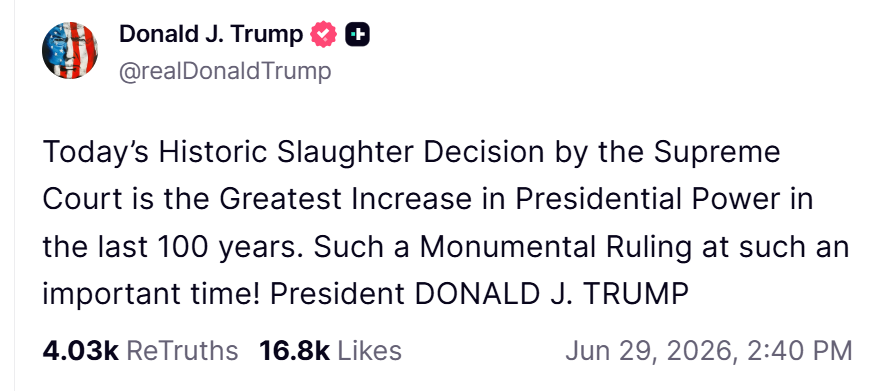
First though, let's finish putting away Trump v. Slaughter. There isn’t much to say relative to previous coverage. The 6 justices in the majority are quite clear that they are simply killing 90 year old precedent wholesale:
Its powers, however, do not belong to the President or his appointees alone; they instead belong to five Commissioners, each of whom serves for seven years and may be removed by the President only “for inefficiency, neglect of duty, or malfeasance in office.” 38 Stat. 718, 15 U. S. C. §41. We hold that such protection from removal is contrary to the separation of powers enshrined in the Constitution. [...] If anything more is left of Humphrey’s, we overrule it. Humphrey’s has for decades been a result in search of a rationale. [emphasis added]
Now, onto the exception. In my September piece on Cook v. Trump reaching the supreme court, I laid out the four possibilities I saw for the outcomes of these two deeply intertwined cases. SCOTUS itself agreed with me that these cases were intertwined, which is why both decisions were released Monday. Anyway, here is what I said back then:
We are thus left with four possibilities. First, the Supreme Court will officially strike down Humphrey’s Executor for all agencies, including the Federal Reserve Board and the Federal Open Market Committee. Second, the Supreme Court will issue another “emergency stay” overturning lower courts decisions but without providing any reasoning justifying Lisa Cook’s firing. Third, the supreme court may leave Lisa Cook in place and eventually solidify the “unitary executive minus the Federal Reserve System theory”. Fourth, the supreme court may remove Lisa Cook while, at the same time, solidifying the “unitary executive minus …” theory while emptying it of content. [emphasis added]
Clearly, the third option I laid out here is what the supreme court went with. However, as we’ll discuss, it also did its best to make the “for cause” requirement as minimalist and weak as possible.
To remind readers, the FTC case was not about “not being able to” fire an FTC commissioner. It was instead about whether the president needed “cause” (however defined) to fire an FTC Commissioner. Trump v. Slaughter says that no, Trump doesn’t need cause to fire any independent agency head… except one special one. The fact that the supreme court is upholding “for cause” protections for Federal Reserve officials does not mean that Federal Reserve officials can’t be fired. So the question is how strong is the Federal Reserve’s “for cause” removal protection?
The Supreme Court adopts a “goldilocks” view of “for cause” removal protections:
If the Government’s (and JUSTICE THOMAS’s) test is too lenient, however, Cook’s is too stringent. Cook argues that we should interpret “cause” to refer only to the specific causes provided in other statutes as bases “for presidential removal”—specifically, as of 1935, inefficiency, neglect of duty, malfeasance, and ineligibility. Brief in Opposition 20. But we see no reason why that should be so. It is true, of course, that some statutes by their terms incorporate an “external body of law,” as when a statute refers generally to defenses “available by law.” Jam, 586 U. S., at 210 (emphasis deleted; internal quotation marks omitted). That inference, however, works only if the statute actually references that body of law. The statute here does not. It refers to “cause” generally, 12 U. S. C. §242, a concept familiar to the common law. It does not refer to “causes that Congress has otherwise recognized as adequate. [emphasis added]
To summarize: the Supreme Court is saying that since the statute providing “for cause” protections does not define what “cause” is (many others do and most commonly they define it as “inefficiency, neglect of duty, malfeasance”), this is left to common law—as interpreted by the courts. Yet, the Supreme Court skips over defining what the only remaining “for cause” protections in the Federal Government are:
Having rejected both parties’ positions, we need not fully demarcate the contours of “cause” today. For present purposes, it is sufficient to observe that any definition of “cause” in this context must reflect the Federal Reserve’s unique historical status and role.
Whatever that means!
What we do know is that whatever “for cause” is, it doesn’t require much of an administrative process:
Of course, that is not to say that a Federal Reserve Governor is entitled to an audience with the President or a full-blown judicial trial. [...] Instead, all that is required is notice “to the officer of the charges made against him” and “an opportunity to be heard in his defense.”
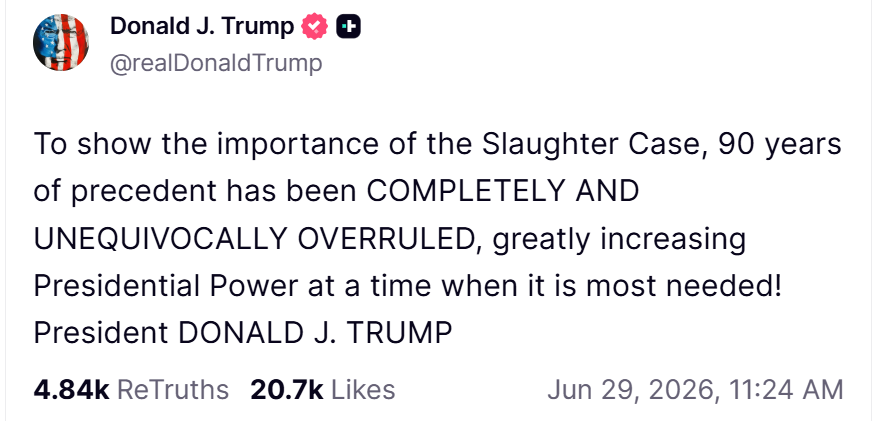
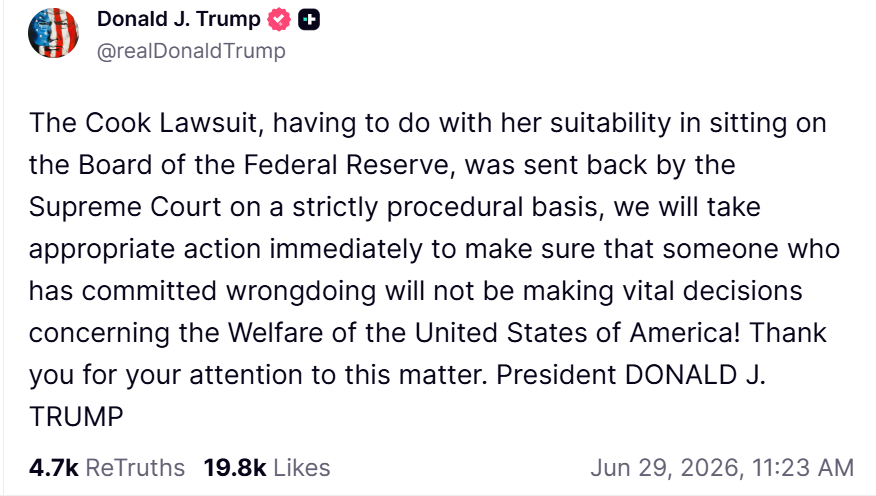
This isn’t nothing—but it isn’t much of anything either. It shouldn’t be a surprise that the legal attack on Cook will continue, as Trump himself immediately announced on Truth Social:
In short, one of the great ironies of this fitful saga is that the Federal Reserve has historically—despite all the blather about central bank independence—had the weakest legal protections against removal of any independent agency. It's just that now all the “taller buildings” have been bombed into smithereens by the Supreme Court’s air division and the only independent agency left standing is the Federal Reserve. Well until Clarence Thomas’ dissent- correctly noting the incoherence in the “unitary executive minus the Federal Reserve” theory- becomes the majority position. After all, this case was decided 5-4. If you’re a financial market participant calmed by this decision, I would like to sell you one trillion Crises Bucks. Don’t worry, it's on the blockchain.
Let's take a step back here.
It's important to understand—and this is something I’m going to expand on at great length in the following year- that unitary executive theory fundamentally challenges the ability of anyone to get relief in the courts. After all, the executive branch is, well, the executor of the laws. If the executive branch—meaning in this context the President’s will- does not wish to follow statutes passed by congress, how can the court interfere? A court can simply make a ruling, order an agency to spend—or order the OMB to allow an agency to spend-—and then watch as its court order goes unexecuted.
Indeed, the Supreme Court has closed off this very possibility in a series of “shadow docket” decisions responding to lawsuits over unconstitutional impoundment. For various reasons related to administrative law, plaintiffs have typically made cases based on the “Administrative Procedure Act” to challenge the termination of grants, the withholding of funds etc. The Supreme Court has not provided much, if any, guidance or reasoning to explain its decision-making but Fordham law professor Adam Orford seems to have constructed, in my judgment, the best explanation so far. In his short (for a law professor) piece “Funding Freeze Formalism” he argues that the Supreme Court is fundamentally changing the reigning legal conceptualization of the Federal Government. The trend established by Humphrey’s Executor, the Administrative Procedure Act and other 20th century developments was to reconceptualize the executive branch as containing not just direct instruments of the president’s will but professionalized administrative agencies who implement congress’s will balanced by broad juridical powers to review agency actions. Despite all of the Supreme Court’s radical moves over the past handful of years, this framework still is in many people’s mental model. It is, however, clearly not the framework that the “majority” justices have in mind.Professor Orford argues that the Supreme Court intended these “shadow docket” decisions to require any lawsuit that in some form seeks the Federal Government to pay money to go through the Court of Federal Claims (CoFC). Because all sorts of areas of federal policy could be interpreted as involving an “obligation to pay money”, various parts of the executive branch’s actions become “nonreviewable”. To put it simply, if you want to get your grant money, you can’t sue under the Administrative Procedure Act. If you can’t sue under the APA, you can’t get an injunction against unconstitutional impoundment in the future. You can just try to get yourself paid after the fact. Plaintiffs can’t impact government policy just because they’ve been wronged. That’s so 20th century.
The Supreme Court doesn’t simply want congress’s grubby hands off of the executive branch, it also wants the courts to keep their grubby hands out too. They can’t go the full way—for example ruling that the APA is an unconstitutional violation of the separation of powers—at least not yet. But they can narrow the scope of the APA considerably. This is all in service of concentrating power in the president and fundamentally changing the nature of the presidential spending power. As Orford says in his abstract, the Supreme Court intends to make spending an “Executive prerogative subject only to the limited oversight that the government itself has consented to allow”.
A way to think about it is this: the Supreme Court this week said in Slaughter v. Trump that Congress couldn’t “reach into” the executive branch to create removal protections for executive officers. If now anyone (absent Federal Reserve officials) are subject to removal by the president without cause, what would stop a president from simply firing officials who dared to execute laws he wanted unexecuted? Remember that a common way for courts to protect against illegal executive behavior is to judicially impose removal protections for officials resisting the unconstitutional directive in question! This clearly isn’t going to fly in a unitary executive world. The Supreme Court has not only avoided proposing a remedy to unconstitutional impoundment of congressionally ordered spending, it's currently still avoiding recognizing there is a problem. All signs point to this being by design.
This is what people mean when they claim that the unitary executive is “inherently lawless”. In its strongest form this vision of the constitution essentially establishes that the president can do what he wants up until (and unless) congress impeaches him. It is striking how close this “strongest form” is to the daily reality of trying to hold the Executive branch accountable for anything it does through any existing legal mechanism.
Which leads to a “meta” point. The frustrating thing about reading Supreme Court decisions carefully nowadays is it feels like wasted effort. The justices didn’t put all that much effort, why should we? The reasoning is not the point, the point is the final decision. Yet those of us on the outside of the court looking in can’t help but attempt to peer in through the texts, to get a sense of what’s going on. Even if it all changes next week.
For now though, here is where we stand.
Sign up for Notes on the Crises
Currently: Comprehensive coverage of the Trump-Musk Payments Crisis of 2025