The Medium is the Message: The First Three Levers OMB Has Over Agencies
This is a free piece of Notes on the Crises. All pieces in this OMB series will be free. Please take out a paid subscription to support this work. Or leave a tip.
Joshua Lawrence is a research fellow at Notes on the Crises and graduate of Sarah Lawrence College. Find him on Bluesky here.
Juan Hanes is a research fellow at Notes on the Crises and a Journalism student at NYU. Find him on Bluesky here.
In our last piece we covered the basics of Resource Management Offices, Program Examiners and the Presidential budget along with the entire budget preparation process. As we said in our last piece, the “preparation” stage of the annual budgeting process is long and multi-faceted. It is the Office of Management and Budget, staffed by its army of “program examiners”, that is tasked with seeing that the president has his way as this process unfolds. Today we will dive into specifically how OMB involves itself in the budget preparation process.
Our analysis, split across the many parts of this series, is based on the concept of the “seven levers” that the OMB Resource Management Offices (RMOs) have at their disposal to influence agency policy. This concept was first developed by Georgetown law professor Eloise Pasachoff. And indeed, it is her 2016 paper which labels these mechanisms as “levers” and we follow her terminology and definitions in this miniseries. According to professor Pasachoff the seven “levers” are:
- Form and Content Lever
- Approval Lever
- Confidentiality Lever
- Specification Lever
- Monitoring Lever
- Presidential Management Agenda lever
- Budget-nexus lever
The first three, which take place during the “preparation” stage of the annual budget process, will be the focus of today’s piece. In future pieces, we explore the levers in the “budget execution” stage and eventually those in that fall under her “management initiatives” category.
The Form-and-Content Lever
As the name implies, OMB’s first mechanism to influence agency policymaking comes via its authority to dictate the “form” and “content” of an agency’s budget request submission. In other words, the medium is the message. Pasachoff described this lever best:
The first lever that OMB can use to control agency policymaking through budget preparation is the ability to tell agencies what they should put in their budget requests in the first place (the content) and how they should convey this information (the form).
The name is self explanatory, but the actual mechanisms to articulate form and content are much less well known. There are two main document types that OMB uses for these purposes: Circular A-11 and memos. They both play a unique role in controlling form and content, so let’s examine each.
The Circular A-11 is the 900+ page document that OMB releases every year to help guide agencies on how to prepare, submit, and execute the annual budget. From a very straightforward definition of what the budget is to nuanced technical and legal questions, the document contains nearly everything that an agency might need to know in order to draft its budget numbers and eventually submit it to OMB. It is a very important document, usually getting republished early in the budget formulation process (for FY28, for instance, we should expect to see the new A-11 released in July 2026) and containing summaries of important changes that have been implemented from one year to the next. Given the fact that the earliest stages of budget formulation begin in a highly decentralized manner within each individual agency, the A-11 Circular is an extremely powerful tool to push standardization on these Agency’s informal processes and “set the tone” for OMB’s ongoing centralized authority over the budgetary process.
Like all procedural, seemingly technocratic documents the A-11 is not without its fair share of political language and value-based judgements. Pasachoff noted in her original article on the levers that the A-11’s most powerful form-and-content guidelines are those that demand agency confidentiality and force agencies to comply with the president’s “management initiatives”. Agency confidentiality cuts out administrative agencies from the congressional aspect of the budgetary process, granting OMB and the white house a great deal of “initial authority” over the budget. As with any negotiation, being forced to only negotiate with one actor gives that actor a lot more leverage than if you could play multiple parties against each other. In other words, control over the “form and content” of budgetary requests is itself a powerful lever of control. In the 10 years since Pasachoff’s original article, the A-11 circular’s political language and value judgments have exploded in both quantity and intensity.
Revisiting the form-and-content lever in a post-Trump context, Pasachoff noted in 2020 that the A-11 had quietly dropped references to requirements that agencies discuss their climate change plans. And in the first A-11 of the second Trump administration, released in August 2025, dozens of changes were implemented to align the budget process with Russell Vought’s fiscal vision. A full exploration of these changes merits its own breakdown at some point in the near future (especially since we should expect to see a new A-11 released within the next month or so), but we will briefly note a handful of the most significant changes:
First, the language around impoundment has completely transformed to conform with Vought’s attitude on the issue. In a section dedicated to defining dozens of “special terms”, the definition for “impoundment” has completely disappeared. Elsewhere, the document has reworked interpretations of the Impoundment Control Act, suggesting that it is legal for the president to delay expenditures in order to “establish” or “change” programs or even to “develop policies … to align with administration policy”. As established in past NOTC coverage, these legal “interpretations” of impoundment coming out of the White House are nothing short of a full blown violation of the constitutionally protected separation of powers. Although these changes don’t necessarily pertain to the “form and content” of budget preparation, they do signal to agencies what type of attitudes and hurdles they will have to go through in order to secure proper funding. Impoundment itself is a potent threat against agencies which reinforces the drive to “reign in” budget requests.
Elsewhere, the A-11 seeks to downgrade the importance and role of the Government Accountability Office -- the congressional agency created specifically to oversee the executive branch’s conduct and the constitutionality of its actions, especially on impoundment. In one revised section, the document declared that GAO’s legal interpretations are “non-binding on the Executive Branch”, and elsewhere, it stated that GAO’s oversight of impoundment/recissions have no effect on when OMB will release funds to agencies. This shouldn’t be all that surprising insofar as downgrading congress as a subordinate branch of government also entails downgrading congressional agencies meant to protect congress’s will and oversight role.
The A-ll circular also removed an old guideline that directed agencies to include estimates of how budgetary authority will be spent in line with the goal of promoting “equal opportunity”. The removal of this section is apparently in accordance with Trump’s executive order titled “Ending Radical and Wasteful Government DEI Programs and Preferencing”. In place of the old “woke” guidelines are instructions for agencies to “find efficiencies; address fraud, waste, and abuse; and support administration priorities” within their budgetary proposals. Along with the submission of their budget requests and spending plans for the upcoming year, agencies are also encouraged to “work closely with OMB on identifying administrative savings” and “comply with any savings targets provided by OMB”.
It is hopefully apparent from the description of these changes how the form-and-content lever manifests. Agencies must go through OMB to develop their preliminary annual budgets. This is true regardless of how much congress ends up appropriating to them at the end of the entire process. In order to work with OMB, though, agencies must first play by OMB’s rules. Stated another way, agencies must make their budgetary proposals legible to OMB and compliant with the more supplementary demands that the office makes. OMB sets the tone; agencies have no choice but to play along.
This reality is something that agency officials are aware of well before they even come close to tallying up their final requests for submission. Knowing what OMB wants out of agencies -- and those wants can be both implicit or explicit -- is crucial to drafting a budget proposal that the Office is even willing to entertain.
And there still might be more hoops that OMB forces agencies to go through.
Second to the A-11, which Pasachoff described as perhaps more procedural than anything, OMB also has the power to express its form-and-content desires through good old memoranda. Ironically, as we continue to go through our Fiscal Year 2025 memo breakdowns, it will become apparent that OMB didn’t actually put out much explicit guidance on “budgeting” last year compared to guidance on regulations, procurement, and general spending. In past years, though, memoranda have been used explicitly to constrain and guide agency action in the budgeting process.
As exemplified in memos like M-03-10, budget guidelines memoranda tend to be quite clear in what they want agencies to focus on during the budgeting process. Guidance via these memos can be broad -- like the suggestion that agencies try to save costs in light of record defense spending -- or they can be quite specific, like a Carter-era requirement that agencies use a “zero-based budgeting” methodology to prepare their requests (we will spare you the details on what that means … at least for today).
Even in years like FY25, when OMB didn’t release a specific memo on budget preparation, agencies can still gather a general sentiment on what OMB and the White House might be focused on in a particular year, and that knowledge can inform how the agencies go about building their budget requests. Knowing that OMB is hell-bent on cost saving and destroying parts of the administrative state by any means necessary, for instance, probably has a pretty strong effect on the way agencies draft their budgets. As Pasachoff explained (in more neutral language):
The memoranda indicate that agencies are more likely to be successful in their budget requests to the extent the agencies can shape their priorities to match those of the President.
But the form-and-content lever can only go so far. OMB can massage agency budget requests as much as they want in those early stages of the preparation process, but if an agency decides to “go rogue” and submit a request completely out of line with OMB’s guidance, a more forceful mechanism must be used. That lever? the approval lever.
The Approval Lever
Just like the form-and-content lever, it shouldn’t be too hard to guess what the “approval” letter entails in a broad sense. OMB, as the office that has final say in the construction of the presidential budget, has the power to “approve” the budget requests of the federal agencies. With the power to “approve” of course, comes the much more powerful tool to “disapprove” or, said better, “reject”.
The power to approve and reject budgetary requests exists in both a formal and informal capacity. Let’s start with the formal approval mechanism.
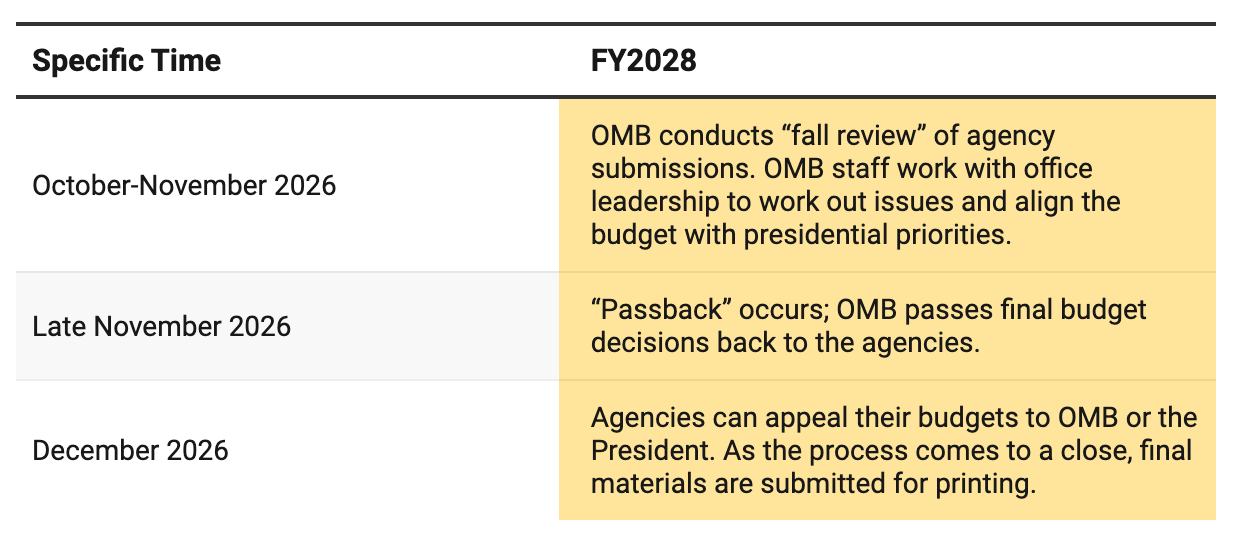
If we refer back to our timeline/chart of the annual budget process (a snippet of the chart is pictured above), you will see a reference to the term “passback” in the “Late November 2026” column. “Passback” is an official stage in the OMB budget preparation process, usually arriving towards the tail end of it all. Well after the informal preparation process begins and a few months after agencies actually submit their requests to OMB, the office “passes” their final budgetary decisions “back” to each agency. More than just one big budget number or a handful of smaller numbers, though, what agencies receive is often a detailed plan on how much they will receive and how exactly they are allowed to spend the money. Like with everything involving OMB, the devil is in those details.
The amount of specificity tied to an official passback decision is often related to how favorably the president/OMB view that agency and how relevant the agency is to the wider policy goals of the administration. Agencies that are more favored by White House leadership often get more discretion in their final budgetary numbers, meaning that they are allowed more room to determine how they want to spend their money. Agencies disliked by the president -- or those that leadership feel compelled to keep a close eye on given their political relevance in a given moment -- are likely to receive very detailed and constraining passback decisions.
Though the details of passback themselves only relate directly to the budgetary numbers in the (nonbinding) presidential budget, it is those details that ultimately get translated into the line-item appropriations that the president asks Congress to pass. For those unfamiliar, appropriations bills -- the actual legislation that creates new “budgetary authority” for agencies to spend -- are written in plain English with instructions on how the appropriated money should be spent. Each new “line item” is a different program. As a result of this formatting, the authors of the appropriations bills have the power to grant budgetary authority with a high degree of specificity, creating infinite opportunities to constrain agency discretion. That this process begins in the executive branch via the language of passback -- instead of in Congress -- means that OMB gets first dibs in articulating how agencies are allowed to spend their money. Well before that budgetary authority is actually created, then, it is the passback process that sets the tone for what is to come.
Of course, agencies are allowed to appeal their passback decisions, but the appeal process itself often amplifies the heated discussions that take place as budget season ramps up. Consequently, agencies have learned to be careful in picking and choosing these budgetary battles.
Pasachoff writes that passback disagreements are “often negotiated at the staff [program examiner] level”, but if agency officials are still dissatisfied with what they’re getting, they have the opportunity to raise their appeals to the OMB Director or even the president. Because of how busy these higher level leaders are, though, not every issue can be taken straight to the top. Only the most pressing concerns typically reach the president, and even if they do, there is no guarantee that agencies will have their way just by nature of having appealed. Ultimately, then, OMB wields a tremendous amount of power in its ability to formally approve or disapprove an agency’s budgetary request.
On the informal side of things, though, OMB’s power might be even greater.
As mentioned in the first part of this series, the job of the RMO program examiners is to become as familiar with their assigned government function as possible. In practice, this means that the examiners often embed themselves into their agencies. Deeply.
Examiners are expected to keep regular contact with their agencies and work with them on a near-constant basis. By virtue of the budget season’s unendingness, this symbiosis is only exacerbated. The result is that the program examiners have an opportunity to exercise a perpetual approval lever well outside of the official passback mechanism.
At any stage in the budget preparation process, and especially early on while the agency is still piecing everything together, the omnipresent examiners are there to tell agency officials what they should and shouldn’t do. Per former OMB staffer Jennifer M. Forshey, it is not uncommon for even the junior level program examiners to work directly with agency heads to answer budget questions. Given the historic mission of OMB as a cost-saving office (and this “cost-saving” mission has only grown under Trump/Vought, of course), this constant interplay makes the relationship between examiners and agency officials quite adversarial.
To be sure, not every government function is beholden to these forces. A staple of Notes on the Crises coverage is reporting on the many, many accounting gimmicks that exist across the federal government to keep funds flowing outside of the regular appropriations process. The concept of “mandatory spending” -- spending that is authorized outside of the annual appropriations process -- is the simplest mechanism that comes to mind. Nathan spent much of last year writing about another accounting gimmick to avoid the annual appropriations process- connecting spending with a specific “revenue” stream.
However, it's important to emphasize that even with agencies that deal primarily with mandatory spending, there are ways for OMB to get involved. Toying with the limited “discretionary” budgets of such agencies -- these budgets usually affect staff levels and other operational costs and are authorized via the annual budget -- is one easy way to do so.
Seeing the need for some parts of the government to be independent of this oversight, though, Congress has created protective mechanisms for select agencies. “Bypass” authorities are the primary way for agencies to get around OMB oversight. Although they manifest differently in different agencies, a bypass provision typically means that a selected agency (these agencies tend to be the historically independent agencies of the federal government) can either submit its budget to the president and Congress concurrently or that the president must submit the agency’s original budget proposal to Congress without any changes. Both of these help to circumvent the effectiveness of the presidential passback. (OMB and unitary executive fans, of course, have never really been a fan of these provisions, often suggesting that they are counterproductive or unconstitutional, but the validity of such arguments is a discussion for another time).
But short of these special privileges, though, (or short of an agency/bureau having a more unique funding mechanism, like the Office of Financial Research), the passback reigns supreme. Once an agency has been informed of their budget for the following year and the appeals process is over, it comes time for OMB to package all the requests into one big, beautiful budget to submit to Congress. But even after the budgetary heavy lifting has moved on to the legislative branch, OMB still has one more trick up its sleeve to keep agencies in check.
The Confidentiality Lever
We mentioned earlier that the Circular A-11 contains a section that demands “confidentiality” from agencies after the submission of the budget to Congress. In part one of our FY2025 memo breakdowns, we also highlighted M-25-19 and its outlining of the “legislative clearance” process. It is these -- and many more -- documents that make up the third lever of the budget preparation stage: the confidentiality lever.
In a sense, this might be the most powerful lever we discuss today. The confidentiality lever demands silence and support from the federal agencies once the presidential budget has been submitted to Congress. And for what it generates in “cohesiveness” and “unity” in the government, it creates equal amounts of opacity and impenetrability within the executive branch. It is the confidentiality lever that goes a long way to making OMB one of the most opaque- and powerful- parts of the federal government.
When we discussed M-25-19, we noted how OMB was specifically seeking to enforce unity in communication to Congress. But in the wider confidentiality lever, as best outlined in section 22 of Circular A-11, confidentiality is something that government officials must practice with everyone outside of the executive branch -- including media and the public.
In practice, this lever essentially means one thing: once the president’s budget has been drafted (or even while it is still in the works), agency officials must act in support of it at all times, no matter how hard they fought against the budget behind closed doors. Before speaking with anybody in Congress or the media, agency officials are expected to “clear” their communications with OMB to ensure that they are consistent with the president’s vision. And when an official is invited to Congress to testify about the president’s budget request, the A-11 instructs the official to “give frank and complete answers”, but also to “avoid volunteering personal opinions that reflect positions inconsistent with the President’s program or appropriation request”. And in case an agency head somehow thought they could get away with saying something to Congress, one of the key responsibilities of the program examiners is to attend Congressional budget hearings to track progress and ensure that all testimonies from executive branch officials are in line with presidential policy. Some might refer to this discipline as “democratic centralism”.
We have previously detailed some moments in recent memory when the confidentiality lever worked its way into the public eye. Pasachoff notes in her 2016 article some important anecdotes about the power of this lever. Past officials have lamented the need to clear everything they do with OMB staff, and one overzealous examiner even threatened to “make life miserable” for an Inspector General that disagreed with his agency’s assigned budget. These stories only made it out of the woodwork for their exceptionality (in the case of the IG, the examiner was disciplined only because IGs are supposed to be exempt from the confidentiality requirement), though, and there are almost certainly countless other stories that we will never get to hear.
And when we say that “agency officials” are not allowed to breach confidentiality, we are referring to everybody in the agency. Nobody -- not “independent” agency officials nor low-level career staff -- are exempt from this requirement.
Violation of the confidentiality rules has even led to some staff getting fired. In 2002, when the at-the-time head of the Army Corp of Engineers spoke to Congress about how the president’s budget would cause massive staff cuts in his agency, he was forced to resign shortly thereafter. Soon enough after the incident, a private memo leaked revealing that the OMB Director and other high level White House staff were referring to the testimony as “totally bogus”. Mitch Daniels, the at-the-time OMB director, denied involvement in the forced resignation, but the timing of the memo and the context surrounding the incident remain conspicuous.
As mentioned, the nominal goal of the confidentiality requirements is to ensure that the executive branch “speaks with one voice”. By and large, though, the primary effect of this lever is a culture of secrecy. Those familiar with political organizations that are run in a democratic centralist manner will find this unsurprising. Pasachoff highlights a number of questions that are born out of the lack of transparency in OMB:
We do not know, for example, when, which kind, and how many meetings between the RMOs and the agencies occur over the course of the budget preparation season and throughout budget execution; what interest groups or other administration officials meet with the RMOs, what the meetings are about, and who is present during such meetings; what kinds of agency policy work interest the RMOs, and what kinds do not […] and how all of the above might vary by administration, by OMB Director, by PAD, by program examiner, or by agency.
These questions are crucial to holding the government accountable, and the pursuit of answers to the above is one of the greatest forces driving our deep dive into OMB. That OMB has operationalized its opacity via the confidentiality lever means that the office has in its toolbox an incredibly sophisticated and legally enshrined way of making it impossible to know what is going on within one of the most important parts of our entire federal government. This reality, though it has been like this for decades, remains deeply alarming. That such a power has now been in the hands of Russell Vought and the Trump administration for years is only adding fuel to the flames.
Coming next time is a discussion of levers RMOs have available during the “budget execution” phase. If they have this much power over preparing the budget, imagine how much power they have over actually implementing the budget?
Sign up for Notes on the Crises
Currently: Comprehensive coverage of the Trump-Musk Payments Crisis of 2025