
“It’s Like a Knife in the Back”: The President's Budget, Budget Preparation and the Most Important Job You've Never Heard of
This is a free piece of Notes on the Crises. All pieces in this OMB series will be free. Please take out a paid subscription to support this work. Or leave a tip.
Joshua Lawrence is a research fellow at Notes on the Crises and graduate of Sarah Lawrence College. Find him on Bluesky here.
Juan Hanes is a research fellow at Notes on the Crises and a Journalism student at NYU. Find him on Bluesky here.
In our first article breaking down the Office of Management and Budget’s memoranda for Fiscal Year 2025, we took some time to outline the basic structures of the OMB. As a quick refresher, we established the idea that OMB is broadly divided into an “M” side for “management”, and a “B” side for “budget”. Underlying that structure is the less acknowledged “P” -(or “policy”) side, that Georgetown law professor Eloise Pasachoff has explored in great detail for the past decade
The “P” side comes out in both the budget and management activities of OMB, but on budget matters especially, OMB’s efforts to control policy manifest most clearly through the Resource Management Offices (RMOs). The formulation of the annual presidential budget is one of the most intense, high-stakes rituals in the executive branch. And it is in service of that ritual that the RMOs have been armed with tools to carry out the will of the White House. In her 2016 paper exploring the influence of the RMOs, Pasachoff established seven “levers” that the offices use to control agency policy.
Today, in our efforts to map out every corner of OMB and its mechanisms of control, we will begin a four part mini-series breaking down these levers and explaining exactly how they work. We will periodically be taking these kinds of breaks from the “Memo” series for explainers that help provide crucial context for the importance of the OMB’s activities. It is via the Resource Management Offices that OMB is most capable of exerting its influence over the federal agencies, and understanding these levers in detail will go a long way in helping to understand how Trump’s OMB is forcing its policy goals through to the federal government at large.
However, today’s piece won’t even be talking about the levers! First we need to go into more detail about how Resource Management Offices work and their role in the budgetary process. Which means… also talking about the presidential budget and the budget preparation process.
OMB, the RMOs, and Program Examiners
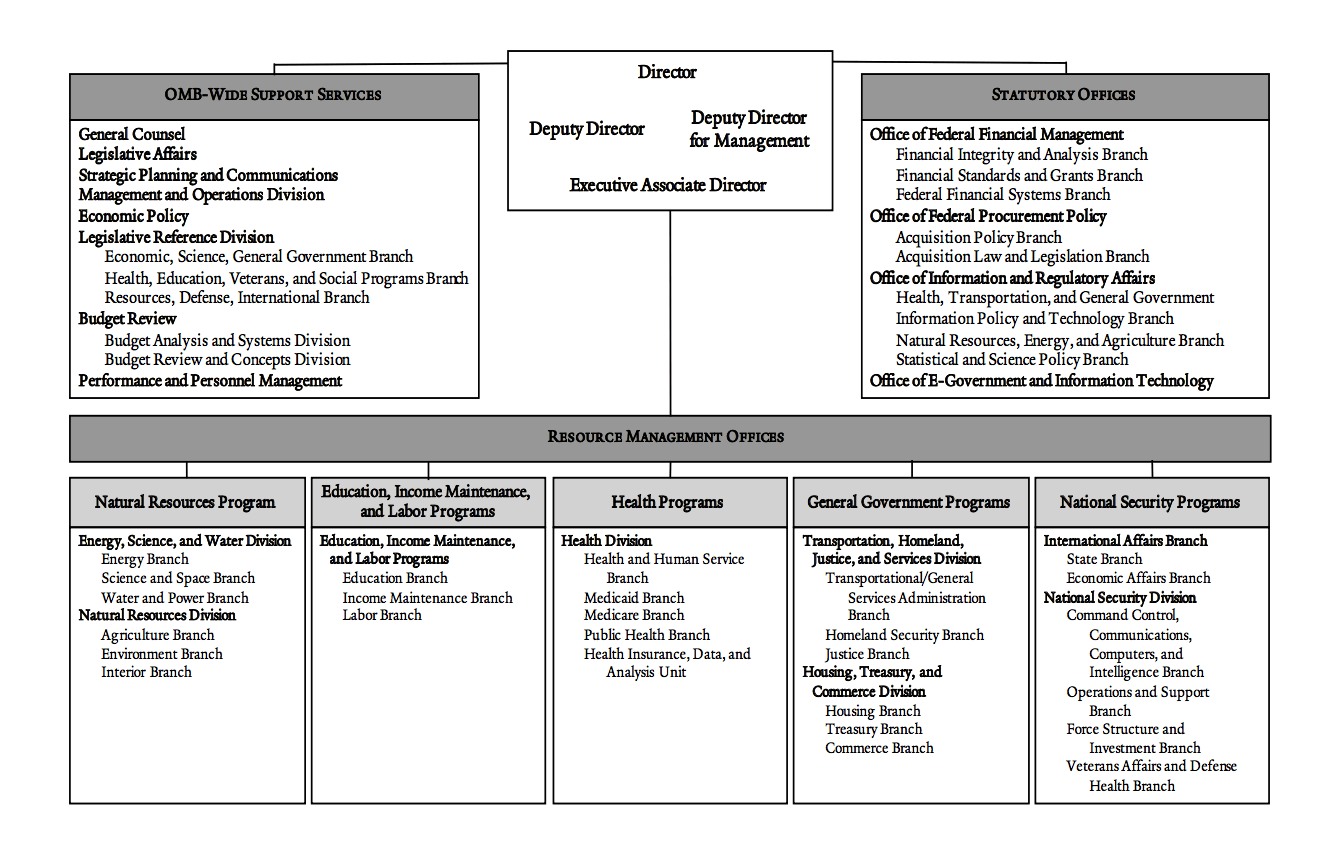
Most charts that depict the structure of OMB tend to place the RMOs in the center of the organization, and for good reason. By shaping the entire federal government’s budget, Resource Management Offices inevitably shape governmental policy and governmental regulations. Stated simply, the RMOs, composed of about 200 employees split across five distinct offices, are the backbone of the OMB’s activities and influence on all governmental policy.
To understand the Resource Management Office’s powers and capabilities, it’s worth going into some of the specifics about the hierarchy and divisions within the RMOs. So bear with us as we somehow dig up even more staff names and acronyms to clutter this article with. We promise that it's necessary!
In order to shape the federal government’s budget, the OMB needs detailed knowledge about the functioning and needs of individual administrative agencies. Each RMO is tasked with collecting such information and becoming knowledgeable about agency activities. As discussed in our first memo piece, there are currently five Resource Management Offices. Those are “Natural Resource Programs”, “Education, Income Maintenance and Labor Programs”, “Health Programs”, “General Government Programs”, and “National Security Programs”. Leading each office is a presidentially-appointed figure known as a Program Activity Director, or PAD. Below each PAD is one or two Deputy Associate Directors (or DADs) who oversee a more specialized division. (Yes, they really do call them “DADs”.)
Whereas the PADs are political appointees, the DADs are long-term civil service employees who tend to remain in place even as presidential administrations change. Below these leadership positions is an impressive army of “program examiners” split across the five offices. Program examiners are the career employees tasked with developing the most granular and intricate knowledge of their assigned functions. An examiner might be assigned to oversee a component of a large agency, multiple small agencies, or some combination of the two. During their time at OMB, the examiners are expected to become experts on their assigned fields—-knowing everything from the history and functions of their agency, to its current staff, and budget numbers.
It is with this knowledge that the RMO staff aid OMB in the execution of the office’s various mandates. In formulating the president’s annual budget, for instance, much of the technical, quantitative budget work is handled by the Budget Review Division (BRD), an entity separate from the RMOs. It is the Resource Management Offices, though, who provide data to BRD so that their work can get done. And more than that, when it comes to actually settling on the final budget numbers to submit to Congress, it tends to be the RMO staff that call the shots. It is this shot-calling ability that makes the RMOs so powerful.
As a quick summary then, we can understand the chain of command within OMB to go as follows (from bottom to top):
Program examiners → DADs → PADs → OMB senior leadership
The senior leadership constitutes the Director and Deputy Director(s).
As we will get into later, the people at the top of the hierarchy are (obviously) the ones with the most power, but the high expectations, responsibilities and discretion placed into the hands of program examiners means that even the lower level staff have a considerable amount of power and leverage in the federal government. James Miller, who was head of the OMB for three years in Ronald Reagan’s second term highlighted in an oral interview with University of Virginia's Miller Center the tremendous power Program Examiners have:
It’s the same dealing with Congress. A budget examiner at OMB can undo a congressman and they’ll never know what happened. It’s like a knife in the back: they’d never know where it came from. It’s the same with an agency. The OMB people, all the way down to the budget examiner level, have great power. I know enough about the tax code that I could go in there and fix it so the government would get another 20 billion dollars a year and nobody would know where it came from. [emphasis added]
A terminological note: in 1994 “budget examiners” were renamed “program examiners”, which reflects the increased desire for examiners to also serve a role in the development and implementation of regulations. Indeed, this name change also implicitly reflected the ever increasing role of examiners in policy.
However, in spite of this tremendous power, almost nobody talks about examiners and the RMOs outside of academia and various oral histories like the one referenced above. And even among legal scholars who discuss OMB, most attention goes to OIRA, the regulation-focused counterpart to the RMOs. Georgetown law professor Eloise Pasachoff is among the few scholars to have written extensively on these more “obscure” parts of OMB.
Now that we’ve established what the RMOs are, though, it’s time we explore how they influence policy during the formulation of the president’s budget. But wait … what exactly is the president’s budget?
The President’s Budget
As discussed many times in Notes on the Crises coverage of the second Trump administration, it is Congress that the Constitution ordained with the power of the purse -- not the president. And for much of American history, it was Congress that worked directly with individual administrative agencies to construct the annual appropriations bills piece by piece. This fundamentally changed in 1921 when the “Budget and Accounting Act of 1921” became law. This statute created the Office of Management and Budget’s predecessor, the Bureau of the Budget. Through the Bureau of the Budget, Congress gave the executive branch a much greater role in the budgetary process. Today, before Congress even begins their annual budgeting process, they wait for the president to send his budget ideas first. For the past 50 or so years, OMB has been the office tasked with working with individual administrative agencies in the formation of the President’s proposed budget.
To be clear, the president does not have the power to determine how much “budgetary authority” is appropriated to each part of the government in a given year. The annual budget that the president presents to congress is — technically speaking — nothing more than a formal suggestion which lawmakers have no obligation to follow in constructing their own appropriations legislation. Nevertheless, it is the president’s budget that sets the standard for how much the agencies can expect to receive in a given year. Furthermore, the more political alignment there is between the executive and legislative branches, the more closely the final appropriations might mirror the budget proposals submitted by the president.
For a great deal of our modern budgeting history, the president’s “suggested” budget deficit has formed a de facto “ceiling” for congressional government spending, with the Congressional budget often opting to spend below this “ceiling”. This standard-setting power has become a little less true lately, as divides between the president and congress have intermittently spiked in recent years. But even now, passing appropriations with spending figures way above the presidential suggestions has remained an enormous political challenge. That the president has the power to veto appropriations bills he doesn’t like only adds to the de facto “bindingness” of the president’s de jure non-binding presidential budget.
Which brings us back to the Office of Management and Budget. The de facto power of the president’s appropriations requests “on behalf of” individual agencies makes the interactions with OMB during the “budget preparation stage” an extremely high stakes process. At a superficial level, you might think that the heads of individual agencies (especially those in the cabinet) would have a large voice in how big their agency budgets are. In practice however, program examiners wield enormous influence over individual agencies, despite being three levels down from OMB senior leadership.
For example, Greg Thielmann ended his career as a very high level State Department employee. He is most well known for publicly disputing the Bush administration’s rationale for invading Iraq after his retirement in 2002. However, he got his start as an examiner for the OMB. His description of being an OMB examiner in the 1970s is very revealing:
So I got a job that actually turned out to be a very good job as a budget examiner for naval research and development, which was a four billion-dollar line item, bigger than the entire State Department budget. That allowed me even as a young budget examiner to get very good treatment visiting the naval research and development establishment and even getting some tours of operational activities like P-3 patrols over the Atlantic and carrier landings off South Carolina. So for the next two years I worked as a budget examiner and learned a great deal about the budget process and defense activities in particular. [emphasis added]
An individual OMB examiner, at the age of 25 and fresh out of school, had enormous authority over a four billion dollar budgetary item, and was treated as a VIP. For context, 4 billion dollars in 1975 was 1.31% of the President’s entire proposed budget.
In short, it's not a stretch to say that “OMB Program Examiner” is the most important government job you’ve never heard of. It's certainly the most important government job you’ve never heard of that 20 somethings get shoved into. Whoops, it turns out there is a precedent for “Big Balls” after all.
If individual OMB examiners can have this much power, think about how much power OMB’s senior leadership has. In turn, consider how much power this puts under potential presidential control through centralization at the OMB. Indeed, up until this point, presidential power over fiscal policy through the OMB has predominately been limited by the forbearance of the presidency itself. Which brings us to the year(s)-long process by which agencies prepare budgets for executive consideration.
Budget Preparation
As it turns out, one year is not very much time to piece together a cohesive budget for an agency — let alone the entire federal government. As a result, the budgeting process for the following fiscal year … after the next one …runs concurrently… with the upcoming one. Now is a good time to remind/tell readers that the federal “fiscal year” runs from October 1 to September 30 of the following year. In practice then, the budgetary process for the “next next fiscal year” (please forgive us) begins almost immediately after the white house submits the “next fiscal year” presidential budget to Congress. Given the fact that the budgeting process for multiple fiscal years is ongoing simultaneously at any one point in time, things can get a bit confusing … to say the least. Are you confused? We’re confused too. And we’ve spent countless hours reading about this stuff. Next time you see us, buy us a drink.
We’ve made a (very simplified) table to map out where each budget process for a given fiscal year might be at various points throughout the year. (We also ask your forbearance for calling this monstrosity a “very simplified table”. We’re trying okay…)
Since we’re planning on catching up to current events, we’re explicitly using the coming fiscal years of the second Trump administration for this table but it applies to any given fiscal year(s). You’ll likely be seeing this table a lot as time goes on. We use the word “should” a lot in this table. Obviously, things often don’t go according to plan…Especially in recent decades of recurrent appropriations crises. Given the realities of Congressional inaction, read the table not as a history of what has happened during the first few years of the Trump administration but rather as a model for how budget procedures are/were expected to go if Congress met its own deadlines.
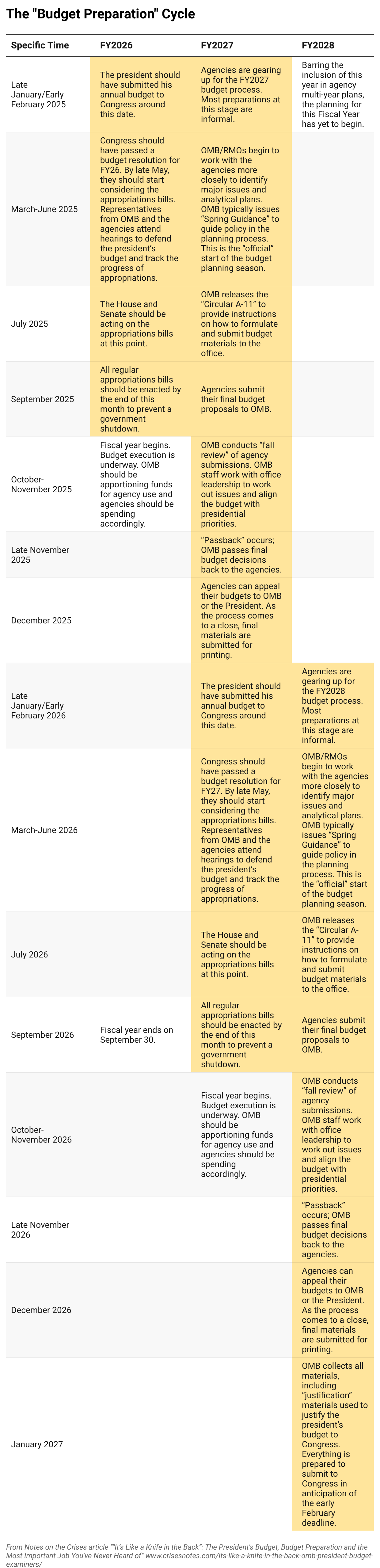
The “budget preparation” process as used in our breakdown today involves basically anything that happens before a final appropriation bill is passed, and an agency has its budgetary authority for the upcoming year legally codified. In the table above, that process has been identified by the yellow squares.
As you can see, the process to “prepare” the budget for one fiscal year itself spans well beyond a single fiscal year. In other words, the “official” budgetary planning for any given fiscal year is around an 18 month or so process, but the informal preparation can stretch it out to 21 months or more. This is because the “preparation” process involves everything from the earliest informal discussions about the next year’s budget to the high stakes debates, held right before Congress passes an appropriations bill. Consequently, OMB’s powers during this stage are sweeping and extensive. Unlike what we might see in the later-stage levers, much of OMB’s efforts in this stage manifest in the form of broad guidelines and policies, that shape agency requests well before anyone submits a document to anyone…And certainly well before a congressperson hears a word about the budget.
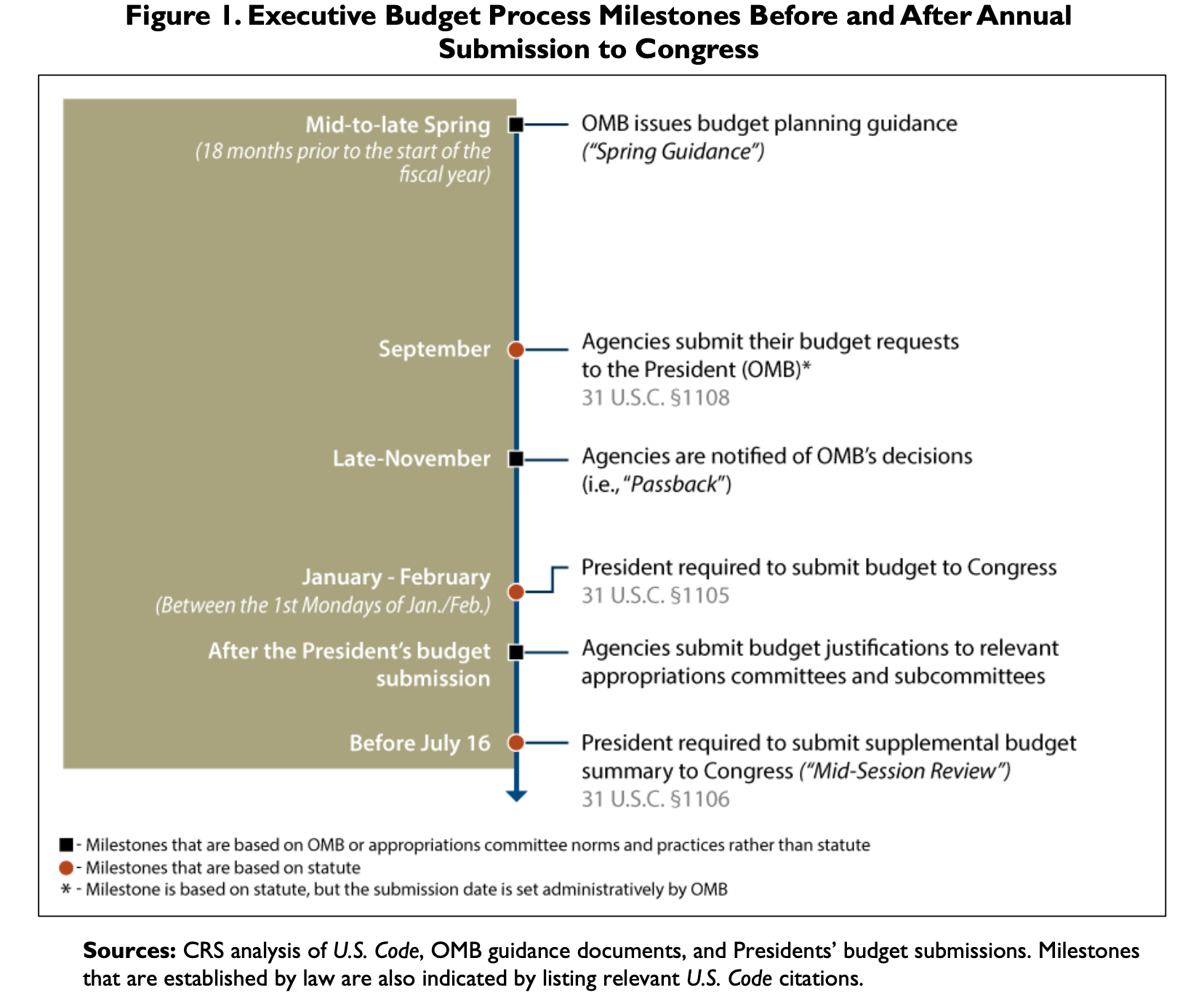
To provide a clearer sense of what this process looks like during the drafting of only one year’s budget, we’ve also included the above chart found in a Congressional Research Service brief. As discussed, the OMB spends nearly a year of the proposed 18-month process shaping the President’s budget proposal for the following year before Congress ever gets involved.
In this sense, the OMB is kind of like Marvel Films planning out blockbusters years into the future and congress are the film distributors who won’t get a preview of what's coming down the pipeline until the filming process is already well underway. While distributors may demand reshoots, this is the exception rather than the rule.
I hope we’ve already illustrated the Office of Management and Budget’s enormous power. In the next parts of this miniseries, we’re going to get into the specific “levers” that the OMB uses to shape budgets to their (or the White House’s) will.
Sign up for Notes on the Crises
Currently: Comprehensive coverage of the Trump-Musk Payments Crisis of 2025