
The Oil Market is a Conventional Wisdom Processor
I had so many thoughts about the run up to- and beginning of- the Trump-Iran war. My biggest thoughts were focused on how the ideas that I developed about the stock market as a “conventional wisdom processor” applied- or would apply- to the behavior of the oil market given Trump’s behavior.
Dear Editors: If you want to commission a simplified version of this piece, email me.
One of the most frustrating things about being sick this winter and spring is that I had so many thoughts about the run up to- and beginning of- the Trump-Iran war. My biggest thoughts were focused on how the ideas that I developed about the stock market as a “conventional wisdom processor” applied- or would apply- to the behavior of the oil market given Trump’s behavior. I was strongly confident that typical heuristics oil market experts use when thinking about “balance” in the oil market would not work well in understanding price dynamics in this circumstance. The forecasts I was particularly focused on were from the people Bloomberg’s Joe Weisenthal referred to as “barrel counters”, those who try to project oil price changes from inventory changes. One such “barrel counter” is my social media mutual Rory Johnston.
Rory Johnston in particular made a bold forecast of $200 dollar oil prices early on in the Trump-Iran war and then returned to Odd Lots recently to explain why his forecast went wrong (I will publish a transcript of this conversation later this week, perhaps Saturday). I swear, by the way, that I started writing this piece before I got booked for my Odd Lots appearance with Lev Menand last week.
Anyway, his later interview accords with my “conventional wisdom processor” view, although of course he knows 1000 more technical details about how the oil market than I will ever know. What I think I have to bring to this conversation is a different analytical vision to understand what’s happening. Alas, there is nothing that hurts a writer more than thinking you have an important opinion that sharply diverges from the informed common view and being too ill to put that analysis into writing. I can’t get credit for the opinions I didn’t express- nor should I. Yet they weigh like a nightmare on my brain. So we’re finally going to get them on paper today,
My thoughts on this are defined by my longstanding interest in the economist Gardiner Means’ work on “administered prices”. Some readers may recall that my commentary on Covid and “Post-Covid” inflation has been fundamentally defined by the distinction between administered and non-administered prices. To recap, administered prices are prices that are set for a period of time and series of transactions by some entity, usually businesses. Typically, these markets are “Price leadership” markets where competitive interaction between an often “dominant” business and “non-dominant businesses” leads to “price leaders” and “price followers”. You can read more about this in my 2021/2022 paper coauthored with Law Professor Luke Herrine. The biggest weakness in the literature I have been contributing to-in my view- is insufficient work on how non-administered prices work.
That’s why I began working in 2023- in the midst of many, many projects- on a paper provisionally entitled “Theorizing Non-Administered Prices Without the Price Mechanism: Reexamining Gardiner Means’ ‘Administered Prices Thesis’”. This is a very ambitious paper that is about half-written. Hopefully I will get it fully written and published in the next four years. But for now, I’m drawing on thinking I developed in this paper in this piece and everything else I write about the Oil market- or indeed commodity markets in general.
I’m not going to belabor the theoretical motivations behind this paper or my analysis but briefly put, one of the major themes of this rethinking is to nail down in conceptually clean and coherent ways exactly what a “supply and demand” theory of prices would or could mean. This is surprisingly difficult because people utilize the phrase “supply and demand” in thousands upon thousands of different- and mutually inconsistent- ways. For the purposes of this piece- and to let “supply and demand” put its best foot forward- I’m going to say that
- “Supply and demand” is in balance when the quantity demanded of “end users” is equal to the quantity supplied by producers.
- Prices are “supply and demand” determined when “imbalances” between the demand of end users and the supply of producers are resolved by price changes.
I use the term “end users” because the typical choice to refer to those seeking to purchase a good or service as “consumers” biases people to think about markets in terms of individual consumer markets. But there are vastly more markets for commodities, intermediate inputs, investment goods and government goods than final consumer goods.
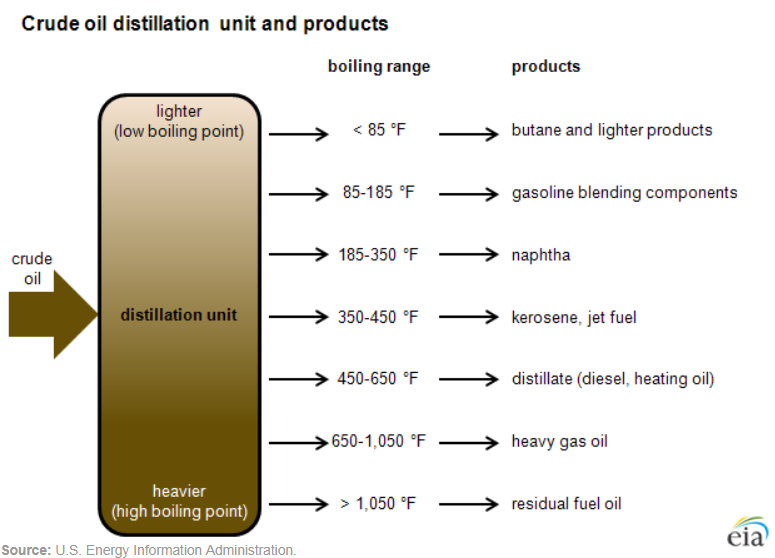
Most obviously, the market we are discussing today is the “crude” oil market- a market for a commodity which is an “input” to the oil refinement process which leads to a variety of other intermediate goods and services (see the graphic above). Ultimately, of course, retail gasoline is made out of oil. But price determination in retail gas markets is a whole other story. The ultimate point is we are focusing on a specific subset of purchasers and sellers and this is a key global input to many, many production processes the world over.
It's important to keep in mind that, whatever one’s theories or beliefs about how prices are determined, the physical quantities produced and utilized in production must balance over some time horizon. Indeed, it is this clear fact about the world which gives various systemized or “folk” supply and demand theories of prices their intuitive plausibility. As a matter of fact, the “inability” to store inventories of electricity and the crucial necessity for “real-time” physical balancing of electricity grids which attracted utopians seeking to create “spot” electricity markets with “incremental cost pricing”. But that’s a story for another time.
Putting aside those utopians, the “physical reality” of an electric grid is important to pause on for a moment to help clarify our thinking. Why does “physical” electricity demand need constant real-time balancing with electricity supply? Simply put: because if it doesn’t have it then the grid will overload and there will be a rolling blackout (or worse). The painless way to keep an electricity grid balanced is to produce more power. In recent decades, and the advent of various “smart” technologies, there has been increasing attention to “demand flexibility”. These work by balancing certain kinds of electricity demand with reductions in other kinds of electricity demand. Note though that these are supposed to work by shifting down electricity demand from sources that “won’t miss it” (such as an EV that can charge at night).
Regardless of how the electricity grid is physically balanced, it needs physical balancing to stop it from breaking. The electricity grid is one of the most “mission critical” systems we have. Demand for energies in “non-electric” form also needs to be physically balanced, but that physical balancing does not have the same “real-time” urgency of an electricity grid. Nevertheless, it does need to be physically balanced over some time horizon.
Furthermore, one way this “physical balancing” happens is through order backlogs- increasing orders that stack up waiting for a supplier to deliver. However, since our piece today is about oil prices we have to set aside order backlogs for now. This will certainly be a subject of a future piece. The price determination process in the oil market makes growing order backlogs a sign of instability rather than a stabilizing force. Administered price markets, by contrast, have far greater scope for “strategic” use of order backlogs. When you assume away order backlogs, oil markets must consistently physically balance.
However, physical balance is different from “supply and demand balance” as I’ve defined it above. In particular, inventories can be accumulated or “disgorged” by a variety of market participants while the quantity demanded by end users remains below or above the quantity supplied by producers. In other words, the oil market can be “physically unbalanced” while “supply and demand” (as defined above) is in balance. Conversely, the oil market can be “physically balanced” while “supply and demand” is imbalanced.
For there to be some type of “price mechanism” in the “systemized” theoretical sense there must be, as the late great microeconomist Fred Lee constantly emphasized, a “law-like functional relationship between price and quantity”. The existence of administered prices already “delimits” the set of markets in which some type of “price mechanism” might operate. Administered prices do not balance “supply and demand” and price setters don’t set prices in order to accomplish that goal. I.e. administered prices are not, nor are they designed to be, “market clearing”.
The real challenge- the holy grail so to speak- is undermining the existence of such a “law-like” relationship in non-administered price markets. In other words, “even” exchange traded prices do not “clear markets” i.e. balance the quantity demanded by end-users and the quantity produced by producers. Nor are they designed to, despite various price heuristics market traders use which I discuss below. In theory terms, this is easier if we rephrase our point of contention as the existence of a “law-like functional relationship between (relative) price and (relative) quantity”. But that brings up too many theoretical issues that are far afield of the current piece.
For our purposes today, we are going to stick to oil quantities and monetary oil prices. This also stacks the deck in favor of “supply and demand” theories of oil prices, though not necessarily the “systemized” ones.
Anyway, the key question is this; What are the other factors bringing physical “balance” to the oil market?
Which brings us to the Trump-Iran war itself. What makes this war so interesting is that the closure of the Strait of Hormuz has, for so long, been the “doomsday” scenario where massive quantities of produced oil are suddenly taken “off the market”, leading to a huge imbalance between the demand of end users and "accessible" oil production. If any scenario was supposed to lead to eyewatering oil price increases, it was this scenario.
Is it any wonder that our friend Rory Johnston, one of the best “barrel counters” around, felt confident predicting $200 dollar barrels of oil? This is not what has happened. As of this writing the peak Brent Crude price was $118.03 dollars while the current price is $72.24 $80.95 $83.80 dollars. This is despite the fact that the United States is again imposing a naval blockade of the Strait of Hormuz and bombing Iran. Indeed, as of this writing Trump has claimed that he will be imposing a “20% Toll” on ships passing through the Strait of Hormuz.
Being a thoughtful and reflective person, Johnston has spent much of this war thinking about what “went wrong” with his original position. In his reflection we get valuable insight into how the oil market has been “physically balanced” so far. Crucially, we also learn why the underlying trends- and declining inventories- haven't kicked prices ever higher. It is in these explanations that I see the strength of the “conventional wisdom processor” view in understanding the oil market. Let's start with his analysis of what I would call the “physical balancing” of the market.
It turns out that the core of the story is China. That is, China’s astounding collapse in demand for imported oil:
We always knew China had huge stockpiles of oil, but we didn’t know how it would react to this crisis. What we’ve seen is that Chinese crude oil imports, China being the world’s largest crude importer, fell by upwards of five million barrels a day, comparing the three-month average before the war to June. We’re not quite done with the month, but that’s roughly where we’re trending. That five million barrels a day was upwards of half of the total spot-market supply hit to Asia. That allowed the other Asian importers to avoid the competition for barrels they otherwise would have faced.
It turns out demand flexibility isn’t only for the electricity grid!
How did China accomplish this feat? I strongly recommend listening to the Odd Lots episode, or reading the full transcript Notes on the Crises will publish soon. For our purposes today, however, these excerpts from Rory’s commentary will suffice:
China doesn’t publish official demand data, and importantly, it doesn’t publish official inventory data either, so we’re left feeling around in the shadows. [...]
The one thing we can say: the crude oil inventories we can observe, the floating-roof storage tanks of crude oil, are still very high, roughly where they stood at the beginning of the crisis. [...] The caveat is that satellite analysis can’t see into underground storage caverns, where China’s actual SPR (Strategic Petroleum Reserves) sits: six known caverns, holding roughly 131 million barrels. [...] So we’re feeling around the shadows for the Occam’s razor here which is that they’ve been silently releasing additional crude inventories. [...]
But we have almost no firm information into those stock levels [of refined petroleum products] and cannot track them closely on a daily or weekly basis, because unlike crude they don’t sit in floating-roofs. [emphasis added]
In other words, we don’t really know.
Thus, one of the most interesting conceptual points that we can derive from Rory’s commentary on China is that the rest of the world does not have insight into how much of China’s collapse in orders for imported oil comes from a genuine and sustainable reduction in the demand of end users and how much has come from releasing state-owned oil inventories that oil market participants have less insight into. In the framework we’ve developed so far, this means there is uncertainty over whether China has merely “physically balanced” the oil market without reducing “supply and demand imbalances” or whether they have been reducing physical imbalances by reducing supply and demand imbalances.
This example highlights how much of the “supply and demand price theory’s” price determination role comes from norms and perceptions of sources of oil production and oil demand rather than a straightforward reflection of what’s going on “physically”. Newly published data about the areas of China’s economy that Rory says there is not “firm data” on would greatly impact oil prices and oil trading despite the fact that publishing data doesn’t actually change the underlying “physical facts” that they describe.
The tricky thing to capture about the difference between the “conventional wisdom” view and the “supply and demand” view of oil markets is that the former incorporates the impact of market participants and analysts “supply and demand” mental models on the exchange traded oil price itself. In plenty of market periods the distinction between these two views of chartered exchange market price determination may come off as merely academic. In an extraordinary situation like the current(?) war, the distinction is very much not academic. In other words, when the “supply and demand” mental model is dominant among traders and there is a shared understanding for what that implies for oil prices, oil prices move where that mental model says that it “should”. Differing beliefs and differences in knowledge among market participants can add “volatility” and “deviations” from one particularly informed trader’s view of the “S&D theory” price. But it shouldn’t be surprising that market participants can come to believe that the “actual” market price will converge to the “S&D theory” price. The difficult to grasp point is that their shared belief is what generates this outcome- when it is actually generated- Not the correctness of the theory itself.
Indeed, at times when there just aren’t very pronounced imbalances between the quantity demanded by end users and the quantity produced by producers this mental model may not be a significant determiner of prices at all. In other words, “supply and demand imbalance” may be minor and easily managed over the course of many years. We only test the importance of supply and demand imbalance to prices when we actually experience major supply and demand imbalance. Other “fundamentals” may be transmitted from the mental models of market participants to prices. The most important type of “fundamental” that may be transmitted is production and transportation costs.
It's important to make clear that this is not something I’m projecting onto oil traders and analysts. Johnston himself articulates this point in his own terminology and refers to what I call the “S&D theory price” as the “fair value” price. Johnston describes it this way: “. When you think about fair value in this market, it’s really about the relationship between inventories and prices.” Many different valuation methods may produce prices consistent with physically balancing the oil market. Or, in other words, there isn’t a … law-like and functional relationship between monetary oil prices and oil quantities.
The physical balancing of the oil market is a necessary condition for market stability but it is not a sufficient condition. To say that prices and quantities are structurally disconnected in commodity markets requires separately establishing how prices are being determined. Given the importance of the “fair value” price to current market participants, we still have to explain why they haven’t produced prices that someone like Rory Johnston initially expected. In this, Rory characteristically provided quite helpful insights (in a future piece I will provide broader background on how price determination in the oil market works and has evolved since the 1970s “OPEC” crisis).
Over the course of this conflict the “supply and demand price” mental model has produced not one benchmark price, but two (okay, probably a lot more than two, but let me simplify). We can call these the “opened Hormuz” price and the “closed Hormuz” price. The very fact that on any given day, or even any given hour, the chances of the war’s end fluctuates in the perception of market traders creates instability in which “fair value” price anchors market trading. To take market positions based on the “closed Hormuz” price and then face an “opened Hormuz” means losing potentially gigantic amounts of money. Market traders have regularly been caught between these two benchmarks this year.
Anyone paying attention can tell that the Trump administration is very aware of this and clearly has been timing their actions and rhetoric to create optimism at the beginning of a week and only intensify conflict- such as through bombing- when markets close during the weekend. It's in fact notable that Trump chose to escalate conflict on July 13th, a Monday. Putting aside recent developments, for months there has been a farcical dynamic where the “fool’s gold” of a quick end to the conflict kept on being offered week after week after week.
Yet, what Trump did worked.
Specifically, the “fools gold” Trump kept on offering created lots and lots of “downside volatility” which hurt traders who were confident that the “closed Hormuz” fair value price was the likely benchmark that actual market prices would move towards. It's not simply that these traders took losses and made decisions to pull back. The very volatility in the market, particularly on the downside, triggered internal risk controls which limited the positions that these financial firms risk departments would let them take in the oil market. This is exactly what led to market dysfunction when Trump caused such an explosion of volatility in the aftermath of “Liberation day”. The similarity is so striking, in fact, that I wonder if there are Trump advisors who observed what happened last year and intentionally tried to recreate the same dynamic, in a controlled and more useful way, in the oil market. Of course, it could just be dumb luck.
Rory Johnston has heard directly from oil traders confirming that this has been the dynamic:
They [oil traders] have their own models that show them fair value. They keep saying all their models say this is a raging buy, but they got so blown out repeatedly in that kind of March and April period, all their risk management limits have been throttled down by 90%. The quote was, "Everyone's bullish, but no one's buying." And I think one thing I also deeply misappreciated going into this crisis was the potential power of Trump himself, more broadly Trump administration, to inject so much downside volatility that it kind of arrested the normal melt up process. [emphasis added]
There is another important conceptual point that comes out of this. If oil prices were going to rise anywhere near Rory’s prediction, it wasn’t going to happen because of end users' purchase orders and producers' offers to sell. After all, the market was being physically balanced. Instead, it would be through general market “bids and asks”. Eye-wateringly high prices were not going to be produced in a “hydraulic” manner: it required speculation. That is what financial firms and traders taking “net long” positions means. Taking a “net long” position means making a speculative bet on the future direction of oil prices (obligatory acknowledgement of hedging here).
Recall that in basic textbook supply and demand curves, speculation is ruled out by assumption. In the real world bids do indeed periodically greatly raise exchange-traded prices. Asks (financial market terminology for offers to sell) do periodically dramatically drop exchange-traded prices as well. However, the difference between end-user purchases (or producer sales) and bids (or asks) on organized exchanges makes it quite clear they are quite different and the differences between them matter a great deal. I want to emphasize this point. The vast majority of participants in these markets are not end users or producers. They need a very specific set of incentives for their speculations to move in the same direction as “supply and demand imbalances”.
To summarize then, what has been happening is that the oil market has been physically balanced- seemingly mostly by China’s changed behavior- while Trump’s masterful orchestration of oil market trading has helped discourage speculation on higher future oil prices. As Rory rightly says in the interview, neither factor would be sufficient for keeping oil prices down but both together have been a powerful engine to keep oil prices down. The key, then, is to understand that there is a physical limit to how much a “supply and demand” imbalance can be papered over without being alleviated. We also don’t know how much China has actually managed to suppress end-user demand for oil imports. Furthermore, we don’t know how much of that “suppression” is sustainable.
If or when the oil tankers “run dry” and there aren’t enough oil barrels in “circulation” to fulfill oil contracts outside of the “cash settled” oil markets, both “physical” and “financial” aspects of the oil market will freeze up and break. In other words, “cash settled” market trading can dominate price determination right up to the point that sustained physical imbalances start breaking down the basic mechanics of market functioning. Where that point is is, however, not obvious.
It's also important to think through the mechanisms by which oil market prices can potentially balance “supply and demand”. Mild and gradual monetary price increases may slowly reduce the demand of end users or encourage more production by producers. But these incentives are just that: slow and gradual. They also may be short-circuited by a variety of market dynamics. Demand reductions by end users also typically involves reorganization of production (such as acquiring and installing renewable energy ‘plants’). The reorganization of production in response to monetary price changes has all sorts of knock-on effects that don’t appear in the benchmark models which exploit our intuitions.
Nevertheless, price increases may move to cause immediate physical balance. If a particular monetary price goes high enough, quickly enough it can “choke off” demand from end users. Think of how disruptive such an adjustment process would be. What basic economic activities would go away in order to make such end-user demand reductions for oil possible? We are clearly not talking about a smooth and stable process. This is not the economics of equilibrium, it's the economics of crisis. It's to our benefit that even exchange traded markets like oil are primarily balanced by “non-price” mechanisms. Rory’s $200 dollar oil would be a crisis, not a return to equilibrium. Let alone even more stupendous oil price increases.
It also is clear from this that even with all the ways we stacked the deck in favor of “supply and demand theories of price”, non-price adjustments dominate. The exceptional moments where monetary prices actually adjust to rapidly balance supply and demand are crises. In mainstream economics terms it is the so-called “income effect” which is doing the work. In other words, just as administered prices don’t “clear” markets and aren’t designed to, non-administered prices don’t “clear” markets and aren’t designed to.
What oil market participants- and people the world over- are learning is that the “social” limits on oil prices remaining aloof from supply and demand oil imbalances are much closer to physical limits than was commonly realized. In closely examining how the oil market has functioned during the Trump-Iran war we see how these markets are “conventional wisdom” processors, not information processors. We also see how a unitary executive imperial presidency in the hands of someone like Trump makes conventional wisdom, as understood by market participants, so bendable to Trump’s will.
I don’t want to leave readers with the impression that $200 dollar oil is impossible. If speculators find the balance sheet space to take sufficient “net long” positions through their risk internal controls, and/or China no longer brings the oil market into physical balance, this may yet happen. This is an empirical question. What the conventional wisdom processor view helps us understand is why this hasn’t happened yet and what dynamics could prevent it from happening even as this war drags on and on.
Sign up for Notes on the Crises
Currently: Comprehensive coverage of the Trump-Musk Payments Crisis of 2025