Notes on the Crises on Bloomberg Odd Lots: Lev Menand and Nathan Tankus on Why Fed Independence Is Now Hanging by a Thread
Last August, President Trump made the unprecedented choice of moving to fire Fed governor Lisa Cook
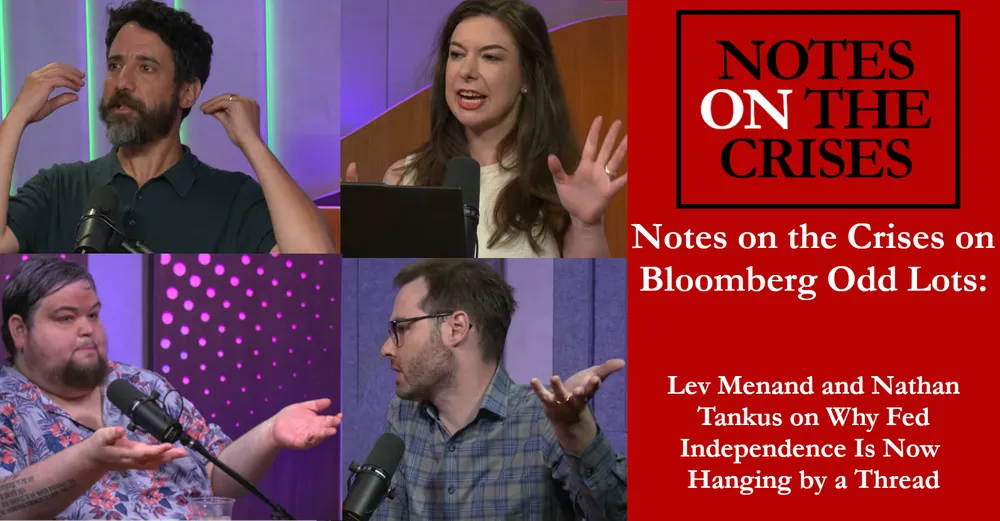
Thanks to Joe and Tracy for having me on and thanks to Lev Menand for joining me on Odd Lots. I think this conversation documents, in a comprehensive manner, the tensions and complexities coming out of the Supreme Court’s adoption of “Unitary Executive Minus the Fed” Theory. Thanks also to Odd Lots for letting me take the rough transcript and clean it up (with thanks to Juan Hanes for taking the first pass on short notice).
Listen to Odd Lots on Apple Podcasts
Listen to Odd Lots on Spotify
Watch Odd Lots on YouTube
Last August, President Trump made the unprecedented choice of moving to fire Fed governor Lisa Cook. The administration claimed she was being terminated with cause, citing an ongoing investigation in alleged mortgage fraud committed by Cook. The legal battle between Cook and the administration has been tangled in the courts for the last year, eventually reaching the Supreme Court. This June, in a 5-4 decision, the court ruled in favor of Cook. However at the same time, in a different case, the court allowed the President to fire individual members of the FTC, undermining its role as quasi-independent body not beholden to the executive branch. So what are the implications here? How can the court change the status of a body like the FTC while allowing the Fed to continue operating as is? And for how long will the Fed maintain some amount of operational autonomy? On this episode we speak with Columbia Law School's Lev Menand who just wrote a piece on these two cases for Just Security called The Federal Reserve Exception to the Slaughter Rule as well as Nathan Tankus [See “Agency Independence in One Agency: Humphrey’s Executor is Cowering in the Basement of the Eccles Building”]
(writer and president of Notes on the Crises). The two of them lay out the consequences of these two decisions and they dig into the generations-long legal history, starting with Alexander Hamilton, that explains how we got here.
Tracy Alloway (00:23): Joe, let me ask you a personal question.
Joe Weisenthal (00:27): Go on.
Tracy Alloway (00:27): Is Alexander Hamilton always right?
Joe Weisenthal (00:31): I doubt it. I have not read the complete works of Alexander Hamilton. My main knowledge of Hamilton [Tracy: is it the musical?] No, I was going to say my main knowledge of Alexander Hamilton is Christian Parenti’s book, Radical Hamilton. But I've also watched the musical and let me state at the outset my most controversial opinion. So when that musical came out, a lot of people really liked it. And then a few years later, everyone's like, "Oh, this is Lib and Cringe." It's a good musical and it's time for people to set aside everything else. It's time for people to accept that in the category of musical theater — which I get is not to everyone's tastes, and I have some strong opinions on how much of it is bad — it is an upper decile or upper, what's the five one? Quintile musical.
Tracy Alloway (01:22): Hamilton being a great musical is going to be the most controversial opinion [Joe: I know, that's right] in this entire episode. But the reason I bring it up is because a couple of things have happened recently with the US government. So we had a Supreme Court decision that basically turbocharged the president's ability to fire heads of agencies, right? And then we had another Supreme Court decision that basically carved out an exception for the Fed. This is where Hamilton comes in, while citing the history and tradition of the independence of the Central Bank, Hamiltonian theory and all of that.
Joe Weisenthal (02:02): Right. I think a lot of people, even before this decision — and we did some discussions about this — have this view. It's like the Fed is different because the Fed is different. That it's like, yes, legally or sort of on a formal written status, why should it be different than the FCC or the FTC, et cetera. Looks the same.
But a lot of people have this intuition that the Fed is different because it's different. But when you're making laws, you sort of have to write something down in theory to establish that — in one of the things that was stated in the decision so that Trump couldn't easily remove Lisa Cook, which was really all it said — they sort of wrote down the thing that makes the Fed different. And one of the things they say is it has a tradition going back to Alexander Hamilton.
Tracy Alloway (02:54): Right.
Joe Weisenthal (02:54): The Hamilton exception.
Tracy Alloway (02:55): Right. And I mean, on the one hand, I think you're right that a lot of people would argue that the Fed is different because the Fed does monetary policy and ostensibly you want an independent central bank. But on the other hand, the Fed does a lot of regulatory things that look a little bit more like an agency. So anyway, we're going to get into all the details of the case and what makes the Fed special, I guess, and why the president can now fire people at the FTC or the SEC, but not at the Central Bank.
We have the perfect guests. We're going to be speaking with Lev Menand. He is of course a Columbia law professor who's been on a number of times before. He also just wrote a paper called “The Federal Reserve Exception to the Slaughter Rule”.
Joe Weisenthal (03:40): There we go.
Tracy Alloway (03:40): Yep. And we're also going to be speaking with Nathan Tankus. He is the president of Notes on the Crises and has been writing a lot about the Fed and also government agencies more broadly.
Joe Weisenthal (03:52): And also a repeat guest.
Tracy Alloway (03:53): Also a repeat guest.
Joe Weisenthal (03:55): Friend of the Pod.
Tracy Alloway (03:56): Alright. So thank you very much for coming back on All Thoughts.
Nathan Tankus (03:59): Thank you for having me. And I want to make it very clear at the jump that I am in no way associated with Joe's opinions about the Hamilton Musical. It's horrible history. And by association, I'm not going to subscribe to the “musical itself is good absent the content” [perspective]. [Joe: I respect it]. Just chuck it all out.
Tracy Alloway (04:19): Lev, do you want to disclose your Hamilton musical opinions upfront?
Lev Menand (04:23): I went and I enjoyed it.
Joe Weisenthal (04:25): Okay. That's all you. Okay, that's it. That's it. Alright. No more. That's all. That's it.
Nathan Tankus (04:29): Hey, comp me a ticket and I might change my mind.
Tracy Alloway (04:31): All right. Why don't we just begin? We need a bit of context and background on this. So let's start with something called Humphreys Executor, which seems to come up quite a bit in these cases. What is it exactly?
Lev Menand (04:44): Humphreys Executor is a Supreme Court decision from 1935. Unanimous Supreme Court decision rejecting President Roosevelt's attempt to remove a member of the Federal Trade Commission without cause. And the court said “Congress passed a law", said “you can only remove members of the Federal Trade Commission for inefficiency, neglect of duty or malfeasance in office. And you don't have some inherent constitutional authority to override or ignore that law”.
Now, Roosevelt had reason to think he did. The Supreme Court had decided in a 1926 split decision [Myers v. United States] that the President was allowed to fire a postmaster without the consent of the Senate, which the statute required. And Chief Justice Taft wrote this long opinion saying the President has these inherent powers. And everybody interpreted that opinion to mean Federal Trade Commission, you could fire those people. And so Roosevelt was just like, "I'm doing what Taft said presidents could do.”
And the court was like, "No, no, no, no, no. That's okay for a purely executive officer, but we're going to cabin that Myers decision. And if the agency or the government official has functions that are “quasi-judicial” or “quasi-legislative”, like the Federal Trade Commission and like a whole bunch of other agencies, then it's totally appropriate for Congress to put limits on the President's power to remove these officers. And the President doesn't have any inherent constitutional authority."
Ever since that decision, the presidentialists have been aggrieved. Humphrey’s Executor, it unfairly limited Myers and this conception of this sort of President who can oversee the whole executive branch. And in a way, what we're experiencing is the great victory of the anti-Humphrey’s Executor crowd who have been fighting to get back their version of Myers from 1926 all this time.
Tracy Alloway (06:51): Can I just ask really quickly? So the court decision back then, one of the things you hear is the reason you don't want the president to be able to fire heads of agencies is because you want some continuity with technical staff who are working at these things and you don't want a president who, for instance, I don't know, on the night that he's leaving office just decides to fire everyone for the incoming president. Did they cite public good or anything in their decision?
Lev Menand (07:22): I can't emphasize this enough. The Myers decision was radicalism and it was the court striking a sort of wild blow at Congress and at the rule of law to say that the president can just override these statutes. And Humphrey's executor was walking back something that the court really should have never done. And what's gotten sort of overlooked I think in recent years is the extent to which these bipartisan multi-member commissions, the Federal Trade Commission, these are lowercase c conservative institutions. They're meant to stabilize the law, to moderate the law, to prevent polarization, to allow people to make long-term investments. This is about our capital markets being attractive. And what we do here is we now mean that every four years you can get a major shift in policy. You don't see that anywhere discussed by the majority in the recent cases or by Taft in 1926.
Nathan Tankus (08:25): I do want to tackle that, the specific thing in your question. Basically what you're referring to is a kind of policy justification [Tracy: Yeah!] for insulating officers from direct presidential removal, but that's not necessarily the legal framework in which this is structured. Now obviously policy, it's inextricable. There are policy justifications for various things, but at root, it was the question of what legal powers does Congress have to structure things in the executive branch without just sort of the direct command of the executive branch? And to bring up that point about Myers and Humphrey’s Executor, this “quasi-judicial” language and “quasi-legislative” language was an attempt to kind of thread the needle between not fully overturning Myers, but getting the substantive policy thing that you would want to carve out and make that more limited. And in a lot of ways, that attempt to make a decision where what they wanted, where removal protections were "consistent with Myers", are in some ways why we're in the situation we are in today. And of course we can talk more about that.
Joe Weisenthal (09:46): One of the funny things about this conversation to me is like, okay, so we have these various governmental entities that sit somewhere between the legislative branch and the executive branch, and one of them is the Fed. Now it just so happens that in the world of economics, in the world of academic economics, there is a particular premium that academic economists play on so-called independent monetary policy. Is that just sort of a coincidence? I don't know. I mean, I imagine academics like the idea of all kinds of independent bodies that are outside the realm of “politics”. But it's sort of funny to me that the Fed does on some level sit in the same realm as the Federal Communications Commission legally. I don't think that there is the same degree of like “it is very important that from a functioning standpoint, communications regulation is independent”.
You don't hear that same sort of talk the way you hear from academic economists. Is it just sort of a fluke arrangement that the Fed sits in this sort of regulatory sandbox that happens to align with how many purely econ folks think the Fed should be set up?
Nathan Tankus (11:08): I don't think it's a fluke, but I don't think it has actually much to do with law. [Joe: Yeah!] I think it's an ideological thing. I think, as we'll get into in more of the conversations about “history and tradition”, there's this invocation of this longer legacy. And we, both Lev and I, have huge problems with this invocation. But nevertheless, it is true that there's these institutions —the First and Second Bank of the United States, the Bank of North America — that were founded, that had various things that insulated them from presidential- or even at times congressional control. And there's of course a huge history of these kinds of institutions, which people now look back on and call central banks, even though that wasn't the conception at the time in Europe. And economists are very familiar with those histories because they're proto central banks. So that's what's important in their minds.
And economists, if you're theorizing in the 1950s or 1960s, if you're Buchanan or any of these big economists, it doesn't occur to them to like, “maybe I should read administrative lawyers in terms of thinking about how these things are structured”. Economists always have this weird thing where they're talking about things that we refer to — but it's different. It's like a different thing in their models and they're just named the same. A central bank model [Joe: Yeah Yeah! That’s what I’m saying] in an economics model is very different than a central bank in actual legal reality. One of the things that I've really emphasized for a number of years about this point, up until these recent Supreme Court decisions, as a legal matter, the Federal Reserve had the weakest protections against removal of any of the independent agencies. And if you thought that economists cared at all about administrative law, that economists actually thought that these legal protections mattered, you would think that they would advocate for the strongest removal protections being at the Fed.
But no one ever cared because it was all this norm thing. In March 1951, two people each handshake, they release a press release called the “Fed-Treasury Accord”. And that's good enough for economists because for economists, it's all this sort of vague credibility stuff rather than legal institutions.
Lev Menand (13:25): I think an important part of the context here is the post-Volker shock development in the economics profession of a whole literature that says you need an independent central bank in order to provide monetary stability. And that literature was very influential. And the United States government spent decades and so did the IMF going around the world and persuading other countries to change their laws to make their central banks independent of their finance ministries.
And this is somewhat contingent that this literature created a bit of a dissonance that we were about to say, “actually this thing the United States has been promoting around the world for decades now? It's unconstitutional here in the United States”. This created an incredible dissonance. It's not to say that nonpartisan communications policy isn't important or that legal stability in our capital markets regulation by having a bipartisan commission structure for the SEC isn't important. It's just that there wasn't this enormous amount of academic attention and then sort of proselytizing globally about it. Nor is there much of a sense here, I think, that we already have a very political bureaucracy in the United States. In the Treasury Department layers upon layers of people are political appointments. And in a lot of our other advanced economies, it's just taken for granted that communications policy is done by civil servants by and large.
Joe Weisenthal (15:13): If I could just ask a quick follow up to that, one of the things that we've heard in the wake of the decision is that if Congress had known that the president would have been able to remove people at will or just automatically fire people from say the FCC or the FTC, they wouldn't have arranged these entities as they did. What was it about these particular realms? Because other agencies have regulatory responsibilities too, what was it about these particular realms where they thought it's particularly important that we have sort of co-equal ownership [by Congress and the Executive Branch] almost of them?
Lev Menand (15:53): So the first one of these independent multi-member regulatory commissions was called the Interstate Commerce Commission. And Congress created it in 1887. And Congress envisioned it as like a specialized court because up until that point, railroad regulation was enforced through the federal courts. You would have a bunch of statutes and then you would bring cases against the railroads and federal judges would decide them. And Congress was dissatisfied by the ability of generalist judges to adjudicate these disputes. They came to think “actually we need specialists who are experts in railroads who have some understanding of these complex modern markets who are going to develop the law”. That our common law-based system of economic regulation was obsolete. And that's sort of the germ of what became the modern American administrative state with these sort of court-like bodies. And so the Federal Reserve Board, which was created in 1913, is an Interstate Commerce Commission-style body for banking.
They're supposed to be judges of the banking system who have the ability to adapt the banking law to circumstances case by case in a way that wouldn't work very well if we were to use the federal judiciary and prosecution and have statutes cashed out in that manner. And that was how Congress actually came to this. And so communications —these are advanced economic sectors that need specialist judgment applied.
Of course, through the 20th century, these agencies evolved. They start to pivot towards rulemaking and they do less and less of their policymaking through adjudication, through case by case. “That's an unfair method of competition. Company X, let's have a sort of in-house FTC assessment”. They start to write general rules. And obviously we're very familiar now — like capital rules. That's like a big area where the Fed is active. But the stress tests you can think of actually as sort of this type of adjudication this body was set up for in 1913. Expert judgment: does this large bank have enough capital? And that was a judgment that Congress felt was quasi-judicial. Some can't be partisan, there's due process, but sufficiently technical that it wasn't something you wanted the Article III judges trying to figure out.
Nathan Tankus (18:41): I think what Lev brings up really highlights that economic motivations, and a belief that you're dealing with very advanced economic issues, has primarily been the driver for these multi-member independent commissions. And if anything, I would say that that was a weakness that people were especially motivated in that case and less motivated by, say, science having an independent framework. I wrote about this in a piece that only published last year, but I wrote for Lev in another publication in 2021 where if you look at 2020 or 2021, it's not at all clear that the independence of the Federal Reserve was more important than the independence of the CDC. If we're talking about credible commitments, about forward guidance, those ideas would have been much more helpful and much more important at the CDC than at the Federal Reserve at that time. And furthermore, as our experience at that time highlighted, the ability of, say, Fauci or whoever to speak fully independently of the president in articulating what the latest best science is — I mean, we're talking in a very literal sense, [saving] hundreds of thousands, potentially millions of lives; [That] is the difference.
Lev Menand (20:00): It’s great that Nathan brought up the science because if you were building the government from scratch, in light of the experience we're having right now in the second Trump term, you would think that the way we hand out NIH and NSF grants, which is critical to our research universities functioning, should be independent of partisan politics. But when it was set up, it's part of the executive branch. And so norms were undergirding that. And so no one had looked closely before at whether that was the right structure. And so the fact that the Fed had this structure that was like the ICC is somewhat historically contingent at the end of the day.
Nathan Tankus (20:43): Trump's a great stress test.
Lev Menand (20:44): Yeah. Stress test for the constitutional system.
Tracy Alloway (20:47): Before we go any further, let's just talk about the court's reasoning behind the carve out. Okay. So I'm going to put you on the spot and just ask you to summarize and then we can ask you a bunch of questions about why they went that way. But history and tradition, what did they mean exactly?
Lev Menand (21:05): So they have this case called United States v. Rahimi, which is a Second Amendment case. And —
Tracy Alloway (21:14): This is the crazy thing. There's like a gun case connected to the independence of the Federal Reserve.
Lev Menand (21:17): Yes, that's now the doctrine that is supporting the carve out. So last year, some listeners might recall, some court watchers might recall that there was this decision, Wilcox, where they gave us a single sentence saying, sort of indicating to the president, "We're kind of looking the other way as you remove all these other government officials, but the Fed will be different". And then that gave rise to the Cook case as a “for cause” removal. They've made some innovations since then. And the big innovation is to bring in Second Amendment doctrine. And the way the Second Amendment doctrine works briefly is that they understand the Second Amendment to be this absolute right to bear arms. And then the question is, well, there must be some abrogations of those rights. It's such open text. We can't possibly enforce it that way. How do we know when it's okay to abrogate that?
Joe Weisenthal (22:22): It’s like you're not allowed to own nuclear weapons.
Lev Menand (22:23): Exactly. Yeah. And so they say, "Well, we look to the sorts of regulations that took place in the founding period. And then we understand that those exceptions are okay." And so there's now Second Amendment jurisprudence has turned into this wild game with hiring all these early American historians and all these arguments about what type of firearm rules there were in the 1780s to try to decide what analogs Congress is allowed to have or states are allowed to have today. Nevermind that this is not how the Second Amendment was understood in the 1780s or any of that. This is all recent development in Second Amendment world too and has created all sorts of weird dynamics. Now the court's saying “that's how we're going to understand an exception to our new categorical rule in Slaughter that says the president can fire any executive officer”.
And basically everybody in the government is an executive officer, so they need an exception and they say, "Oh, we're going to look for... Is there an analog just like in our Second Amendment? Is there a history and tradition?" That's where the language comes from, from Rahimi.
Tracy Alloway (23:35):
Everyone to the library.
Lev Menand (23:37):
Everyone to the library. Is there a history and tradition of this? Okay. There's so many weird things about this, one of which is nobody looked to see if there was a history and tradition for the FTC in the Slaughter case. So they decide that without mentioning this. And then the Cook case, they're like, "Well, let's look to see." And then viola — here brings us back to Alexander Hamilton — voila, there is a history and tradition because Alexander Hamilton said independent monetary policy, that's very important. I mean, I have a lot of thoughts, but —
Tracy Alloway (24:08):
And we must do what Hamilton says.
Lev Menand (24:10): We must do what Hamilton says.
Joe Weisenthal (24:28): I have a sort of philosophical question. And maybe I'm going to ask you to put yourselves in the minds of these sort of executive branch maximalists and we should probably have one on. We will have one on at some point. But I understand what the letter of the law says in following the Constitution advice and consent of the Senate and so forth for all of these positions, whether we're talking about just normal cabinet level members or not. If you sort of take this sort of maximalist executive branchism, what is even the defense of the Senate getting to say, "No, you can't have that person be your Defense secretary. You can't have your person be your Department of Energy secretary." What even is the logic there at that point? If these are going to be true employees of the president?
Lev Menand (25:19): One real tension in what's known as formalist separation of powers theory is the fact that — and they can't really get around this — the Constitution is blending functions across departments as they would have called it back then, not branches all over the place. So you're mentioning the fact that the appointment's power by the plain text of the Constitution is shared with the Senate. It's a joint appointment. The Vice President of the United States, an executive officer, serves as the president of the Senate. The president can veto legislation all over the place. Powers are blended. Formalist separation of powers theory basically accommodates this by saying the constitution structure requires that these powers be completely separated except where it explicitly says they can be blended. And they can't really tell us —
Nathan Tankus (26:20): I feel like I can make a defense of this.
Lev Menand (26:22): Well, what's the defense?
Nathan Tankus (26:23): So **unitary executive theory, voice, mind, everything**. So yeah, the constitution says that we can't quite get around that, but all they're saying is the appointment is the appointment. So there is an entry. Of course, proper legislative supervision and what they are supervising is the entry. It would be absurd to say that once they've entered the executive branch and have become employees of the president, that the president can't remove them and fire them. Well, there is removal protection, but there is no principle where there's a formal process for the Senate to look over oversight of firing a cabinet head. So this is the only process we have. And the founders in their infinite wisdom decided that this was the proper role of the Senate in this process.
Lev Menand (27:25): Yeah. The tension is just that if you think that the president is there to check Congress by executing the law as the president sees fit and not as Congress forces the president, then you're going to experience a tension from the fact that the president can't make the appointments the president wants to help the president carry out the president's duty. The president is stuck getting the Senate to consent, otherwise that person can't serve. And that does reflect a sense that the President is not absolute in law execution. And you might think that it follows naturally that Congress can shape the executive branch through limits on removal. But that is what this court just said Congress can't do except for the Fed.
And let's just go back to it for a second. Because Alexander Hamilton thought independent monetary policy was important, which is true. But the huge mistake that they're making, just a fundamental logical failure here, is that the First Bank of the United States, which is what Alexander Hamilton was advocating for, was an investor-owned commercial bank. It was not in any way abrogating the president's rights to remove executive officers. Nobody at the First Bank of the United States was an executive officer. It's not a government body. It's not a regulator. It's not part of the government. The government originally subscribed to 20% of the shares, but then sold them. It was a private commercial bank. And so it's just a misapplication of the Second Amendment Rahimi analysis.
In the Rahimi analysis, you're looking for a restriction on gun rights that existed at the founding and trying to have an analog. There was no restriction as reflected in the Bank of the United States on the president's removal power over executive officers. Alexander Hamilton didn't want a government bank. And that in his report on a national bank, he says a government bank is a bad idea. We need an investor owned bank. And so they're misreading Hamilton.
Tracy Alloway (29:42): Well, on a related note, so Hamilton says that we need independent monetary policy, right? But I don't think he says we need independent banking regulation at any point in time because I don't think we really had a banking regulator back then.
Nathan Tankus (29:57): We didn't have banks yet!
Tracy Alloway (29:58): Yeah, exactly.
Nathan Tankus (30:00): Yeah. I mean, that's a really important point, though.
The first bank really is the Bank of North America, which is a state chartered institution that gets actually multiple state charters and stitches together a monetary power out of that. Very Articles of Confederation. That's another point. It was founded before the Constitution and you only start getting Banks of New York and all this stuff in the 1890s and you don't get general incorporation for state chartered banks until the late 1830s. [Editors Note: I misremembered here. The Bank of New York and Massachusetts Bank were both chartered in 1784. The main point stands because the special charter each of these banks were granted was the regulatory mechanism. These were more like state level versions of the bank of the United States at the time]
And so it's a total misunderstanding. And as you're pointing out, all sorts of things — security regulation, financial regulation — is cut out of history and tradition by virtue of just that that was the developmental point in the 1780s.
Tracy Alloway (30:49): Well, what I was getting at is, okay, you have this decision citing Hamilton on monetary policy. You don't have anything to back up the sort of regulatory aspect of it. So could we end up in a situation where someone ends up saying that actually the Fed has improper authority over regulation and not monetary policy?
Nathan Tankus (31:13): They're already saying it.
Tracy Alloway (31:14): Yeah.
Lev Menand (31:15): So there are people saying that. Here's the tricky situation. The Federal Reserve Board of Governors, which is the seven member multi-member commission that Congress created in 1913, which is a government body whose officers are principal officers of the United States who have limits on their removal that the president, the court has now said, has to respect. That body is not a bank. It has no balance sheet.
Nathan Tankus (31:45): Well, it does have a balance sheet.
Lev Menand (31:45): It does not have what we think of as the Fed's balance sheet. It can make no loans. It is a government agency and it regulates banks and it conducts quote unquote “monetary policy”, which is overnight interest rate policy. That's how the Federal Reserve pursues its section 2A mandate currently through regulation of the Federal Reserve Banks, which are government chartered banks, but they're nominally outside of the government. They're membership cooperatives owned by the investor-owned banks like JP Morgan Chase. So the Federal Reserve Bank of New York, that is a bank. That is outside of the government. The Federal Reserve Board of Governors, that is a government regulator, that is inside of the government. And all the board of governors does is regulate stuff. And so it carries out monetary policy through regulations and it also does bank regulations, but those are all monetary policy in a broader sense.
They're not used to adjust monetary conditions for macroeconomic reasons generally, but they could be. And so currently what the Trump administration is doing is relaxing the equity capital requirements on banks. This is stimulative. This is monetary stimulus. That's not why they're doing it, but it is stimulating the economy right now. And the court has no easy way out of that, which is why you have this weird footnote six in the Cook opinion where —
Tracy Alloway (33:22): I love weird footnotes.
Lev Menand (33:23): Yeah. There's a lot of great weird footnotes in these opinions. In footnote six, Chief Justice Roberts is saying, "Well, our exception for the Fed is as the Federal Reserve is currently constituted and with its existing enforcement authorities." Just to head off at the pass, the idea that, well, let's go power by power and see whether these are actually each power the Fed has consistent with Alexander Hamilton's vision. Because if you start doing that, things start to get really messy and confusing.
Nathan Tankus (00:33:56): And Clarence Thomas does that. I do want to pick up since you said the no balance sheet thing, and before we started, Tracy asked for really getting into the weeds. [Joe: Excruciating detail]. And this is a big hobby horse of mine, as you know, to really emphasize the point that Lev is making. So I cut in, well, they do have a balance sheet. And what I meant by that was, is technically speaking, the Federal Reserve Board and subsequently also the FOMC, is funded by assessments on the Federal Reserve banks. So you can kind of think of it as similar to the assessments for the FDIC fund, but instead of it being on commercial banks, it is on the Federal Reserve banks themselves. And so they have these assessments and they can determine the assessments wherever they want. And this is really actually really important because one of the most unique things about the Federal Reserve board is its complete autonomy from the appropriations process.
And the basis of that complete autonomy is when they want more funds, they have complete autonomy to raise the assessments on the Federal Reserve banks. Now formally, this is an assessment. You kind of think, “oh, we're just taking some money from here, taking from money there”. But if you think about it, the Federal Reserve Banks are creating money. And so whenever they hit an assessment and order up some more assessment payments, they're essentially directing the Federal Reserve banks to create money and credit the Federal Reserve Board's bank account. The Federal Reserve Board has a bank account with a Federal Reserve Bank and runs its spending, pays its payroll out of that. And that's what keeps it complete separation, keeps the OMB out, keeps the White House out. And this has been a recurring argument where literally it was like, "Well, if you don't do this, they might run out of the budget to process checks. And we want them to process checks so we've got to give them unlimited freedom from appropriations."
And that unlimited freedom of appropriations was obviously founded on being independent of the president. Because if you have unlimited freedom from appropriations and you have direct control of the Federal Reserve Board, it's not the Federal Reserve Banks. It's literally the board part where you can just raise assessments as you want and spend, spend, spend. So there's been a big hobby horse [of mine] that they kind of have total freedom of fiscal policy notionally over their operational expenses, but that can be of course defined in all sorts of ways.
Joe Weisenthal (36:31): This sort of is a nice — brings me to the question that I had on my mind. So can a random person file a friend of the court brief or do you have to be like a lawyer or something like that? Could one of us file an amicus curiae?
Lev Menand (36:46): You need a lawyer to represent you.
Joe Weisenthal (36:48): So let's say this comes up again. Here's an argument. Let's say I want to find a carve out and I want to find something more compelling than this weird Second Amendment thing. What is wrong with the argument that says, look, regulatory policy is monetary policy. So there's no separating those because I've read The Fed Unbound: Central Banking in a Time of Crisis by Lev Menand. And monetary policy can be recast as a quasi-fiscal policy. We see it in various ways in which loans get directed to specific sectors. We certainly saw that during COVID. We saw the rescue of Silicon Valley Bank, et cetera. Monetary policy alone and there are ways to structure loans that are essentially fiscal allocations. There's not a bright line between monetary and fiscal policy. We've clearly established that the power of the purse rests in Congress. This is a known thing. Why not make an argument that no, monetary policy is fiscal policy, fiscal policy is Congress, and therefore it's just not like these other things.
Lev Menand (37:58): So I suggested that the court do this in a law view article that I guess was published about May 1st called “The Unitary Executive and the Federal Reserve”. What is distinctive about the Federal Reserve Board, and this does tie exactly to what Nathan was saying, is that its independence implicates the ability of the legislature to use the power of the purse to check the executive, which was actually at the heart of the framer's understanding of the separation of powers. Alexander Hamilton said, "We're going to be safe under this constitution because the sword is in one hand and the purse is in the other."
Joe Weisenthal (38:36): Because we could clearly, if it were entirely under the president completely, we know from COVID, we know from the GFC, we know from SVB, we know from other things that there would be all kinds of ways to structure things under the form of lending and loans and nominal monetary policy that could have fiscal functions.
Nathan Tankus (38:57): Yeah. I mean, I've been getting to this a lot the last few years and trying to get memos and justifications from this from the Fed and specifically from the Federal Reserve Bank of New York and specifically around — it's very under talked about — but they made use of a lot of non-recourse loans. [Joe: There you go] And a non-recourse loan is just... If you're making a non-recourse loan and it's much above the current asset value, it's essentially a purchase. And that power is extraordinarily high. There's nothing on the books that can prevent a unitary executive Fed from making non-recourse loans where they're putatively accepting it as collateral for Trump coins and just buy Trump coins out[right].
Lev Menand (39:44): It deeply threatens the actual constitutional scheme to let the president have access to the money printing machine. And Alexander Hamilton was referencing this and this goes back really to like Magna Carta in the Anglo-American legal tradition. The idea that the way we ensure we don't have a tyrannical executive is that the legislature controls access to supply. And Sir Paul Tucker, the former deputy governor of the Bank of England, has been making this argument for many years now that that's really the logic. Now, why didn't the court embrace it? Why didn't the court embrace it? Well, one problem is it's really inconsistent with their theory of the Constitution's separation of powers, which is a formalist theory because it says things that impede functionally on Congress's power of the purse, well, we can't allow the president to control them. Well, the Board of Governors of the Federal Reserve System isn't the only part of the federal bureaucracy that implicates Congress's power of the purse.
And so there's a very important Supreme Court case from the 1980s called Bowsher v. Synar, which was about the Emergency Deficit Reduction Act where Congress was trying to ensure that the government didn't spend over certain spending levels to help bring down the deficit in the 1980s. And as part of that law, it was a bipartisan compromise with the Reagan administration, an officer called the Comptroller General, who the president cannot remove at will, was given the authority to calculate certain caps. And the court struck that down and said the comptroller general cannot have that power because that's an executive function. And this is an officer the president doesn't have the right to remove. And during that period, people thought we were going to have a resurgence of Myers. What we just had in Slaughter, they thought was going to happen in the '80s. And the court is committed to that.
They don't want to give Congress the power of the purse in that way that you're suggesting because it would mean that other functions besides the Federal Reserve Board would need to be protected from presidential plenary power.
Nathan Tankus (41:59): That I think is really a point that really needs to be hammered, which is coming out of the New Deal, certainly partly the progressive era, but especially the New Deal, we kind of had a compact in the 20th century in the United States where we were going to have this expert administrative state that was insulated from the president with various removal powers. Congress would have great power to structure how the federal government worked, how the administrative agencies worked, but this would be balanced by broad scope for judicial review. So there'd be a lot of judicial review for actions. This comes up in the Administrative Procedure Act, which I believe is 1946. And there are other acts that are around that, but these are kind of the central things.
So we created this system and at the basic political level, you have to see that this compact, this New Deal legal order was something that the presidentialists, that the burgeoning proto-unitary executive theorists hate. If you listen to people around like the Trump administration, they talk explicitly about how they want to kill the fourth branch of government: by which they mean the administrative state, that they see this as the big albatross. Wilson is the biggest evil for having introduced this. You really can't underestimate that drive. And then on the political level, in terms of tech and tech’s swing to the right, the people who are bringing this presidentialist stuff are finding a very receptive audience in the newly radicalized right-wing tech world because they were shocked and bewildered by Gary Gensler and Lina Khan.
And as a result — and they're also all on X, the Everything App, [Joe: That’s right] and cooking themselves in Signal group chats — and they're looking at this and they can't possibly see the kind of common sense reasons that say Lev and I might think that what Gary Gensler was doing on crypto — which we both think of as insufficient, I think it's fair to say — and what Lina was doing as nothing but a bureaucratic deep state conspiracy against the leading lights developing. And so this is, I think, a big part of the political story of the second Trump administration, has been the merging of these long time Federalist Society, far right think tanks with new converts who act with the zeal of the converted to just rip apart the fourth branch of government.
Tracy Alloway (45:03): Okay. So we've been doing a lot of looking back, which is fair because apparently history and tradition is now relevant in ways we perhaps didn't expect. But I want to make sure we address the looking forward. All right, so we have this carve out for the Fed, including its enforcement abilities apparently. Is it safe? Everyone's safe? Fed's safe? Independence is preserved now?
Lev Menand (45:27): The Fed is not safe. This is not a good situation that the Fed has found itself in. The Fed is an endangered species now. It might be the only independent agency that's constitutionally permissible. The court has gone out of its way to delegitimize independence and nonpartisan administration. And then inexplicably they've said “but it's okay for monetary policy”. They're undermining the norms that support actually independent agencies in doing this. And the carve out, the Cook decision is 5-4, and there are only two out of nine justices that think the outcome makes sense. So seven justices think differently. There's the three —
Joe Weisenthal (46:15): Explain that discrepancy.
Lev Menand (46:16): Yeah. So Justice Kagan, Justice Sotomayor and Justice Jackson joined Roberts and Kavanaugh to make the five in favor of Lisa Cook. But they of course are dissenting in Slaughter. They're the three justices dissenting there. They don't think Slaughter makes sense. So they don't think the carve-out doesn't make sense of them. They just think the Fed is constitutional, just like the FTC is constitutional. And so there are only two justices that think that the FTC is not constitutional, but the Fed is, at least who have announced themselves. Thomas has gone out and said, "I think the Fed has to go." The other ones have not fully put their cards on the table, but they voted against Lisa Cook. And so even if they ultimately endorse some carve out, they thought that Trump should be able to remove her during the pendency of the litigation, which means whatever central bank independence they ultimately potentially endorse, if they were to ultimately join on the carve out, would be not serious independence.
So it's only Kavanaugh and Roberts that really buy this equilibrium, which suggests this is an unstable equilibrium that's very dependent on the current composition of the court. And that Roberts and Kavanaugh are young-ish by the US government standards, but they will not serve forever. And it is hard to imagine that this equilibrium will outlast them given all of the skepticism on both sides about the carve out and the way in which now the Federal Reserve Board sticks up like a sore thumb in the administrative state, almost like attracting attention. The presidentialists want to finally win. And it's going to be hard to get the Democrats to accept that the court has just run over all these other agencies but stand back from the Federal Reserve Board.
Nathan Tankus (48:18): In my piece two weeks ago, my piece's title is just “Agency Independence in One Agency: Humphrey's Executor is Cowering in the Basement of the Eccles Building”. And that basically communicates my perspective on this. is that it's 5-4. It's so close. It doesn't make sense. I mean, I got to give it to Clarence. He's right. It doesn't make any sense. I'm on the other side of where he's going to take the conclusion that it doesn't make any sense, but it doesn't make any sense. And I wanted to pick up that point about protections. This case also deals with the question of how much protection there actually is at the Federal Reserve, obviously specifically for Lisa Cook, but for everyone.
Because it's important to keep in mind, this whole thing that we've been talking about has not been about the president's ability to fire an agency head. It has been about the presidency's ability to fire an agency head without cause. What killing Humphrey's Executor removes is that you don't need cause to fire an agency head. But just because there is cause doesn't mean that it's hunky dory because we have to define what cause is. And this is one of the biggest ironies is the Fed went from the agency with the least removal protections because they didn't define cause in the act. Although I think that's because Humphrey's Executor came out just a few months before and they literally waited on passing the bill to see the act. So I think they thought it was kind of obvious that they meant this general tradition. And of course, unfortunately it's not obvious. But anyway, now they've gone from the independent agency with the least removal protections to the most just by mowing down everyone else and they're in the trench.
Joe Weisenthal (50:13): Speaking of the Fed sort of hanging on the thinnest of reeds here, which is okay, on setting again, Second Amendment Hamilton, you find some story. It's not even really... There's only two people who even buy this story at this point given what's changed at the FTC. One of the comments was, well, the Fed is very important for financial stability. That if you mess with the Fed, they can have big repercussions, which I think most people would probably agree with. But that doesn't sound anything like a doctrine that could be embedded in law. Oh, it would really be destabilizing. Yeah. It's not a legal opinion. Right. That doesn't strike me as the type of language that it's like there's a real... There's nothing in the Constitution, I don't think, that specifically says like, "Oh, when it gets a little dicey for the financial markets, then some of these things are” —
Nathan Tankus (51:10): Well, the irony is that what you're talking about actually has a very rich history and tradition in US constitutional law. And this is something I've been focused on for a long while, which is, okay, in the Constitution, in the constitutional times, the term bill of credit is what they would’ve used for money today. Very famously, states were banned from issuing bills of credit. There was a whole debate about whether the federal government should or should not. The power wasn't included but wasn't explicitly barred.
But then there was the question of like, well, we have no money. And the solution that came about was to start chartering banks. That's how we started state chartering banks. In the first place, a lot of the first petitions are like, "We need a medium to pay taxes. So give us a medium to pay taxes and issue bills of credit." But a lot of people, a lot of smart people at the time, looked at this and went, "Well, wait, we're banning the states from issuing bills of credit, but they're allowed to charter banks. That looks like they issue bills of credit." And this book was a huge Supreme Court concept because there are people that were arguing — Treasury Secretary Crawford, who's a Treasury Secretary in the War of 1812, would say when he was a Georgia Senator, I believe it's Senator, maybe Congressman — that what someone does by another, they do by their own hands.
So they don't have the power, essentially. If they don't have the power themselves, they can't delegate the power. And that's the idea of giving state charter banks the ability to issue bills of credit, you're delegating a power you have no right to delegate.
Lev Menand (53:00): I feel like you're trying to work in here a claim that the state banks are unconstitutional.
[Laughter]
Nathan Tankus (53:07): I'm not making that claim. What I'm saying is that there's a lot of historical evidence that Chief Justice Joseph Story believed that was the case, but thought it would be too destabilizing to do it because you would then just by fiat eliminate the main monetary medium for the country by knocking down as unconstitutional all the state chartered banks. And instead they find some flimsy justification for why these things aren't bills of credit. And there's evidence that seems to be that he would say this stuff in correspondence with Daniel Webster who would write it in his constitutional writings, but it was a kind of surreptitious: we all think this, but we can't really say it explicitly out loud so much because it would destroy the Antebellum American monetary system.
Lev Menand (53:59): What you just mean is that necessity trumps law in certain circumstances.
Nathan Tankus (54:02): Or necessity becomes substantive law no matter how much people think they're formalists. [Lev: Concessions of necessity]. Even back two centuries ago.
Lev Menand (54:10): Yeah. I think it's right to say that what makes a judicial decision legitimate or illegitimate, one factor are shared legal understandings and legal arguments.
And that's why the court puts out these opinions to try to persuade the epistemic community of lawyers that what they're doing is within the bounds of their discretion. It is consistent with law, but there's some other constraint which just has to do with the outcome.
Maybe they could tell a good law story, but if the outcome causes us to lose a war with a foreign nation or causes the economy to go into recession, then that is de-legitimating the decision in a sort of more brute force way. It's not about what is our intellectual understanding of your argument. It's just like, look at those results. That can't be a legitimate outcome. And I do think there is some element here where the court would rather have an incoherent legal explanation for the carve out than face the legitimacy crisis that might occur. They don't know if it will, but might occur if they had overruled Fed independence, Trump had fired everybody else on the board and the market had gone into a tailspin.
Joe Weisenthal (55:36): I have one very last tiny question. I'm going to open up a huge can of worms, but we only have a few seconds. So I'm going to do the most trolly question in a short time. Okay. There was this position that you said that tried to limit the executive's ability to do independent fiscal policy outside of Congress. Isn't a good solution to that, one way the executive could do fiscal policy without Congress is fire everyone at the IRS, you don't collect any taxes. Suddenly that's very stimulative. Isn't a good solution to that, the debt ceiling?
Nathan Tankus (56:13): Well, he's already pursuing it.
Joe Weisenthal (56:13): The debt ceiling. That's what I'm saying. Isn't this the defense of the debt ceiling, which all of us wise people hate, that it's a way to prevent the executive from doing unilateral fiscal policy?
Lev Menand (56:26): Absolutely. I mean, before the debt ceiling was in place, Congress used to specifically authorize all of the debt issuances. When Congress would do a spending program, they would join it with a fundin —.
Joe Weisenthal (56:38): So I'm saying the executive could fire the IRS and say, oh, just take 51 weeks of vacation. You don't collect any taxes. Suddenly you've done stimulus. And the one thing that may be in law that could prevent that is the debt ceiling. Anyway, I'm not actually —
Nathan Tankus (56:54): Well, actually, I think just to take it as a straight matter of law, I don't think that would be a limiting principle because this is actually a very interesting thing because for it to work the way you're describing, there would have to be some mechanism to create removal protections for officials at the IRS. Because otherwise, if it's just like “oh the debt ceiling”, well, the president can fire the people from the IRS and just wait until it hits the debt ceiling. Society's going to collapse well before you actually get the debt ceiling.
Lev Menand (57:24): Let's just be clear here. It's illegal to fire everybody at the IRS. They're civil servants.
Joe Weisenthal (57:29): They tell them to go on vacation and to scroll Twitter all day.
Lev Menand (57:32): Yeah, right.
Nathan Tankus (57:33): But I do want to actually, because this does bring up a point that I really talk about in my piece, is that if you're limiting removal protections from Congress, it also implies that the courts can't reach in and create removal protections among agencies.
And that's important because it means like, okay, if some court says that what the federal government is doing is illegal and Trump just keeps on firing the guys who try to follow what the courts say, then the law is what Trump says. And there's a series of what are called shadow docket decisions where they haven't given their reasoning, where all sorts of injunctions and injunctory relief and ways of stopping brazenly illegal activity from the president have been sidestepped. And when there's some money involved and just going, "No, no, no, you can't go through the Administrative Procedure Act” and say, “Hey, they didn't do the proper procedure so we get to stop this activity. You have to go to the Federal Court of Claims and get a claim for money”. But a claim for money is not an injunction. It's not getting into government policy. All you can do is get the money that you're supposed to have, not stop wildly unconstitutional activities.
Lev Menand (58:50): There's a really deep issue here that you guys are raising, which has to do with the rule of law. And you may know a case Marbury v. Madison, very famous case, 1803, which has to do with President Thomas Jefferson's decision not to deliver a commission to a man named Marbury to serve as a Justice of the Peace in the District of Columbia. And it went all the way up to [the] Supreme Court and Chief Justice Marshall said the president can't not do what he's legally required to do under the law. And the courts can — mandamus is the word — the president to do what he is required. And it was that decision up until Myers that was understood to underwrite Congress's ability to limit removal power because under Marbury, the president was not authorized to remove him. He had a five-year term. And to tell the executive branch, the courts can tell the executive branch to follow the law.
Part of the problem with this unitary theory is it's really troubling Marbury and this foundation that suggests the president is under the law, has to follow the law and the court's job is to make the president and the president's officers do that. And as we get away from that, you can have these hypotheticals where you're thinking, "Oh, they're just having the IRS not follow the law."
That is unthinkable to the 19th century. In the 19th century, under Marbury, that's a plain case for mandamus, as Chief Justice Marshall said, having the IRS officers do nothing. But now we actually think that maybe that's; what are we going to do? Because in fact, there are all these agencies not doing their jobs right now and the courts aren't making them do what Congress said to do. And in that sense, we are sort of approaching a constitutional crisis where we have a degradation in rule of law, which is the idea that Congress writes laws and the rest of the government's job is to carry them out, not to come up with their own views about what the law should be.
Nathan Tankus (1:01:00): Lev, did Hamilton write Marbury? Did Hamilton write the decision in Marbury?
Lev Menand (1:01:04): No, no, no.
Nathan Tankus (1:01:05): Well, I don't see how this is relevant.
Tracy Alloway (1:01:09): All right. That's a great place to leave it. Lev and Nathan, thank you so much for coming back.
Nathan Tankus (1:01:14): Yeah thanks for having us. That was great.
Tracy Alloway (1:01:28): Joe, always good to end on a constitutional crisis note.
Joe Weisenthal (1:01:32): I love talking to Nathan and Lev. As you know, I love people who just know a lot of facts and details, et cetera. And I think definitely when you're talking about deep constitutional history, you really want to... We can all say, yeah, in principle, blah, blah, blah, independent monetary policy. When we're at this level, we really want to talk to people, and we did, who actually know a lot of case law and know everything that brings to bear on this question.
Tracy Alloway (1:02:03): Yeah. I do think it's just wild to me that a Second Amendment case —
Joe Weisenthal (1:02:08): Yeah I did not pick that together, but it's a wild stream. It's like, okay, here's an amendment and we've found a way to modify it based on tradition. Therefore, here is another thing in the Constitution that because there's precedent for using Constitution in another case, or sorry, using tradition in another constitutional case, we can revert to tradition here. I also thought it was very interesting, Lev's point and that, okay, the decision to for now keep Lisa Cook in her job was a 5-4 decision, but really only two people on the nine member Supreme Court actually think that this arrangement is tenable where you could fire someone from the FTC but not the Fed that easily. That is a good reason to think that this is not a very stable equilibrium.
Tracy Alloway (1:03:06): Yeah. And also just the idea that basically put another target on the Fed's back. This is the only one. Everyone else is subject to the whims of the president, I guess, and can be treated like an at-will employee, but the Fed has to be, I guess, preserved in amber because it's a precious antique. [Joe: That's right]. It stands out.
Joe Weisenthal (1:03:30): It stands out. It is interesting Nathan's point sort of near the end about, I guess it's not surprising in America, probably in any country. I guess it's not surprising in America that there is a history of, but it would be bad for financial markets or it'd be bad for the economy setting aside the law as... And look, I think it's good that... I think thinking about outcomes are probably good and as a way of, to Lev's point of maintaining the legitimacy of the judicial system, that they don't pretend to be completely ignorant of if we make this decision, will things start to go off the rails?
Tracy Alloway (1:04:20): Alight. Shall we leave it there?
Joe Weisenthal (1:04:22): Let's leave it there.
Sign up for Notes on the Crises
Currently: Comprehensive coverage of the Trump-Musk Payments Crisis of 2025