OMB Fiscal Year 2025 Memos Part 1: The First Ten Memos
This is a free piece of Notes on the Crises. All pieces in this OMB series will be free. Please take out a paid subscription to support this work. Or leave a tip.
Joshua Lawrence is a research fellow at Notes on the Crises and graduate of Sarah Lawrence College. Find him on Bluesky here.
Juan Hanes is a research fellow at Notes on the Crises and a Journalism student at NYU. Find him on Bluesky here.
As announced in the “OMBification of DOGE” piece last week, we are launching a series on the Office of Management and Budget’s fiscal year 2025 memos. This is the first part in that series. As Nathan discussed at the beginning of 2025, the OMB is an obvious institution from which to influence and shape the U.S. “fiscal state”. It is no coincidence that the man who headed up “Project 2025”, Russell Vought, actively sought the head OMB position in order to implement his radical agenda.
To understand why the leader of project 2025 would choose this perch over all others, we have to understand what exactly the OMB does. In 2020 Nathan went about analyzing how the Federal Reserve was responding to Covid by analyzing every press release they put out since January 2020. That systematic effort was a powerful way of getting a full and detailed sense of what the Federal Reserve was up to. We’ve chosen to start with the OMB’s publicly listed memoranda in that same spirit. Starting with this article, we are going to go memo by memo, explaining what the office is trying to do and what the implications of such actions might be. In between this Memo series we will pause to publish “explainers” of very concrete aspects of the OMB’s process. This first installment will focus on the first ten memos published by Trump’s OMB in Fiscal Year 2025, but before we can get into the details, let's establish some basic definitions and history.
A Brief Introduction to OMB and the Administrative State
What is the Office of Management and Budget? The most obvious place to start is the OMB’s own about page:
The Office of Management and Budget (OMB) serves the President of the United States in overseeing the implementation of his vision across the Executive Branch. Specifically, OMB’s mission is to assist the President in meeting his policy, budget, management and regulatory objectives and to fulfill the agency’s statutory responsibilities.
What, however, does this actually mean? It's hard to explain in the abstract, so instead we will clarify through the specific structure of the OMB and the role of its various “offices”.
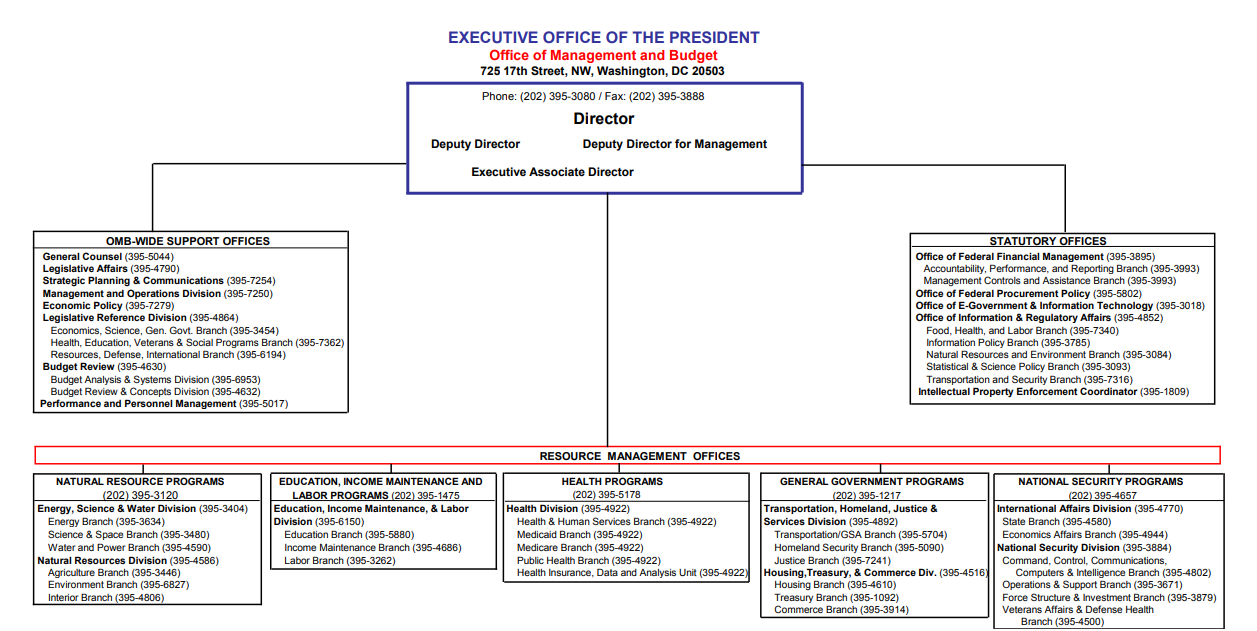
OMB’s modern responsibilities are commonly described as emerging from either the “B”, or “Budget” side, or the “M,” or “Management,” side. The five Resources Management Offices, or RMOs, are the primary offices that deal with budgetary issues. These five offices are the “Natural Resource Programs” office, the “Education, Income Maintenance and Labor Programs” office, the “Health Programs” office, the “General Government Programs” office and the “National Security Programs” office. The various “branches” of these offices provide even more detail on what these offices cover. There are also a number of “statutory” offices focused on government wide issues such as “procurement” or information technology.
The most important of these statutory offices is the Office of Information and Regulatory Affairs (OIRA) which serves as a centralized information gathering and regulatory “clearinghouse”. Although we won’t go into too much detail about these offices today, RMOs and OIRA both will play a central role in the future of this project. Our primary interest in undertaking this project was the Resource Management Offices but we will inevitably be covering a lot of data and regulatory issues in our attempt to be comprehensive. Furthermore, it should be unsurprising that the use of Large Language Models (LLM) in the Federal Government comes up regularly in these OMB memos.
TLDR: RMOs=Budget; OIRA= Regulation and Data
However, it should be kept in mind that this commonplace dichotomy can be misleading. As we will discuss far more in the future, there is a missing “P” at the OMB: Policy. Both the RMOs and the statutory offices are able to affect, or even, determine policy at administrative agencies. This also means that RMOs do, in fact, affect regulation and OIRA can affect budgetary matters. This is a point Georgetown law professor Eloise Pasachoff has gone to great length to emphasize and we’ll be discussing, and drawing on, her work often over the course of this series. She has also emphasized that Resource Management Offices have been greatly neglected by legal scholarship relative to the more familiar OIRA. In this sense our series contributes to an underdeveloped subfield of legal scholarship.
Finally, we have to clarify some concepts before moving onto the memos. Congress passes laws, especially the budget. But rarely do these statutes go into such granular detail that they can simply be “implemented” as written. Administrative agencies are thus granted the ability to “interpret” the statutes. This “interpretation” process is known as “rulemaking” and a specific statute, the Administrative Procedure Act, normally governs how rulemaking is supposed to work- including a “public notice and comment period”. Of course, the power to “interpret”- as we’ve seen- can in practice be the power to “determine” what the law is all together.
On the budget side, meanwhile, apportionment is the core procedure through which the OMB regulates the spending of agencies and thus the Federal government at-large. Congress passes annual “appropriations” which “earmark” budgetary sums for agencies. It is, however, the OMB which turns congressional orders to spend into “budgetary resources” for individual agencies. OMB, via apportionment, divvies up these appropriations for the agency to spend across weeks, months, and years. Those divided amounts of budgetary authority are the apportionments. As discussed in the last piece, “unused budgetary resources” are a kind of “money” internal to the federal government. Agencies “cash in” their unused budgetary resources for orders to spend out of the Treasury’s bank account to their employees, suppliers or other payees. Again, this process will make itself clearer as we dive further into this series.
With those concepts covered- in broad strokes- we have established all we need to begin our deep dive into OMB. So without further adieu let’s take a look at how Russell Vought’s OMB has wielded its power in the past year and a half. What has OMB, under Trump, been directing federal agencies to do?
Memo #1: “Implementation of Regulatory Freeze”
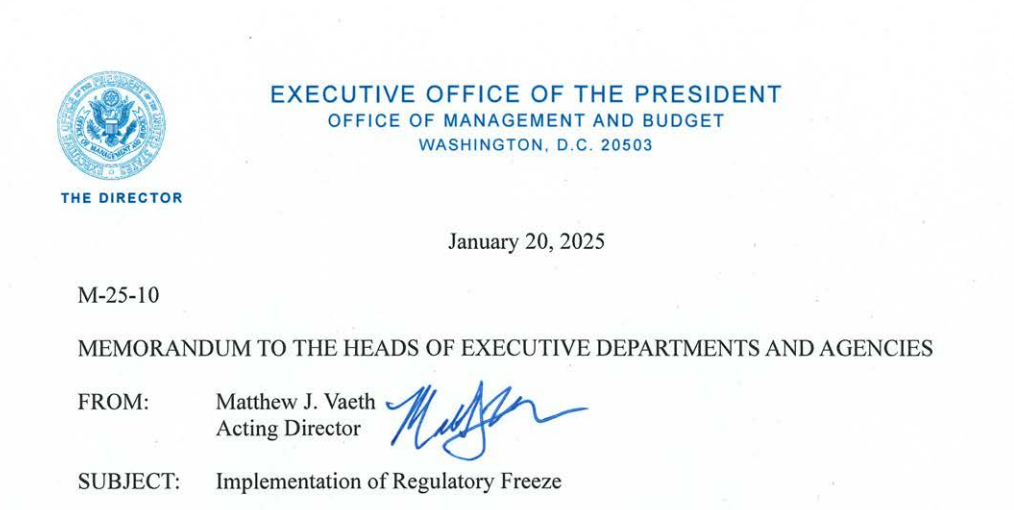
The first White House OMB memo of the second Trump administration (M-25-10) was signed on day one of the President’s term. Like all five of the first memos, it was signed by OMB’s Acting Director, Matthew Vaeth (Vought had yet to be appointed to the Office at this point). Vaeth is a career OMB civil servant who, outside of his acting appointment, has been an assistant director at the OMB since 2011. Specifically he has been head of the “Legislative Reference Division”.
The purpose of this memo was to implement the wider “Freeze Memo”, officially known as Regulatory Freeze Pending Review. This was an executive branch-wide memo signed by Trump on his first day in office. Upon implementation, the Freeze Memo called for agencies to postpone for 60 days the effective start date of any rules published in the Federal Register (or otherwise) that had not yet taken effect. The pause was put in place in order to review any “questions of fact, law, and policy that the rules may raise.” As the title of the memo suggests, the purpose of this action was to freeze any last minute regulatory moves by the Biden administration and evaluate them before anything actually went into effect.
In the memo, OMB directed federal agencies to consider opening a comment period within the two-month timeframe so that “interested parties” could provide remarks on any frozen rule. Petitions regarding those rules whose implementation was postponed were to be re-evaluated and agencies were encouraged to consider postponing the dates that regulations come into effect beyond the two-month window if they deemed it appropriate. If a frozen regulation didn’t raise a substantial question of “fact, policy, or law,” then executive agencies were to notify OIRA two weeks before the end of the regulation’s postponement. If a regulation was found to raise substantial questions, though, then agencies were to notify OIRA promptly and consider “additional rulemaking” or taking “further actions” in light of the concerns. The memo granted exceptions to the regulatory freeze in the event that agencies needed to comply with judicial deadlines or "for emergency situations or other urgent circumstances relating to health, safety, financial, or national security matters, or otherwise."
The implementation of a regulatory freeze by a new presidential administration itself is nothing unusual, especially when the incoming administration is from a different party than the outgoing one. Take, for example, M-09-08 which was issued on the second day of the Obama administration. Still there is something notable about how the Trump administration decided to implement this freeze -- it lacked certain exemptions typical of a regulatory freeze while simultaneously providing OMB with broad authority in reviewing agency regulations and actions. In its list of regulations that could be exempted from this freeze, the Biden era freeze memo included those that dealt with urgent “environmental” matters; this exemption is nowhere to be seen in Trump’s version.
The release of this memo, and its contrast with previous versions released by past administrations, serves as an excellent example of OMB’s broad power and how it works as a platform for reshaping government in the image of the president’s agenda. Trump’s branch-wide freeze memo was notable because it did not itself specify what types of regulations to exempt from this process, stating instead that it is up to the discretion of the OMB director to “exempt any rule that he deems necessary to address emergency situations”. This stands in contrast to the Biden era equivalent executive order, which stated plainly the types of “emergency” regulations to exempt (Obama’s freeze memo contained the same level of specificity as well as an exemption for urgent environmental rules).
Such language by the Trump administration thus empowers both the OMB director (in this case, Russell Vought) and lower level OMB staff to decide for themselves what rules can or can’t get issued amidst this freeze. When that discretion was exercised in the OMB memo itself, it translated into the abandoning of environmental protections. OMB’s power, in this instance, means that the entire regulatory process can be brought to a halt while the agencies of the executive branch submit their actions for review. In the end, only those rules that align with the policy goals of the president (and OMB director) are likely to see light on the other side of the freeze.
It’s also worth noting that when OMB encourages a review of rules that raise questions of “fact, policy, or law,” these terms are not defined. Without a definition, essentially anything could be determined to fit this criteria. The choice of wording again empowers the office to exercise its own discretion when determining whether or not the questions are truly substantial. As we will get into in future breakdowns, the idea that agencies have been overzealously issuing rules that raise “major questions” of fact, policy, or law has become commonplace among right wing critics of the administrative state (above all, the supreme court itself). We repeat, though, that the open-ended nature of this memo is not unique to the Trump administration’s freeze, but it is worth noting regardless to emphasize the broadness of the OMB’s powers.
Memo #2: Guidance Regarding “Terminating the Green New Deal”
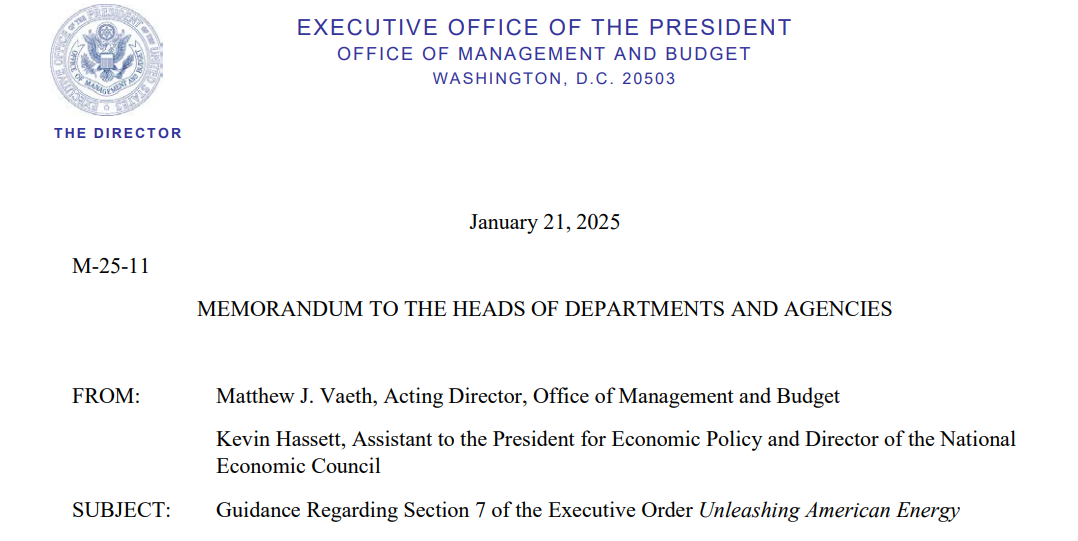
White House OMB memo M-25-11 was signed on January 21st, 2025, and provided instruction for agency heads on how to implement Section 7 of the Unleashing American Energy executive order signed by Trump on his first day in office. This section was entitled, in typical exaggerated Trumpian fashion, “Terminating the Green New Deal.” The alleged “Green New Deal” is the appropriated dollars in the Biden-era Inflation Reduction Act of 2022 and the Infrastructure Investment and Jobs Act. The memo clarifies that the pause only applies to funds supporting programs, projects, or activities that violate Section 2 of the executive order which “signals the administration's policy to encourage the rapid development of fossil fuel resources and all associated infrastructure, and remove any regulatory obstacles; promote the production and processing of non-fuel minerals” and to eliminate the Electronic Vehicle (EV) mandate. The wording of the Unleashing American Energy executive order initially led to a pause in disbursement for all highway improvement projects; it was not until this OMB memo was released that the government clarified its intended (narrower) scope.
Here we can see how OMB can both narrow -- and expand -- the scope of executive orders and the administration’s priorities through these implementation guidelines. The real world impact of these powers, as exemplified by the accidental pause in highway project funds, demonstrates that within the hands of OMB and its leaders lies the power to completely stop or start the flow of funds. This power had gone underrecognized as long as it was used judicially rather than capriciously. With the second Trump administration, we now have a President willing to explicitly back overruling the will of congress using these bureaucratic levers.
Memo #3: Reproductive Rights
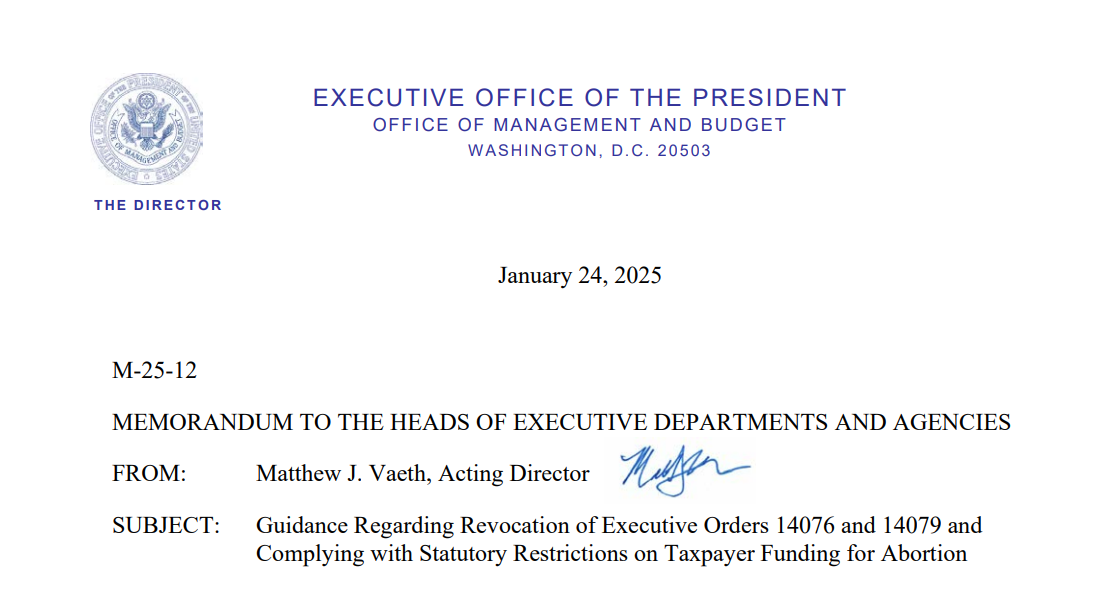
The next White House OMB memo to be signed and released, M-25-12, turned the office’s focus towards reproductive rights. In this memo, the heads of federal agencies are instructed to reevaluate all policies, regulations, directives, and actions in accordance with Trump’s executive order, Enforcing the Hyde Amendment, which he signed on the same day as the OMB memo, January 24th. Trump’s order revoked Biden-era orders 14076 and 14079, which were meant to expand access to reproductive healthcare after the overturning of Roe v. Wade. As the order’s name suggests, Enforcing the Hyde Amendment also affirms the administration's commitment to adhering to the highly controversial statutory restrictions on abortion funding (statutory restrictions such as the eponymous “Hyde Amendment”). Regarding this, the OMB memo states that it is the policy of the administration -- and the federal government as a whole -- to not use so-called “taxpayer money” to facilitate, fund, or promote abortion (including travel for the purposes of obtaining one).
Importantly, the original order signed by Trump goes into little detail outside of the revocation of Biden’s orders. The practical details for implementation are specifically delegated to OMB in the order. Accordingly in this memo, OMB directs the heads of federal agencies to reevaluate all policies, regulations, directives, and actions that might be relevant to Trump’s order. Those policies deemed out of line with the order are to be rescinded. Federal departments, in line with the language of the original Hyde Amendment, are still permitted to pay for or perform abortion in cases involving rape, incest, or to save the life of the mother, provided that the action is both permitted by federal law and permitted under state law. Federally funded projects, programs, and activities which are reasonably suspected to violate statutory restrictions on abortion funding are to be audited with measures taken to prevent the recurrence of “violations”.
It might seem, at first glance, like this Memo isn’t significant. After all, the Hyde amendment is still “good law” is it not? As always however, the devil is in the details. The Biden administration, in response to the overturning of Roe V. Wade, sought out levers they could find to support access to abortion. This meant interpreting the amendment as narrowly as possible. For example, the Department of Justice under Biden produced an interpretation of the Hyde Amendment that allowed Health and Human Services (HHS) to provide public money to expand access for abortion by covering transportation costs. Following Trump’s executive order, and this OMB memo, the Department of Justice reversed the 2022 interpretation.
On one level, this memo represents relatively standard partisan shifts in policy. At another level, it illustrates just how much power there is in the OMB “interpreting” the various statutes which govern the allocation and use of public money. Additionally, when used by a republican administration in concert with the aggressive “law-making” of a far right wing supreme court, it takes on the character of an all out assault on fundamental rights and bodily autonomy using capricious legal power.
Memo # 4-5: Freezing Financial Assistance
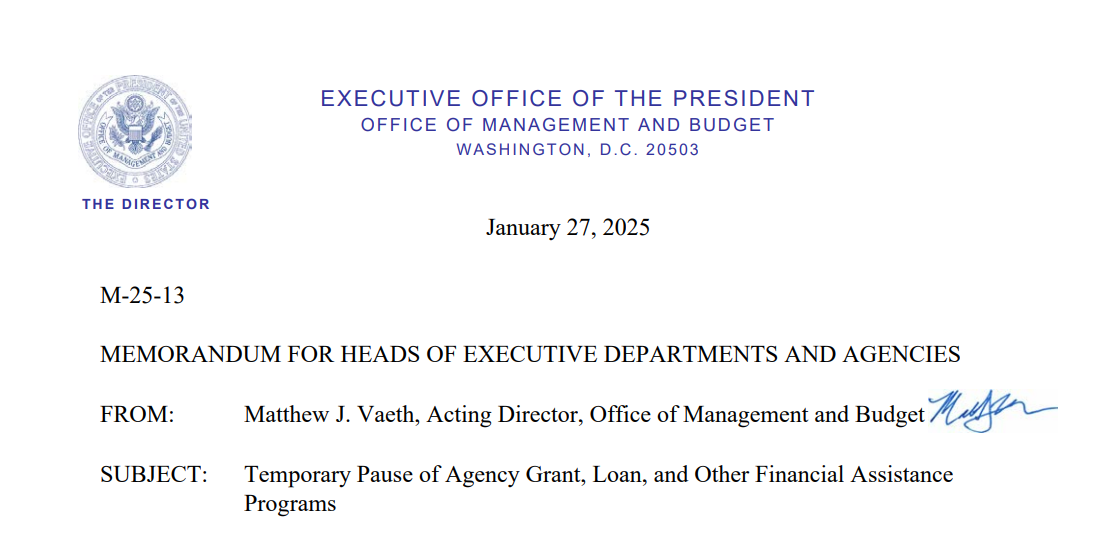
On January 27th, 2025, the Trump White House paused federal financial assistance programs with memo M-25-13. In the memo, federal agencies were instructed to review all Federal financial assistance programs and activities consistent with the President’s policies and requirements, with OMB specifically citing various executive orders signed in the first few days of the administration. Such orders (of which Enforcing the Hyde Amendment was included) were geared towards cutting funding for programs that were not in line with the president’s agenda or, as OMB put it, “ensur[ing] that federal funds are used to support hardworking American families.” In the interim, federal agencies were to temporarily pause all relevant Federal financial assistance activities in order to allow for OMB review. Such activities included (but were not limited to) “financial assistance for foreign aid, NGOs, DEI, woke gender ideology, and the green new deal”.
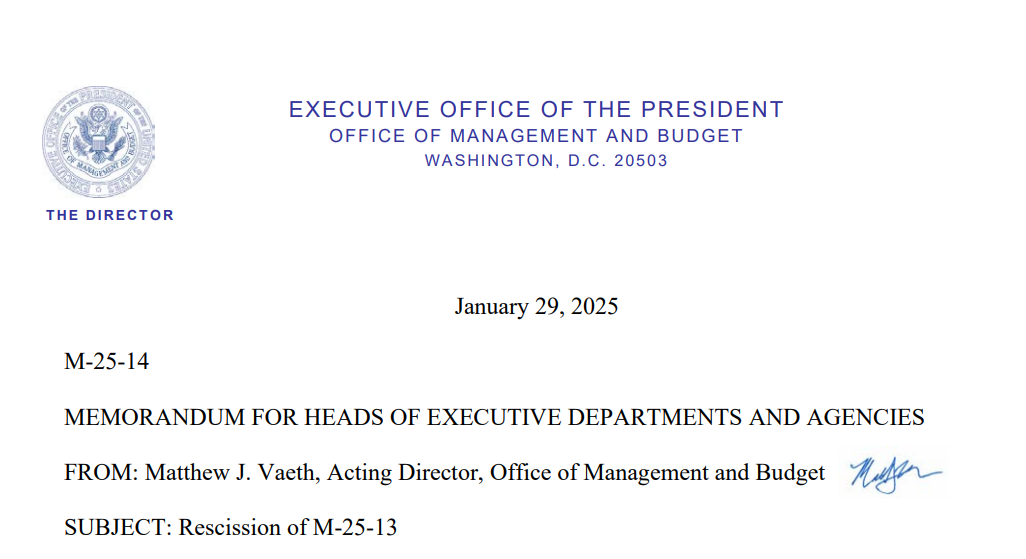
Needless to say, this memo triggered immediate chaos. As covered by Notes on the Crises on January 31st 2025, the unprecedented freeze led to multiple payment portals across the Federal government shutting down. The vague language likely exacerbated this chaos, as it was exceedingly unclear which programs were truly in danger of cancellation. The widespread confusion and immediate lawsuits led to a very predictable update less than 48 hours later. On January 29th, only a day after the original memo’s guidance technically went into effect, OMB issued memo M-25-14 to rescind memo 13. Initially many commentators assumed that rescinding the OMB memo meant that the spending freeze itself had been rescinded. However, the Trump administration never rescinded the executive orders involved. Implementation of the spending freeze was just delayed and made less radical, not eliminated.
The overall implications of these memos, even in their lame-duck status, shine a light on the radical nature of Vought’s vision of the legality and desirability of impoundment. Furthermore, Vought recognizes how far he can get to accomplish his vision using the bipartisan precedents that have institutionalized and expanded the Office of Management and Budget’s role. In short, the Unitary Executive passes through the OMB before reaching into every administrative agency. As described in the original Crises article on these memos, the power of the purse is a power the constitution explicitly houses in Congress. OMB ordering a government-wide payment freeze outside the bounds of the Impoundment Control Act of 1974 is a direct attack on this constitutionally defined power, and the amount of damage it caused in less than a day is exemplary of how dangerous such an attack might be. This particular effort was too audacious, but as we well know by now this was just the beginning.
Memo #6: The Circular A-4
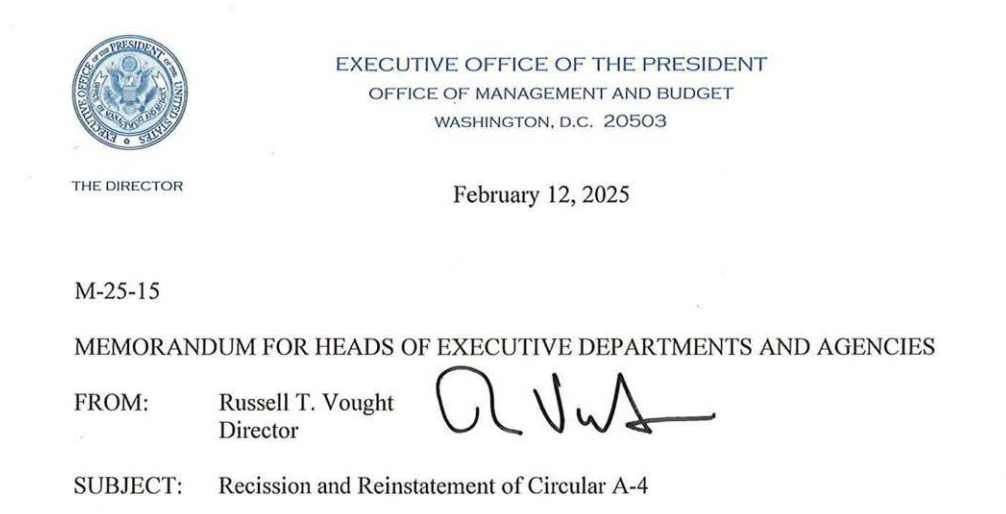
M-25-15 was signed on February 12 by the newly confirmed OMB director, Russell Vought. Despite being one of the first ten memos, we are only going to note its existence today. Explaining what “Circular A-4” is and why it's so important will require an entire article on its own. For that reason, we will be skipping over this memo for the time being, and in part two of this series, we will give M-25-15 the full focus it deserves.
Memos #7-9: Targeting Enemy Law Firms
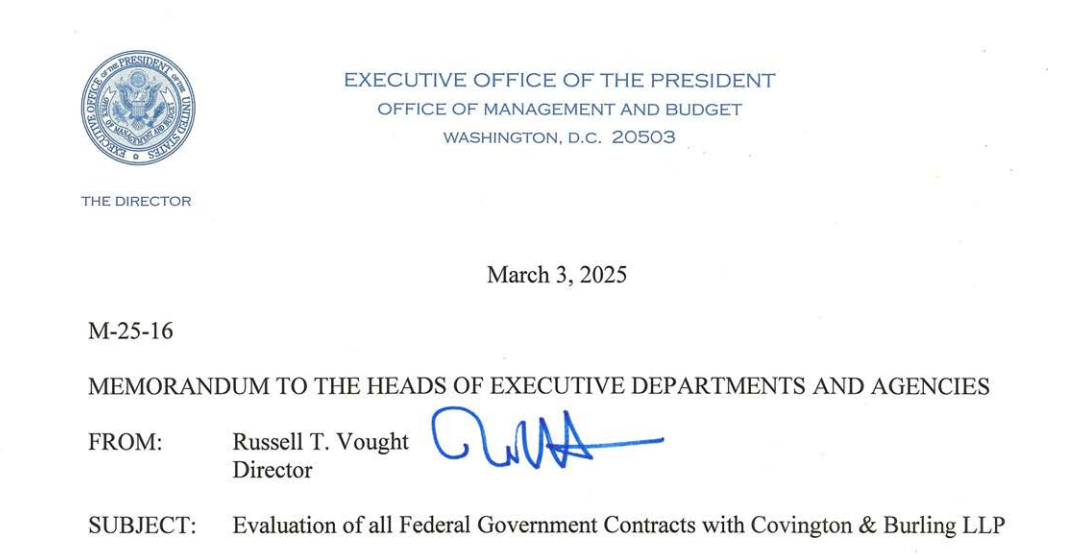
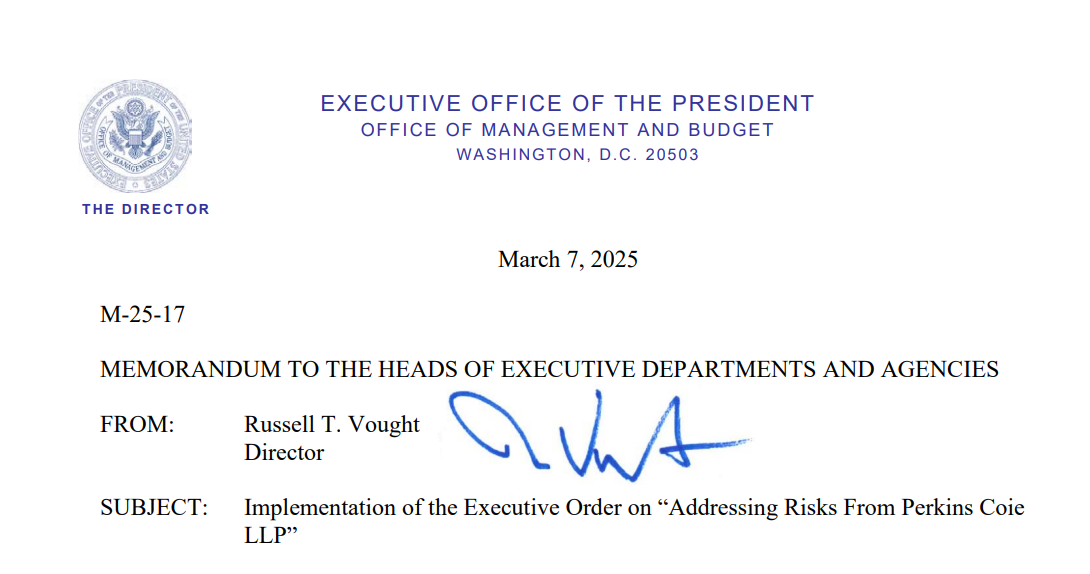
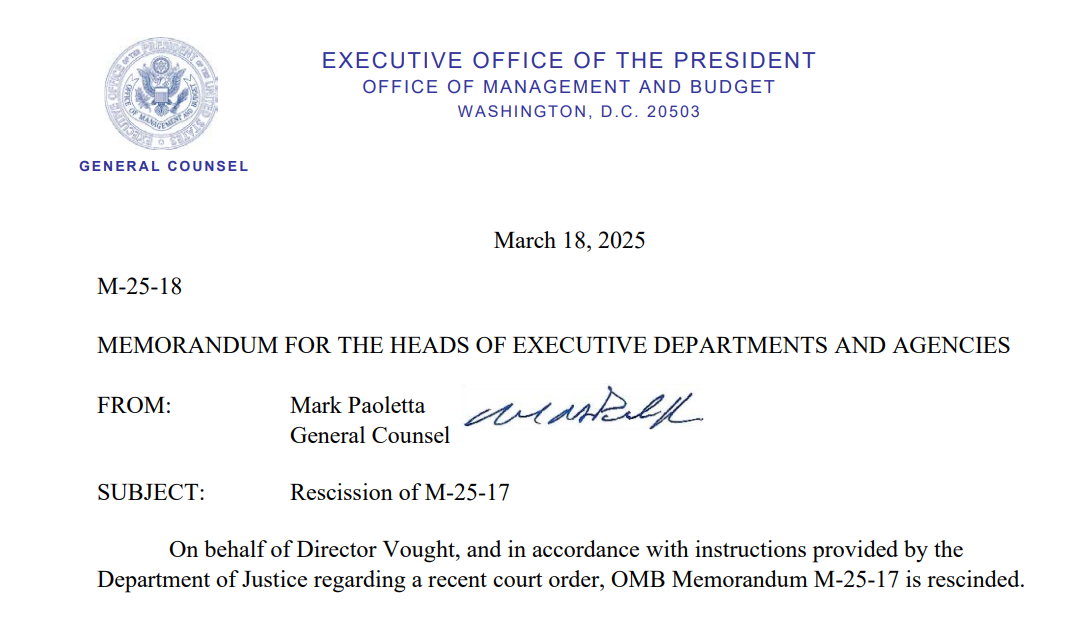
The next two OMB memos released by the White House, M-25-16 and M-25-17 saw the administration target specific law firms with long-standing ties to the federal government. Memo M-25-16 was signed by Vought on March 3rd, 2025, and it directed federal agencies to review their contracts with Covington and Burling LLP and report back to the OMB within a week with details about the contracts. Memo M-25-17 was signed on March 7th and demanded that agencies review all contracts and subcontracts with Perkins Coie LLP before reporting back to the OMB. After a court injunction put a stop to Trump’s tirade against certain law firms, memo M-25-18 was signed by the OMB’s general counsel, Mark Paoletta, as a rescission of the memo targeting Perkins Coie. It is widely thought that the targeting of the law firms in question here is due to their representation of political opponents of Trump (such as Jack Smith, the special counsel who sought to criminally prosecute Trump and was represented by Covington and Burling). Here the subordinate relationship of the OMB to the president is leveraged to target political opponents and the rule of law, once again weaponizing the (constitutionally congressional) power of the purse.
The Trump administration’s overall targeting of Law firms bore fruit. Among other things, nine law firms committed nearly 1 billion dollars of “free” legal services to the second Trump administration. These first two law firms didn’t bend to Trump and have been rewarded in various ways, especially reputationally, for that decision. Other law firms that were targeted subsequently did acquiesce to the Trump administration’s demands, including those among these firms.
Memo #10: Communication with Congress
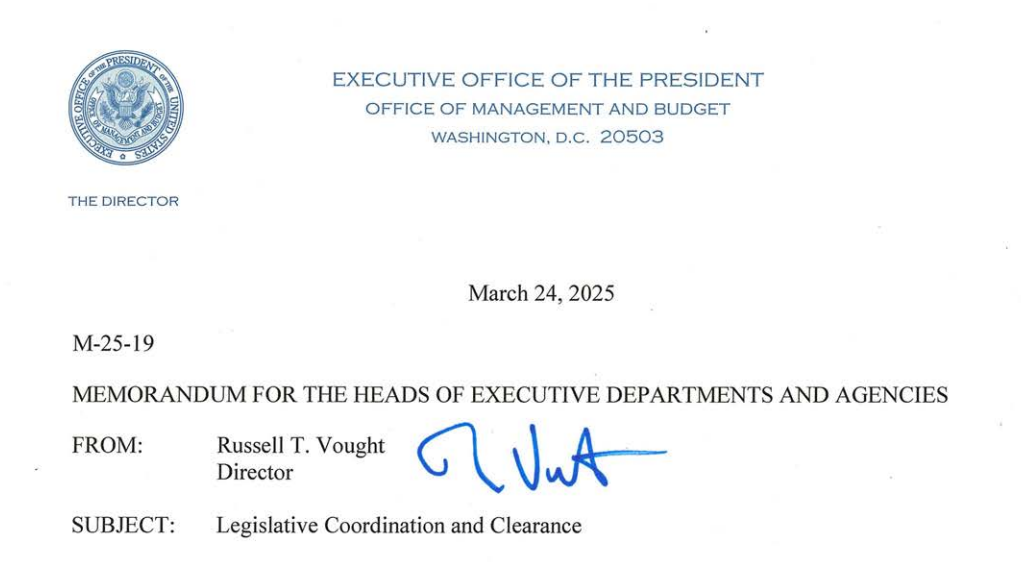
In the final memo we are covering today, we find the OMB reaffirming its longstanding role as the central authority for nearly all executive communications with Congress. OMB memo M-25-19, signed by Vought on March 24th, 2025, explains that nearly all executive branch communication with Congress must be cleared by the OMB in order to ensure that communications are "consistent with the President's policies and objectives" and also to ensure that the administration "speaks with one voice." This is a role that OMB has fulfilled for decades now, and that fact is reflected by the memo’s references to circulated guidance documents that date all the way back to the 1970s.
In spite of this practice being well-known and well-defined, the memo’s attached guidance goes into near-redundant detail on all the different types of communication that must be vetted by OMB. Let’s briefly go through the list:
- Legislative proposals, which are essentially laws that agencies draft and submit to Congress, must be processed by the OMB prior to transmission. Once in the office’s hands, OMB will send the draft to agencies that might be affected by the law, and OMB will act as a mediator to resolve any conflicts or disagreements.
- In a similar vein, if Congress requests an agency official’s testimony or letter of opinion on a piece of legislation, or if an agency decides to send one without request, those opinions must also be cleared with the OMB beforehand. Like with legislative proposals, OMB will circulate the opinion to ensure that it aligns with the President’s budget and policy.
- Additionally, any other legislative communications, such as informal talking points, responses to questions, or reports that include “legislative views,” must be submitted for OMB clearance. Like with the above requirements, the stated goal continues to be an ensuring of consistency with Presidential policies.
- Statements of Administration Policy (SAPs), which are formal documents that the administration sends to Congress, are drafted and coordinated by the OMB when the office determines that one ought to be written regarding a current piece of legislation. SAPs are used frequently by presidents to announce an official stance on pending congressional legislation, and these documents are subsequently used to help guide lawmakers as the process unfolds. Since the Reagan administration, SAPs have been drafted by OMB and circulated to the agencies for review and comment.
- Once a bill is passed by Congress, OMB will collect statements regarding the legislation from stakeholder agencies and compile them all into a memo for the President. OMB will also draft messages or signing statements for the President to review prior to signing or vetoing legislation. These documents are used in guiding the President’s ultimate decision regarding a bill.
Though none of the above processes are a particularly new feature of Trump’s OMB, they go to show how central OMB is in coordinating the executive branch. Basically all agency efforts to communicate with Congress must filter through OMB first. This process is so central to OMB that the office tends to release a memo just like this towards the beginning of every new presidential administration (these memos typically come around the time that the executive branch gears up for the earliest stages of the next year’s budget planning process). This memo by the Trump administration is a verbatim copy of its Biden-era equivalent.
In acting as the lynchpin in cross-branch communication, the office certainly helps in streamlining and simplifying the inter-branch back and forth, but it comes at the cost of agency independence. In an administration as ideologically dogmatic and authoritarian as our current one, that centralization can very easily become a tool in silencing certain, often more progressive, components of the administrative state. And such a concern goes well beyond mere speculation; complaints of OMB staff overexerting their influence across the federal agencies have existed nearly as long as the office itself.
The budget-making process is extremely contentious, with OMB and its staff often being the most honed in on keeping spending to a minimum. Agencies are known to make high budget requests to OMB in anticipation of the office cutting down the final number by a significant amount. Once that number has been decided and OMB sends the president’s budget request to Congress, though, the legislative clearance process bars agency officials from publicly expressing any disagreements thereafter. This is an issue that we will explore in more depth when we break down the seven levers that OMB uses to exert influence on the agencies (as first outlined by Eloise Pasachoff), but it's worth highlighting one particular moment when an OMB staff became especially overzealous.
During the formulation of the Fiscal Year 2011 budget, the inspector general for the Office of Personnel Management spoke to an OMB examiner about his frustration with how little money his office was budgeted that year. The examiner refused to help out, ultimately threatening to “make life miserable” for the IG if he spoke out about the budget to Congress.
For those unaware, Inspectors Generals occupy a unique role in federal agencies. These officials were placed in each agency by Congress specifically to act as watchdogs and auditors. Although they report to their respective agency heads, IGs are supposed to have significant legal protections that enshrine their independence from most of the agency -- one such protection is an exemption from the confidentiality requirement. It was thanks to that protection that the inspector general of the OPM felt empowered to speak out against the OMB examiner that threatened him. And though this specific examiner was disciplined for his remarks, it was first and foremost because he tried to enforce the confidentiality requirement against an inspector general. Other complaints, such as one by a former Social Security chief claiming that he doesn’t “miss having everything I say being cleared by a 28-year-old at OMB”, suggest that the forceful use of OMB confidentiality (as articulated in this memo we are examining) might actually be quite commonplace across the federal government.
Conclusion: The OMB and the Effort to Govern
The Office of Management and Budget sits at the nexus of our constitutional crisis. Its entanglement within the entirety of the executive branch, and power to control fund apportionment including through temporary blocks in spending, threatens Congress's constitutional “power of the purse” and has brought the administration a host of legal battles along the way. OMB is able to use its operational discretion over spending to assert greater political control over the executive branch (and so also greater centralization in service to the president). While courts have sometimes been able to limit or rescind the scope of the memos covered in this piece, it's clear that the OMB is a core platform from which Trumpism seeks to govern.
A handful of the memos covered today were largely procedural or relatively narrow in scope. As we get deeper into this series, we will see how OMBs efforts to deconstruct the administrative state have only gotten more absurd and aggressive with time.
Sign up for Notes on the Crises
Currently: Comprehensive coverage of the Trump-Musk Payments Crisis of 2025