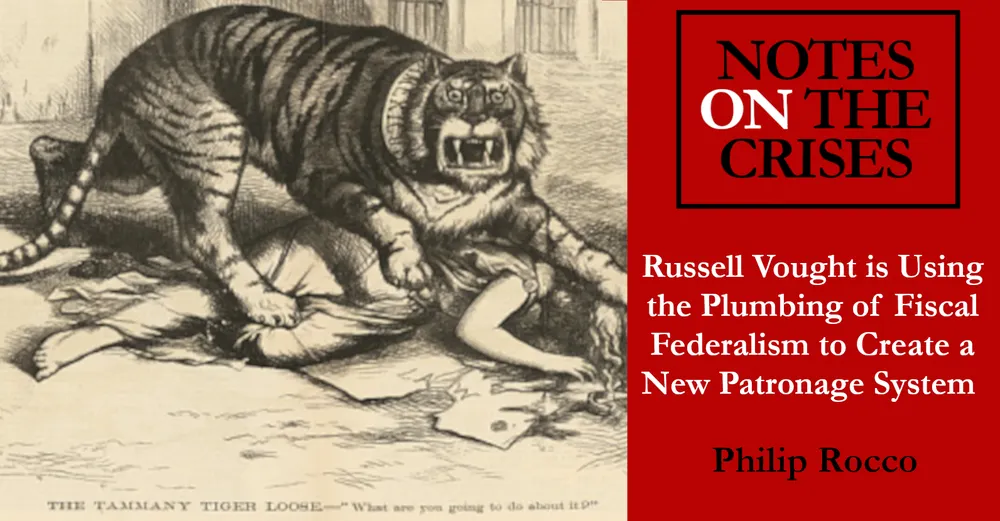
Russell Vought is Using the Plumbing of Fiscal Federalism to Create a New Patronage System
EDITORS NOTE: I (Nathan) have struggled whether to rush to comment on this proposed OMB rule. Being a recent Fiscal Year 2026 OMB memo, and knowing that the OMB will continue to create new forms of budgetary crises, I didn’t want to rush to “catch up” to this memo. However, the opportunity to publish this guest piece from longtime Notes on the Crises guest writer Phil Rocco came about and I thought this was an ideal opportunity to provisionally comment on this issue for the time being. Our Levers series will return Thursday.
Philip Rocco is a professor of political science at Marquette University, co-author of Obamacare Wars: Federalism, State Politics, and the Affordable Care Act and author of the recent book Counting Like a State.
If you’re reading this, chances are you’ve never heard of 2 CFR 200. But if you’ve driven on a freshly resurfaced highway, drunk water from a treatment plant built in the last fifty years, or sent your child to a primary or secondary school, you’ve benefited from it.
You can think of this obscure chapter of the Code of Federal Regulations as the rulebook for federal grants, which are the plumbing that moves more than trillions of dollars in aid from Washington to governments and nongovernmental organizations around the country. But in May of this year, the Office of Management and Budget (OMB) proposed to rip up that rulebook and write a new one, which is slated to go into effect on October 1. Unlike the old rulebook, which was based on decades of practice in cooperation and negotiation between officials at all levels of government from both parties and across the ideological spectrum, the new rules are little more than a naked power grab that would allow the feds to arbitrarily reward friends and punish enemies.
To date, OMB's proposed rule (blandly titled “Regulation for Federal Financial Assistance”) has mostly attracted attention for its potential to both stall and politicize scientific research (if you’re reading this piece before midnight Monday, you can still contribute a comment letter opposing this proposed rule’s impact on science, with the help of standardized language, here). This is no small thing. But focusing on the Trump administration's attack on science does not do justice to the scope of OMB Director Russell Vought’s ambitions here. In addition to going after scientific research, the proposed rule represents the most significant threat to the intergovernmental grant system in American history—the more than $1 trillion that flows out annually to states, cities, counties, towns, villages, tribes, and territorial governments. This is the often-invisible plumbing that delivers countless public goods ranging from health care and housing to transportation and public safety. The rule’s consequences for that system cut far more deeply and reach further than has generally been reported on.
From cooperative to extortionary federalism
If you want a sense of what OMB is trying to do, you don’t need to sift through hundreds of pages of the Federal Register. Just look at what’s happened over the last year. In fits and starts, the Trump administration has already attempted to convert what remains of cooperative fiscal federalism into a more or less explicit system of political patronage, or what my colleague Jacob Hamburger calls “federalism by extortion”. Since the beginning of Trump's second term, the administration has repeatedly used terminations of federal grants to state and local governments as a tool of political control. This includes terminations of $7.6 billion in clean-energy grants to states primarily controlled by Democrats, over $600 million in CDC grants targeted on blue states, $943 million in Department of Transportation grants, and cancellation of teacher-training grant funding to public schools and universities. To date, we only have a crude sense of just how much federal aid has been swept up in these terminations. And while the courts have successfully stalled many of these terminations, the administration’s capricious approach to grant administration has dropped state and local financial officers into dark and uncharted waters. Beyond the terminations, Trump has also used the delivery (or nondelivery) of federal emergency relief dollars as a campaign tool in a hotly contested election year.
The best way of understanding OMB’s proposed rule is that it attempts to turn these one-offs into the law of the land, denying funds to state and local governments whose officials do not toe the party line and trapping these officials in a web of new administrative burdens and procedural requirements that will make it ever easier for Trump to accuse his enemies of “fraud”—the magic word that has become the administration’s go-to weapon for attacking everything from Medicaid payments to electoral democracy.
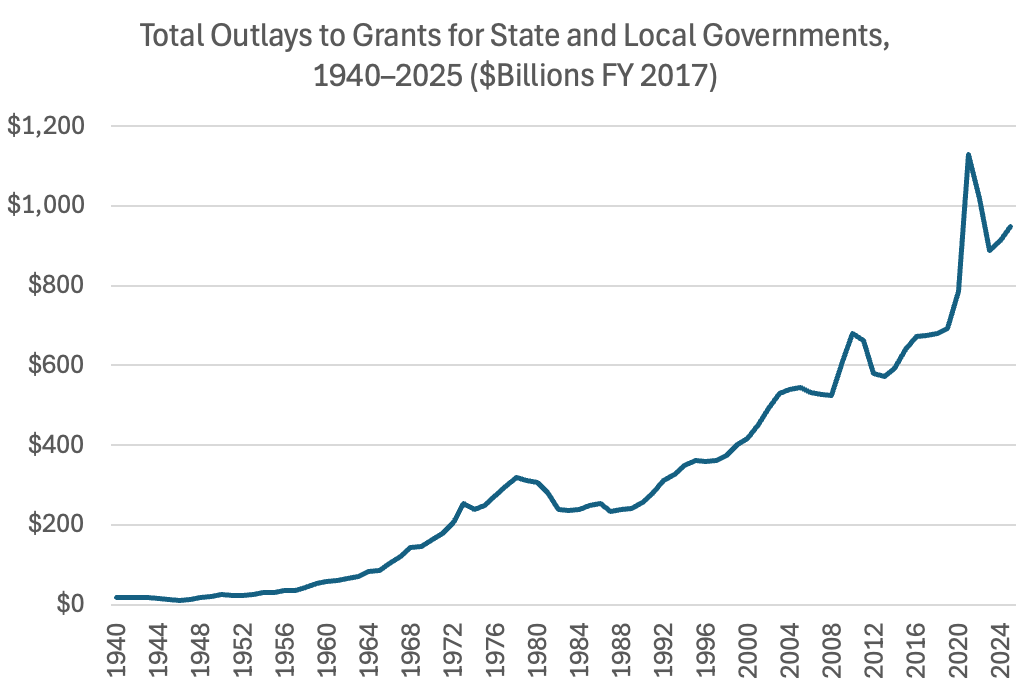
Of course, federal grants to state and local governments are no strangers to controversy. From the impoundment crisis under President Nixon to the battle over unfunded mandates in the 1990s to the blockbuster litigation over the Affordable Care Act, the growing scale of intergovernmental aid has expanded the scope of conflict over federal policy decisions from the halls of Congress to state capitols, city halls, and county buildings. But OMB’s new proposed rule is different in two ways.
On the one hand, Vought is abandoning the political tack some of his predecessors have taken. Prior attempts to gut federal grants in aid—via, say, mandatory periodic sunset provisions, block grants, and major budget cuts—all relied on acts of Congress. But with the “First Branch” effectively defanged, and with a blank check on unitary executive theory from the Supreme Court, Vought believes he can “just do stuff.” This is easier said than done; it takes time to set up a full-scale administrative apparatus of the sort the proposed rule contemplates. But it is unclear that Vought really needs the house to be fully furnished before he can move in. Characteristic of what Ernst Fraenkel referred to as the “dual state”, the second Trump administration has not so much reconstructed government from the ground up as it has created a new set of rules that existing agencies can (arbitrarily) cite when they wish to single out a politically disfavored state, city, county, tribe, or university campus for targeted punishment.
On the other hand, Vought’s approach employs a distinctive mix of policy tools that cut against the entire logic of cooperative federal grants-in-aid. First, the OMB rule will add an unprecedented level of administrative burdens for state and local officials. Grantees will be subjected to an inordinate amount of additional paperwork for every single payment request, new compliance requirements for the Department of Homeland Security E-Verify system, and Buy America requirements for all federal awards. The rule ends so-called fixed-amount awards, which tie pay to milestones or deliverables rather than costs incurred, unless they are required by a statute. This will add significant new financial management burdens, especially for small, cash-strapped jurisdictions. Grantees will also have to run the gauntlet of new pre-payment checks through the Bureau of Fiscal Service “Do Not Pay” system that could delay the disbursement of federal funds. Further, they will be subjected to new restrictions on cost-reimbursement contracts, which will make it difficult for state and local governments to procure needed goods and services.
Under the Paperwork Reduction Act, OMB typically has to supply estimates of the amount of time this will all take. However, OMB has simply disposed of that requirement, reasoning that the law does not apply since “this regulation does not contain a new requirement for information collection.” And, despite the obvious implications of the rule on state and local governments, OMB does a similar handwave on Federalism Review required by Executive Order 13132, breezily concluding that “this proposed regulation would not have sufficient federalism implications to warrant the preparation of a federalism assessment.” This speaks to the inherent weakness of federalism requirements in the regulatory process, but that is a subject for another piece.
Second, the proposed rule subjects federal grants to all new forms of political review. This is the sort of thing that has attracted attention for its potential to politicize scientific research. But the scope is, indeed, far broader than that. Its application to state and local governments does nothing short of using intergovernmental aid to create a new patronage system. Agencies, which the rule deprives of substantial discretion in adjudicating grant compliance, can now terminate awards that do not align with the President’s priorities. Most disturbingly, discretionary grants to state and local governments must now go through “pre-issuance review”, which means that political appointees will scrutinize proposals to ensure not that they are consistent with the statutes Congress passed but that they algin with the prerogatives of the President. The rule arms agencies with new, vague, and easily politicized, criteria to apply. These include ambiguous rules about a recipient’s past “questionable practices” as well as “risk factors” (not defined). Discretionary awards cannot be used to “fund, promote, encourage, subsidize, or facilitate”, among other things, “Any other initiatives that compromise public safety or promote anti-American values.” None of these terms is ever defined, but the last year has given us a clear picture of how they would be implemented.
Third, the text of the proposal—if finalized—could ensnare state and local governments in a series of new procedural traps. For example, if governments make subawards to recipients whose public statements the feds deem “reputationally harmful” (a term whose definition is so broad it could create substantial legal and financial risks for state and local grantees), their prime awards could be subject to termination. Similarly, grants can also be terminated if governments are deemed by the feds to be engaging in “viewpoint discrimination” (presumably as defined by Russ Vought). Grant recipients must now also be alert to changes in the President’s whims. The rule expects grant recipients to adapt to Executive Orders, even—presumably—those that are inconsistent with statutes that might override them. To give the federal government added capacity to enforce these requirements, the OMB rule creates a “litigation state”, allowing agencies to coordinate with “private individuals or organizations” pursuing private causes of action against grantees. The reliance on private litigants underlines that the point here is not to create a regime that operates on “everything, everywhere, all at once,” but one that operates selectively, strategically, and wherever the White House wants it to.
How broadly do the proposed rules sweep?
By now, the thrust of OMB’s proposed politicization scheme should be clear enough. But how broadly do the proposed rules sweep? As currently written, some of the most onerous new measures would appear to apply only to “discretionary awards”, that is grants awarded not on the basis of a statutory formula or entitlement, but via a competitive and (historically) merit-based application process. Specifically, the termination and suspension provisions in § 200.340(a)(2), (e) quite clearly cover only discretionary awards, and carve out what the rule labels “statutory entitlements” (e.g., block grants, formula grants, disaster recovery grants). But most other sections of the rule do not have those carveouts. For example, new content prohibitions would become standard conditions on every federal grant. Governments will be required to certify compliance with each of these provisions. Additionally, simply transforming the Uniform Guidance from a guidance document into a regulation will make it more difficult for governments to seek waivers or flexibility on grants of all types.
In other cases, organizations commenting on the rules are not at all clear on how broadly they apply. For example, the American Association of State Highway and Transportation Officials (AASTHO) has questioned the sweep of OMB’s new requirement that federal programs must be designed with clear goals and objectives that “align with administration policies and priorities”. Specifically, AASTHO has asked OMB to clarify that “this language does not authorize federal agencies to alter statutory formula programs, narrow congressionally established eligibilities, impose additional conditions on apportioned funds beyond those authorized by law, or otherwise subordinate legislative requirements to executive branch policy preferences.”
Understanding these carveouts matters, of course, because it tells us just how much federal funding could be at risk of politicization and termination under the rule. To get some sense of the scale, consider that––according to the Budget Enforcement Act classification scheme––roughly thirty percent of state and local grant outlays are considered “discretionary” while seventy percent are mandatory. Note that this 70-30 breakdown still overstates the number of grants that would be subject to some of the most severe provisions in OMB’s proposed rule (such as termination and suspension provisions), since the BEA’s definition of “discretionary” encompasses grants that some sections of the rule appear to carve out.
To be sure, the Trump administration has and will likely continue to politicize the allocation of programs that are shielded from review under this proposed OMB rule (witness the halting of hundreds of millions of dollars in Medicaid payments over the last year). Nevertheless, a more expansive application of OMB’s rule could mean an even more negative impact on state and local governments’ credit ratings (about which Moody’s has already sounded the alarm).
Even when the rule is not used as a tool of more or less explicit political control, the prodigious number of new legal restrictions, requirements, and risks––not to mention the ambiguities––will simply grind away at the operations of the intergovernmental grant system, increasing administration costs for state and local governments. Legal ambiguities will also increase the (already high) likelihood of litigation over the rule, which brings me to the question of the law. The legal defects with this rule are manifold. I’ll try to address them all in a subsequent article. For now, I’ll just say that OMB’s claim that what it is doing is even remotely legal hangs on statutory authorities that give the agency a rather modest financial management authority and the ability to issue subregulatory interpretive guidelines rather than the sweeping power it is claiming to override explicit statutory language and impose a regime of political patronage.
But what, to Russ Vought, is the law? If anything, the rule’s sheer audacity suggests the results of the last few Supreme Court terms have caused Vought to update his priors. His legal gambit is that his friends on the court don’t care.
Equally importantly, Vought’s political gambit is that, because the details of fiscal federalism and grants management are so irrepressibly dusty and arcane, no one else will care either. But if journalists, activists, and elected officials can manage to dredge this monstrosity from the muck of the Code of Federal Regulations and bring it into the light, he might just be wrong about that.
Sign up for Notes on the Crises
Currently: Comprehensive coverage of the Trump-Musk Payments Crisis of 2025