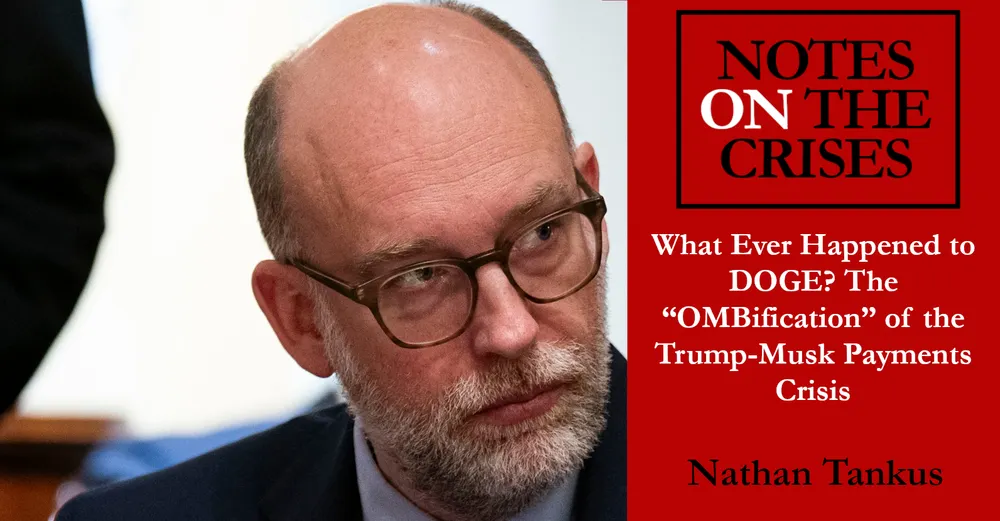
What Ever Happened to DOGE? The “OMBification” of the Trump-Musk Payments Crisis
Dear readers: My deepest apologies for my absence. I got the so-called “Super-Flu” that hit New York in December, then I followed that up with a very debilitating bout of food poisoning in January. As much as I tried to push myself to get back to writing after I physically recovered, it took much longer for me to cognitively recover. I hope it's clear to readers my passion for my unique corner of economics and politics. Thus I would have covered the fast paced events unfolding around me, if it had been possible. I hope you will bear with me as I return to work and restart my regular output. If I have missed your correspondence, please accept my apologies, and feel free to contact me again.
This piece is long, long overdue. Last summer—with Trump`s intensifying attacks on the Federal Reserve—I focused my writing on the attacks on independent agencies and the unique role that the Federal Reserve plays in that drama. Unitary executive theory—the idea that the presidency should have direct control of all activities happening in the federal government—is at the center of the constitutional crisis which animated the Trump-Musk Payments Crisis. Since I’ve been ill there have been more developments on the Federal Reserve front that I have to get back to—from the Supreme Court case over Federal Reserve independence to the eye-popping targeting of Powell with a criminal investigation (something that is not a surprise to Notes on the Crises readers) to Powell’s replacement as Federal Reserve Chair and staying on as governor. Not to mention the war on Iran. Yet, before I get to this backlog I have to deal with my previous backlog: DOGE and the Trump Musk Payments Crisis.
It's taken me a while to work my way back towards the payments crisis, and DOGE more broadly. There is, however, only so much I can write and inevitably the expansion of my operations has taken an enormous amount of effort. Meanwhile, in the spring of 2025 I was on the cutting edge of these stories. In a strange way being at the forefront made it easier to continually pump out writing. Once I got behind, it became harder to synthesize all the secondary reporting I feel I need to explicate to give readers something comprehensive and valuable.
For today, I won’t try to do a play by play of all the winding developments since I last wrote about DOGE in detail. As most readers know by now, Elon Musk officially left DOGE—and thus the Federal Government—at the end of May 2025. As a result, DOGE appeared to many to be “dead” and not the center of the issues with the second Trump administration. However, subsequent reporting, primarily by Wired, has illustrated that DOGE’s operatives have moved into other important positions in government. As one USDA memorably told Wired, “They [DOGE] are in fact burrowed into the agencies like ticks.” Some DOGE employees have returned to the private sector, but often to work on much of the same issues they were doing as DOGE acolytes. After all, so much of the government’s work is done through contractors in the “private sector”...and DOGE's cuts have merely accelerated that trend.
Nor has the legally mandated siloing of sensitive personal data been restored. All signs point to the construction of more and more elaborate and synchronized “master databases” for the targeting and abuse of citizens and immigrants, whether legal residents, undocumented or even citizens. Social Security data has been dangerously abused in ways that were predictable last spring. According to a whistleblower, one DOGE employee is even alleged to have taken some of the most sensitive social security data on a thumb drive to a new job.
Which brings me to my main focus today. My systematic search for around five months last year for more evidence of what I’ve labeled in the past “payments level impoundment”. In the very extreme case of New York City last year, that even led to outright “payment reversals”. To remind readers, “payments level impoundment” refers to using the Bureau of Fiscal Service to directly block payments from an administrative agency that are deemed “undesirable”. These blocks veto payments despite being authorized by congressional appropriations, and having already been checked by agency anti-fraud procedures. Payment reversals involve outright taking funds that have already been disbursed directly out of bank accounts. This happened to the New York City government in an extraordinary case that I covered both in Rolling Stone, and here on Notes on the Crises..
I will be completely honest: my experience with the unprecedented, wild and chaotic way in which both the internal government payments system, and the general payments system was abused last spring made it very difficult to let go of the idea that the abuse of the payments system was going to continue to escalate and escalate. I scoured for signs of that escalation. (One of the pitfalls of doing investigative work is there is a tendency to continue to search until you find what you’re looking for rather than reporting on your lack of findings…)
Over the summer of last year I began work with a journalism student (Juan Hanes) to systematically contact comptroller offices in city governments across the country looking for other examples of payments level impoundment, or payment reversals, targeting “blue” cities. We ended up contacting more than twenty city comptroller’s offices, and heard back from half a dozen or so. I will discuss our findings below. But the short form is this: we haven’t uncovered additional evidence of payments level impoundment targeting city governments. Instead, city comptroller offices—those who were willing to talk to us, anyway—have instead experienced “run of the mill” impoundment. That means the blocking of funds already “appropriated” by congress for specific purposes.
The cities we heard back from were Philadelphia, Columbus, Seattle, Chicago and Houston. Philadelphia’s comptroller office was not willing to directly answer questions about funding cuts put pointed to Philadelphia Inquirer reporting that detailed these specific cuts:
- $3.8 million in funding from the Federal Emergency Management Agency for the city’s Office of Emergency Management.
- $1.3 million in combined funding from two AmeriCorps grants that were destined for the Office of Community Empowerment and Opportunity, which is Philadelphia’s anti-poverty programs, and the city managing director’s office.
- $525,000 in AmeriCorps grant funding for the Mayor’s Office of Education.
- $1 million from the federal Environmental Protection Agency for the city Office of Sustainability’s efforts to fight environmental racism.
Meanwhile Columbus deputy chief of staff Jennifer Fening told Notes on the Crises:
Connecting with our Finance department, I can say that the City of Columbus is actively monitoring the complex and fluid situation surrounding existing federal funds. Examples of canceled funding include grants in Columbus Public Health, the Office of CelebrateOne, and Recreation and Parks. At this time, we and the City Attorney’s Office continue to navigate the federal funding landscape and its direct effect on the city and its stakeholders.
While Columbus also didn’t comment on the specific amounts of cuts, reporting has pointed to Ohio being one of the hardest hit states by Trump administration budget cuts and impoundment.
Seattle Finance Director Jamie Carnell told Notes on the Crises as of September of last year that they had “not had any similar issues” to New York City’s payment reversal which, however, doesn’t mean they haven’t experienced various other forms of impoundments and federal budget cuts. A PR representative of the Houston comptroller office, Tony Castaneda, after an extended back and forth merely linked to a couple of videos of Comptroller Chris Collins speaking in front of the City Council. You can find those videos here and here (timestamps 3:40:05 and 21:40 respectively).
Which brings us to our final city: Chicago. Lakesha Gage-Woodward, the Director of Public Affairs for Comptroller Michael Belsky, initially told Notes on the Crises that she could not provide any comment on questions of payment issues because the “City of Chicago does not comment on active litigation” as “a matter of policy.” It's unclear what litigation she was referring to, but they have sued over being denied emergency grants from the same program that New York City experienced payment reversals from. Chicago also joined a group of “sanctuary cities” who sued over the threat of funding denials based on their policies not to cooperate with federal immigration authorities. Ultimately, after months of back and forths, we were not able to get more detailed information from Chicago.
Stepping back from these details, what I began to conclude last fall is that payments level impoundment seems to have been abandoned because of the specific outcry it caused and the unusual dangers that using these tools posed for the functioning of both our intragovernmental and overall payments system. I, of course, contributed to that outcry myself. Because DOGE’s efforts were thoughtless and didn’t consider or foresee consequences, they didn’t foresee the kind of blowback they would get, such as my Oddlots interview on what they were doing. No one involved likely had heard the term “payment finality” before I wrote about it in Rolling Stone.
Which brings us to Russell Vought and the Office of Management and Budget. In Wired and other outlets it has been claimed (correctly) that Vought, as the head of OMB, has taken on the “budget cutting” aspects of DOGE. However, I don’t think the full meaning and implication of this point has really been explored. Of course, Vought has been on my radar in the beginning. My “day zero” piece on the payments crisis was actually about Vought’s opening volleys in the war over impoundment. I had already called Vought’s shock freezing of Federal spending “the most dramatic event in the constitutional law of fiscal policy in the United States ever”
As I continued to think about this situation—the seeming move backwards on payments level impoundment and the return to “Voughtian” impoundment—it clicked for me that in many ways the OMB already had the infrastructure that Musk and DOGE had tried to haphazardly construct on the fly. The process of “apportioning” appropriations—a concept I will explain in full in future pieces—allows for tight control of agency spending, and for that spending to be blocked together
From this zoomed out perspective, the OMB is kind of a “payments intermediary” in its own right, except it is an intermediary body between administrative agencies and the United States Treasury—specifically the Bureau of Fiscal Service. Before an agency can spend, they must have “budgetary resources available”. When they spend, their “budgetary resources” are debited, the Treasury’s general account is debited, and then payments enter the economy through the banking system. Further the particular type of spending has to be authorized, and the OMB has various powers to tie conditions on that spending. Thus it's not just about the “total budgetary resources” available, but the budgetary resources available for a specific activity…and the OMB has various tools to discretionarily change that. In a sense then, agencies can have hundreds of “accounts” with the OMB, which can only be spent in very specific ways. These are “special purpose” monies. I will be exploring this idea in far greater detail in the future.
It used to be that individual government agencies had bank accounts. As a result, government payments operated out of 100s, even thousands, of federal government bank accounts where individual government agencies had operational control of their own bank accounts. This system was complicated and it was cumbersome. It is obvious why computerizing government payments, (and thus consolidating the Federal Government's payments apparatus) was so attractive in the mid-twentieth century. Yet the computerization and centralization of these payments has allowed for intensifying executive control over agency appropriations—first and foremost institutionalized through the OMB. Thus the unitary executive and impoundment constitutional crisis we’ve been experiencing has been the climax of decades of slow, technical, operational and obscure changes to the functioning of the federal government.
Looked at from this point of view, it's hard not to think Vought was annoyed by the amateurish Musk. He was doing loudly and with very little legitimacy what Vought can do more painstakingly, while using a legitimated tool of increasing executive control that has been constructed on a bipartisan basis. That leaves us with a lot more to say (and to dig up) on the OMB’s operations. The data privacy issues matter enormously as well, and I will be keeping my eye on them. But for now, getting into the guts of the OMB seems to me to be an effective use of my skill sets.
To that end I began working with the journalist student I worked with last summer, Juan Hanes, and another recent graduate Joshua Lawrence in the late winter on an extended project on the OMB. In a coincidence that is fortunate both for myself and Notes on the Crises, I onboarded them enough that they were able to work on our “OMB project” while I was recovering. Over the coming weeks and months we’ll be running an extended series on the OMB. Our starting task is putting out an extended series providing comprehensive coverage of every single memo released by the OMB in Fiscal year 2025. This is to get a thorough and comprehensive picture of what OMB has been up to. Depending on what comes from that we will either get started on fiscal year 2026, or cover various specific issues that emerge from our detailed analysis of that series.
Finally, I’m officially declaring the Trump-Musk Payments Crisis over. For now, it appears we are settling in for a long, drawn out and still ongoing impoundment crisis along with a constitutional crisis over executive authority. But that notwithstanding, the need to focus on the OMB does not mean that the issues brought up by the payments crisis have gone away. The abuse of the ACH system can recur at any moment, and the extent to which the Trump administration has backed away from abusing this system is because they think both impoundment—and targeting enemies—can be accomplished with more familiar tools that are less dangerous to wield. What the Trump-Musk Payments crisis has illustrated is that our payments system is incredibly fragile and subject to enormous abuses.
The economist Hyman Minsky developed the concept of “financial fragility”, to focus on the signs that a financial system is potentially unstable—subject to major disruptions, from the most minor of events. This was a way of thinking about the financial system beyond the dichotomy of stability and crisis. I think the same applies to the payments system. Just because we are no longer in a payments system crisis doesn’t mean that our problems are over. The payments system remains incredibly fragile, and a crisis can break out at any time until we return its resilience and integrity.
Sign up for Notes on the Crises
Currently: Comprehensive coverage of the Trump-Musk Payments Crisis of 2025