
The IOU in The Hierarchy of Finance in a Capitalist Economy
We are going to begin this series at its foundation—the IOU. The foundational capacity on which all finance is built is the capacity to make a promise.
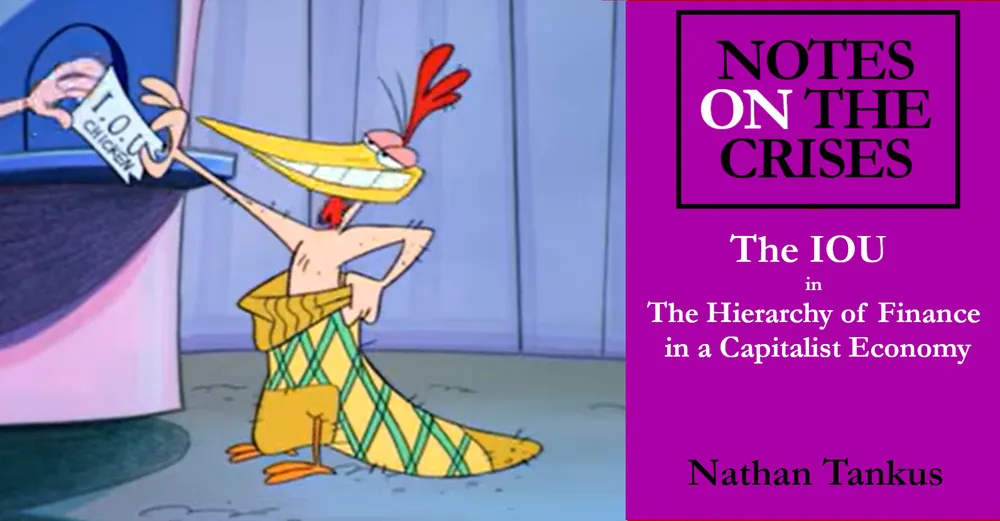
We are going to begin this series at its foundation—the IOU. The foundational capacity on which all finance is built is the capacity to make a promise. Specifically, the capacity to issue an IOU. Meaning: issuing a promise, most commonly a promise to pay a certain sum of money at a certain period in the future. It can also be a promise to accept an IOU in payment: for example a storekeeper can issue a token—or a gift card—which can be used to pay for items in the shop. Whatever its form, it's the ability to enter into an agreement promising something of value in the future which serves as the “cellular premise” of finance. In other words, finance at its most basic level flows from the right to contract.
The ability to issue an “IOU” may seem trivial. But it's not as trivial as it may seem at first glance. To have an IOU accepted by someone (or something) else, a person likely has to be recognized by the legal system as someone capable of issuing legally enforceable promises. You can, of course, make a legally unenforceable loan. But then enforcing that loan is extremely difficult; unless you are the Mafia. It turns out a lot of people—both currently and historically— were not able to make legally enforceable promises. The right to contract is not a universal right of all human beings, and it is also a right that can be taken away.
Sign up for Notes on the Crises
Currently: Comprehensive coverage of the Trump-Musk Payments Crisis of 2025