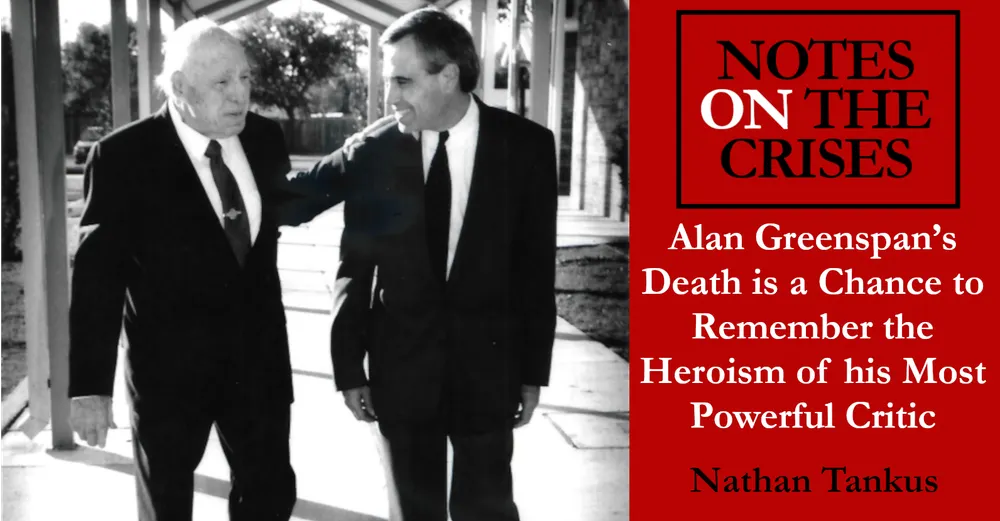
Alan Greenspan’s Death is a Chance to Remember the Heroism of his Most Powerful Critic
This is a free piece of Notes on the Crises. Subscribe to support our work.
When I first learned of Alan Greenspan’s death at the age of 100 a few weeks ago, my first thoughts were not about any of his actions, his relationship to Ayn Rand or the various important government positions he held. My first thought was instead to his most powerful and dogged critic: the late congressman Henry B. Gonzalez. In undertaking research for a book on the Federal Reserve, I dug deep into Gonzalez’s legacy. His confrontations with Greenspan- who was Federal Reserve chair for an extraordinary 19 years- have profoundly shaped the Federal Reserve but have not gotten their due.
Today Fed watchers are upset because of the new Federal Reserve chair Kevin Warsh’s recent choice to back away from “forward guidance”; a phrase that simply means that the Federal Reserve tells you how it's making its monetary policy decisions and what it will do under different circumstances. Nowadays “transparency” is all the rage in monetary policy. This wasn’t always the case. Greenspan’s predecessor at the Federal Reserve Paul Volcker infamously wouldn’t even admit that he was setting interest rates- despite making them soar to over 20% at a certain point. Many obituaries have applauded Greenspan for “bringing greater transparency to the Fed”; though I will say I’ve been pleasantly surprised by the number of mainstream outlets who have underlined the role that pressure from “lawmakers” played.
However, those other obituaries have not named the central “lawmaker” in question. Greenspan was a man under extreme pressure from Henry Gonzalez, a true zealot for government transparency and one who focused intensely on the Federal Reserve. He was well aware that Gonzalez had even submitted articles of impeachment for his predecessor Paul Volcker. Henry inherited this zealotry from fellow Texas congressman Wright Patman. In a secret 1972 volume about the Federal Reserve’s legal status written by long time Federal Reserve legal counsel Howard Hackley, Patman’s importance to shaping the Federal Reserve’s legal status is deeply acknowledged:
In a very real sense, the hero - or the villain - of this piece might be regarded as Representative Wright Patman of Texas. Since 1938, he has been the System's principal critic and the chief proponent of measures to curb the System's independence. [...] Without these efforts by Mr. Patman, much of the material upon which this paper is based would have been lacking. Over a period of many years, he has compelled the System to be mindful of its status and alert to criticism of its independence
Incidentally, I acquired this volume through a Freedom of Information Act request. What Hackley says about Patman is no less true about Patman’s Texan successor.
Today it is commonplace that the Federal Open Market Committee (FOMC)- the part of the Federal Reserve which sets interest rates and determines certain other aspects of monetary policy- releases transcripts of its meetings with a five year delay. This hasn’t always been the case. In fact, after a lawsuit from a Georgetown Law Student David Merrill in the 1970s, they stopped producing a document called the “Memorandum of Discussion”. From that time on, to 1994, all Federal Reserve observers had to go on were very limited FOMC meeting minutes and “records of policy actions”.
Despite this, government transparency laws put the Federal Reserve into a bind. There was always the risk that a lawsuit or new government policy would require them to retroactively produce these “Memoranda of Discussion”. So the Federal Reserve quietly began to keep unedited transcripts of their meetings. Federal Reserve Board Staff Director Stephen Axilrod tried to get permission to destroy the transcripts as time went on. However, no one was willing to destroy the transcripts of these meetings so Axilrod continued to stuff the unedited transcripts into a drawer. They were largely forgotten about and even many participants in the FOMC meetings were unaware transcripts were being kept. Greenspan even claimed in a later oral history with the Federal Reserve that he himself was unaware that transcripts were being kept.
Greenspan knew how big a deal the existence of these transcripts were. In his role as chairman of the House Banking committee, Gonzalez had already been pressing for FOMC meetings to be videotaped. In a response to Gonzalez’s demands along these lines Greenspan, representing the entire FOMC, was against transcripts being released at any time, but especially objected to concurrent releases. They even objected to returning to releasing the “Memoranda of Discussions” that the FOMC had published between 1967 and 1976. In other words, Greenspan was doing his best to stonewall Gonzalez and congress. The public revelation that transcripts already existed was going to stymie these efforts.
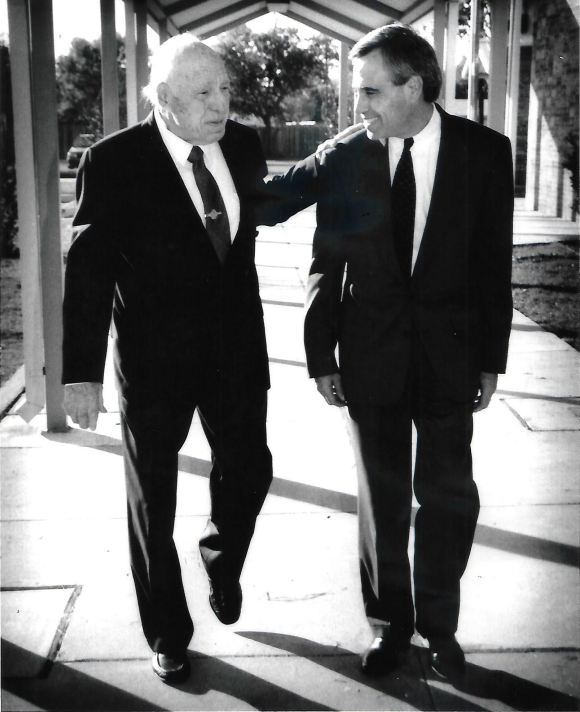
It is unsurprising then to learn that congressman Gonzalez was outraged when this became public knowledge and his office produced a document called the “17 year secret at the Federal Reserve”. One of Gonzalez’s investigators, economist Robert Auerbach, would go on to refer to this as the “17 year lie”. Greenspan’s “disclosure offensive” was aimed to stymie the possibility of scandal. The “offer” to release transcripts with a five year delay was a proffer to hold ground from what he perceived to be a losing position. It is clear from Greenspan’s oral interviews and reading internal memos from that time period- some which the Federal Reserve released of its own volition recently and some I’ve acquired through FOIA, that the Federal Reserve was extremely reluctant to release meeting transcripts, even with a five year delay. If it had not been for the extraordinary pressure from Henry B. Gonzalez, FOMC meeting transcripts may never have been released.
Today the Federal Reserve commentariat sees the regular release of FOMC meeting transcripts as extremely positive. Greenspan’s Federal Reserve resisted every step of the way.
In many ways I’ve followed in Henry Gonzalez’s footsteps- and proudly so. I’ve launched an extensive- and ongoing- effort to use the Freedom of Information Act to unearth tens of thousands of pages of documents from the Federal Reserve. By my judgement the Federal Reserve still has enormous ways to go on transparency. To give just one example: the Federal Reserve Board’s FOIA office has denied me an 82 page 1965 memo regarding the applicability of “Title VI of the Civil Rights Act of 1964 to the Federal Reserve Banks” because “despite their age, disclosure of the withheld documents may discourage staff’s full and frank future utilization of the Board’s legal counsel due to fear of public disclosure”.
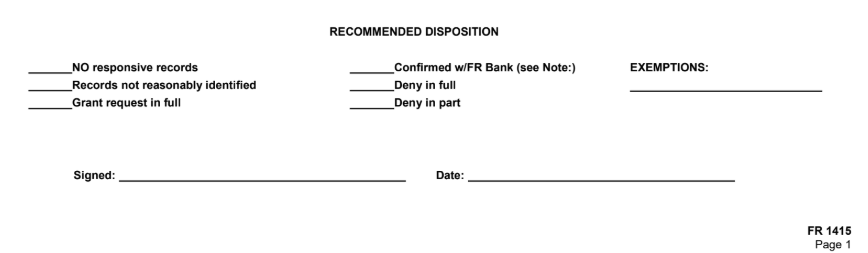
More generally, the Federal Reserve has denied access to an enormous number of documents that define the scope of its “emergency” powers. The public- including congress- only learned of part of the scope of the Federal Reserve’s powers when they were used to dramatic effect in 2008 and then again in 2020. Through painstaking work I’ve only been able to assemble a small portion of the legal memos which make up the Federal Reserve Bank of New York’s “Doomsday Book”, a collection which collates various memos that define the Federal Reserve’s claimed legal powers. The Federal Reserve also hides documents from FOIA by housing them at Federal Reserve Banks who, absurdly, are interpreted as not being subject to FOIA. The extreme reliance on this “disclosure dodge” was inadvertently confirmed to me when I was accidentally sent their FOIA processing documents which includes a section for “confirming” that a Federal Reserve bank has the requested records and thus the document is not subject to FOIA.
There are, of course, other important parts of Alan Greenspan’s legacy. In reflecting on his brief time as head of president Ford’s council of economic advisors he bragged about being able to “rebuff” demands for economic stimulus because “the response to these higher levels of unemployment was remarkably mild.” and specifically noted a contemporary newspaper columnist’s surprise “at the failure of social radicalism to emerge as a consequence.” Before becoming Fed chair he was a paid consultant to infamous Savings and Loans fraudster Charles Keating, giving Lincoln Savings a clean bill of health not long before it failed in spectacular fashion. His most lasting legacy at the Federal Reserve may be the atrophying and disarmament of the Federal Reserve’s financial regulatory machinery which infamously led to an epidemic of mortgage fraud that, in turn led to the 2007-2009 Great Financial Crisis. Indeed the failure of Federal Reserve financial regulation is what led to the creation of the Consumer Financial Protection Bureau (CFPB), which has now been aggressively dismantled by the second Trump administration.
Yet when I think about Greenspan what comes to mind the most is not his faults but heroic defenders of the public interest like Henry Gonzalez who challenged men like Greenspan. Congressman Gonzalez’s example is greatly missed as congress’s power and authority atrophies in our current constitutional crisis. Henry Gonzalez’s son, former congressman Charles A Gonzalez, told me in an interview that “my father would probably be introducing articles of impeachment against the president every week” and that he would find the second Trump administration’s conduct utterly astounding. According to Charles his father would also be shocked by how congress is missing in action, especially as it let its own power atrophy. According to former congressman Gonzalez, his father’s generation of congressmen would “never punt on everything”; which is what he sees as congress’s current conduct.
Which brings me to today. It is no coincidence that I am publishing my “obituary” of sorts of Alan Greenspan, but really of Henry B. Gonzalez, today. I picked today because today is the Humphrey Hawkins hearings, the statutorily required hearings where Federal Reserve chairs are required to testify to congress every six months. Along the lines of the “17 year lie”, I’ve come to strongly suspect that the Federal Reserve Board keeps transcripts and/or audio recordings of Federal Reserve Board meetings. These meetings are no less important than the much more widely publicized Federal Open Market Committee meetings. It would be a great shock to congress, and the wider public, if they exist. As big a shock as the original episode more than 30 years ago.
So why do I think they keep these records? According to their records retention schedule, they don’t. Though people would probably be surprised to learn that they keep audio recordings of board meetings for even two years, and congress has certainly underutilized demanding staff to listen to recordings during controversial incidents:
Tape recordings of Board meetings, prepared as required by the Government in the Sunshine Act or otherwise.
DISPOSITION: Temporary.Cut off files at the end of the year in which the tape recordings were made. Destroy two years after cutoff, or one year after the conclusion of any Board proceeding with respect to which the meeting or portion was held, whichever occurs later.
The reason I suspect they actually keep these audio recordings (or keep a transcript of the recordings) is a crucial tidbit of a 1993 Memo I got through FOIA. This memo is very important because it documents the “informal” conversations Federal Reserve staff had with the National Archives to assess the legality of various options in front of them for dealing with the FOMC transcripts:
NARA has ruled that electronic recordings and transcripts used to comply with the Government in the Sunshine Act are permanent records and may not be disposed of even though the Sunshine statute allows them to be discarded after two years.
To put it plainly, I think the Federal Reserve is carefully misleading congress- and the public- by implying these audio recordings are destroyed when they are not.
Thus, I hope a congressperson asks Chairman Warsh: "Does the Federal Reserve keep Federal Reserve Board meeting transcripts and/or audio recordings because they are permanent records within the meaning of the Federal Records Act?"
Let's see what happens.
Of course, you could also ask Warsh whether the Federal Reserve System will ever purchase, or accept as collateral, Trumpcoins...
Sign up for Notes on the Crises
Currently: Comprehensive coverage of the Trump-Musk Payments Crisis of 2025